


If your lights flickering in house has you confused, I get it. One minute, everything looks normal. Next, a room starts pulsing or dimming, and your mind goes to worst-case scenarios.
In this guide, I’ll help you figure out what’s going on without taking unsafe risks. You’ll learn the most common causes, from a loose bulb or bad dimmer match to overloads, water trouble, and utility issues. You’ll also see how patterns point to causes.
I’ll share the warning signs that mean you should call a licensed electrician fast, plus simple checks you can do first.
By the end, you’ll know what to watch, what to try, and what to report if you need help.
Is Light Flickering in House Dangerous?
Flickering lights in the house are not always an emergency, but they should never be ignored. Sometimes it is just a loose bulb.
Other times, it warns about heat, loose wiring, or a bigger power issue that can damage your home.
Watch for these serious signs:
- Burning or hot plastic smell near outlets, switches, or the electrical panel
- Buzzing or crackling sounds from fixtures, switches, or the panel
- Outlets, switches, or the panel feeling warm or hot to the touch
- Breakers tripping again and again
- Lights flickering in many rooms at the same time
- Some lights are dimming while others get brighter at the same time
If any of these show up with flickering lights, do not push your luck. Turn off power to the problem area if it is safe to do so, stay away from hot or damaged parts, and call a licensed electrician as soon as possible.
Common Causes of Flickering Lights in the House
Before you fix anything, it helps to understand the most common reasons lights start to flicker so you can trace the problem with less guesswork.
1. Loose or Worn Light Bulb
A loose or tired bulb is one of the simplest reasons for lights flickering in the house. You may see a flicker in only one fixture, or when someone walks above it.
Tip: Turn the light off, tighten the bulb, and replace it if the flicker stays.
2. Bulb and Socket Mismatch
Not every bulb seats well in every socket, especially in older fixtures. A poor fit can cause random flicker right after a new bulb is installed.
Tip: Use the correct base size and never force a bulb that feels wrong or wobbly.
3. Dimmer and LED Mismatch
Older dimmers often do not work smoothly with LED bulbs. You may notice flicker only on low settings or only in dimmer rooms.
Tip: Use dimmable LED bulbs and an LED-rated dimmer, and keep one bulb brand on each dimmer when possible.
4. Overloaded Circuit
If too many heavy appliances share one circuit, voltage can dip whenever something starts. Lights may dim, then return to normal, especially during busy times.
Tip: Move heaters, AC units, and other big loads to different circuits and avoid running them all at once.
5. Unbalanced or Wobbly Ceiling Fan
A shaking fan can loosen wires in the fan box and make its light flicker. You might see wobble and hear a light thump as it runs.
Tip: Balance the fan with a kit, and if the light still flickers, have an electrician check the wiring.
6. Loose Connections or Wiring Problems
Loose wires can heat up, which is more dangerous than the flicker itself. You may notice flicker in several fixtures on the same circuit, plus buzzing at outlets or switches.
Tip: Do not open boxes or keep testing. Call a licensed electrician quickly.
7. Water Leaks or Moisture Damage
Water near wiring can cause a short flicker when the area gets wet, then stop as it dries. This often shows up near bathrooms, kitchens, or laundry areas.
Tip: Fix the leak first, then have an electrician inspect any nearby lights and wiring.
8. Voltage Changes and Utility Supply Issues
Sometimes the cause sits outside your home. Wind, storms, or damaged lines can make many rooms flicker at once, and neighbors may notice the same thing.
Tip: Check your utility company’s outage page and call them if the problem seems widespread.
9. Panel, Breaker, or Main Neutral Issues
When multiple lights flickering in house happens across many circuits, the problem may be near the main panel, meter, or service connection. You might see some rooms dim while others brighten.
Tip: This is not DIY work. Call both the utility company and a licensed electrician.
How to Read Flickering Light Patterns in Your Home
When lights flicker, the pattern tells a lot about what might be wrong. Use this table to sort out whether you are dealing with a small issue or something more serious.
| Flicker Pattern | Most Likely Causes | Safe Steps to Try |
|---|---|---|
| Only one light flickers | – Loose bulb – Worn bulb – Faulty socket – Switch issue – Loose connection inside that fixture |
– Turn the light off and tighten the bulb – Swap in a new bulb – If on a dimmer, test with a higher dimmer level – If the socket looks dark, cracked, or melted, stop and call an electrician |
| Several lights flicker in one room | – One circuit overloaded – Loose wire feeding that room – Wiring issue in the switch box |
– Unplug heavy items and test again – Avoid running big appliances on that circuit – If lights still flicker, call a licensed electrician |
| Multiple lights flickering in the house (whole-home flicker) | – Loose neutral or hot at service – Utility supply issue – Loose panel connections – Main breaker or meter problem |
– Write down when the flicker happens and what is running – Call the utility if neighbors see a flicker too, or if it started after a storm – Call a licensed electrician if it seems limited to your home |
If the table points to whole-home flicker or wiring issues, it is safer to pause DIY work and let a licensed electrician and, if needed, the utility company check the system.
What Community Users Say About Whole-House Flicker
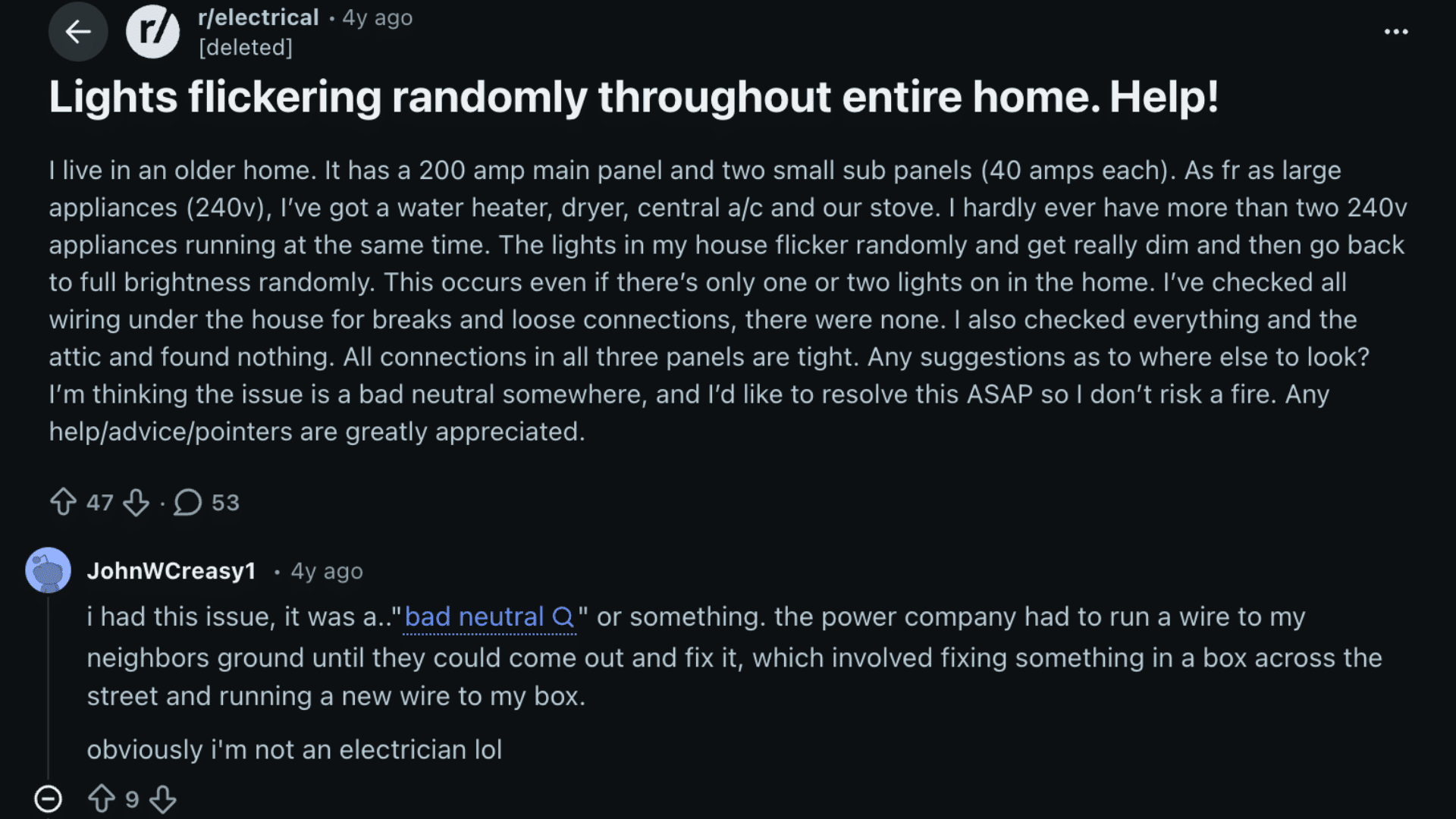
Homeowners in a Reddit discussion about lights flickering throughout an entire home describe lights dimming and brightening in every room, even when only a few fixtures are on.
Electricians in the replies say the most common cause is a loose or bad neutral at the service or from the utility, not a simple bulb issue.
Some people later found arcing and loose screws on the main breaker or heat damage on the neutral.
Many pros suggest calling the power company first, then an electrician, because whole-house flicker often starts at the service connection, not inside one circuit.
Step-by-Step Troubleshooting Flickering Lights in the House
Before calling for help, you can follow a few simple steps to narrow down the cause and understand what’s happening in your home.
Step 1: Note When and Where It Happens
Write down which rooms flicker, what time it happens, what appliances are on, and if there’s wind or storms. Also note if some lights dim while others brighten. This simple log helps an electrician spot patterns quickly.
Step 2: Check Bulbs and Dimmers
Tighten the bulb in the flickering light, then swap it with a new one if needed. If the light is on a dimmer, use a dimmable LED and try a higher dimmer setting. Changes here can show a simple bulb or dimmer issue.
Step 3: Turn Off Heavy Appliances
Turn off the AC for a bit and avoid running the microwave, heater, or vacuum. Watch the lights while these are off. If flicker improves, the circuit may be carrying too much load and needs a better layout.
Step 4: Look, Touch, and Smell (Safely)
Do not open the panel. Look for dark marks or cracked plates, gently touch covers to check for warmth, and sniff for a burning smell. If anything seems wrong, stop testing and call a licensed electrician right away.
Step 5: Match the Problem to the Right Help
If homes nearby flicker too, call the utility company first. If only your home flickers in many rooms, call an electrician. If flicker happens after storms or near leaks, you may need both the utility (or plumber) and an electrician.
Special Flickering Cases that Come up A Lot
Some flicker issues show up a lot, especially after LED swaps, homework, or in older houses. This compact table helps you match your situation fast.
| Situation | Common signs | Best next step |
|---|---|---|
| LEDs flicker after bulb change | Old dimmer, mixed LED brands, low-quality bulbs | Use dimmable LEDs, switch to an LED-rated dimmer, and keep one bulb type per dimmer |
| Flicker after renovation | Starts right after repairs, near the worked-on area | Have an electrician check connections in that area |
| Older home wiring | Frequent flicker, warm outlets, old panel, breakers trip | Schedule an electrical inspection |
If your issue fits one of these rows, it often needs more than a quick bulb swap, so getting it checked early is the safer move.
Wrap-Up
If you’ve been dealing with lights flickering in house, I hope this guide gives you a clear path forward.
You now know what small fixes you can try on your own and what signs point to deeper trouble. You also learned how to read flicker patterns, when to call your utility company, and when your home needs a licensed electrician.
Your home should feel steady and safe, and simple steps can help you figure out what’s going on before things get worse.
Want to stay ahead of home problems? Check out other home maintenance guides on the website to keep your house safe, efficient, and stress-free year-round.