

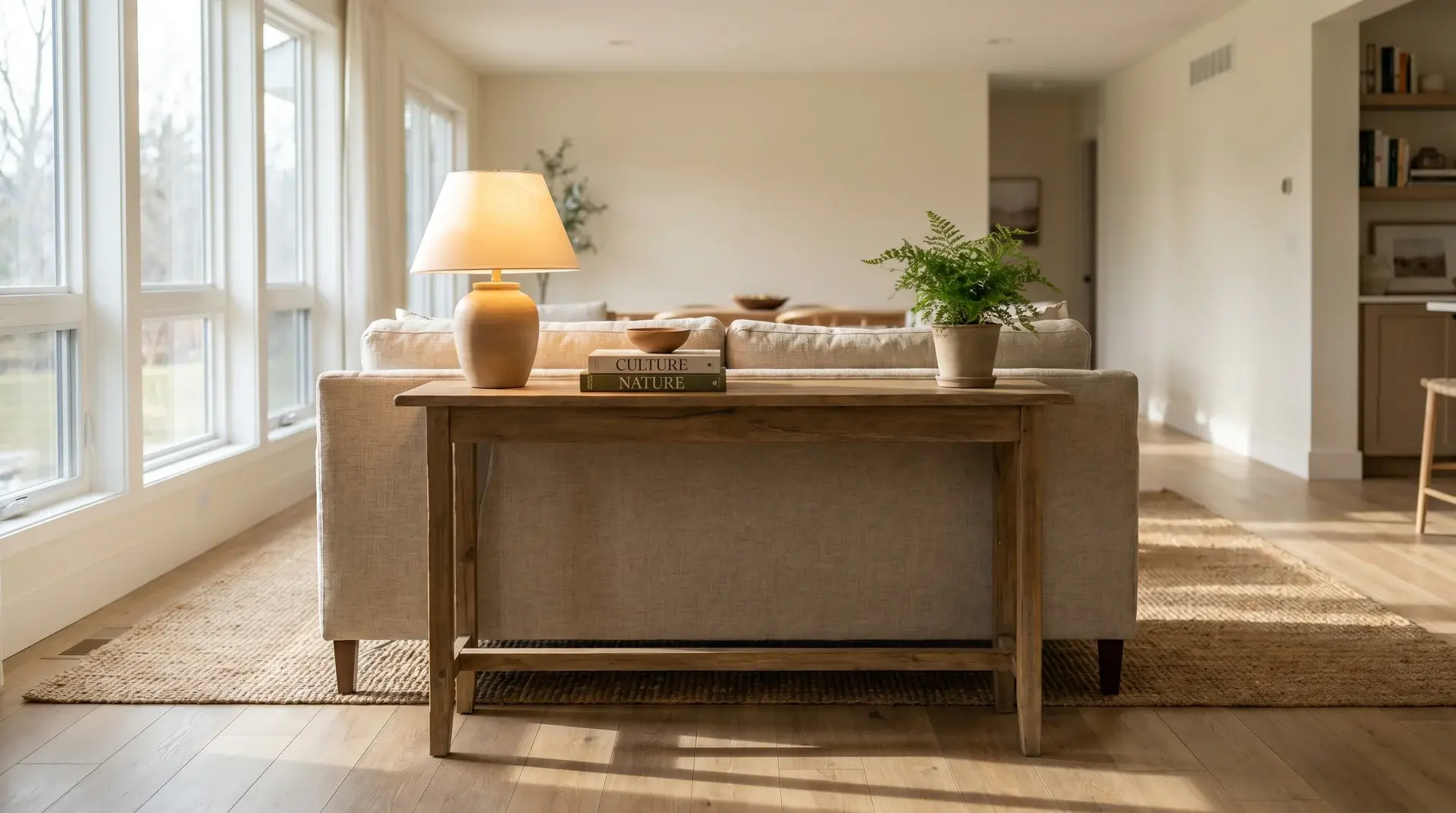


The space behind a floating sofa is one of the most overlooked layout problems I run into. The sofa looks fine from the front. From behind, it looks unfinished like someone moved in but didn’t finish the room. A sofa table solves that. It gives the back of the couch a clear edge, a surface, and sometimes storage, without adding a piece of furniture that fights the room.
A sofa table is a long, narrow table that sits directly behind a sofa. It typically runs level with the sofa back or 1 to 2 inches lower, and most models range from 48 to 72 inches in length and 10 to 18 inches deep. That slim footprint is what separates it from other table types, it fits behind seating without blocking the walkway.
In open-plan living rooms, a sofa table behind the couch also marks the edge of the living zone. It separates the seating area from the dining area, kitchen, or entry path without needing a wall to do it. That’s a layout job a lamp on the floor cannot do.
| Typical Length | 48 to 72 inches (half to two-thirds of sofa length) |
| Typical Depth | 10 to 18 inches (10 to 12 inches for tight walkways) |
| Typical Height | Level with sofa back or 1 to 2 inches lower |
| Also Called | Couch table, behind-the-couch table, sofa console table |
| Primary Placement | Behind a sofa or sectional, especially when the back faces a room |
The table above covers the basics. The rest of this article covers which type of sofa table fits which room problem – and how to choose the right one without wasting space or money.
Sofa Table vs Console Table, Coffee Table, and End Table
These four table types look similar in furniture stores. The difference is where they sit and what work they’re doing.
A sofa table is built for the space behind a couch. A console table is a broader category, the same shape, but meant for hallways, entryways, or any wall that needs a surface. The terms overlap, which is why many listings use both. If it’s going behind a sofa specifically, sofa table is the more accurate search term.
| Table Type | Where It Goes | What It Does | Key Difference |
| Sofa Table | Behind a sofa or sectional | Adds a surface, lighting, and storage to the back of seating | Height and depth are sized specifically for behind-couch placement |
| Console Table | Entryway, hallway, or against a wall | Drop zone, decor anchor, or storage piece | Same shape, broader placement options |
| Coffee Table | In front of the sofa | Holds drinks, remotes, books, and trays | Lower profile, made for daily arm-reach use |
| End Table | Beside a sofa or chair | Keeps a lamp, glass, and phone within reach | Small, meant for one side of a seating piece |
The practical takeaway: if the problem is the exposed sofa back in an open room, a sofa table solves it directly. A console table could work in the same position, but size it like a sofa table – same height, same depth, same length rules – or it will look awkward.
What a Sofa Table Is Used For
I use five tests before recommending a sofa table for any room. If the piece doesn’t solve at least two of these, the room usually doesn’t need one.
1. Filling the Exposed Back of a Floating Sofa
This is the most common reason. When a sofa sits away from the wall – in an open-plan room, a studio, or any layout where the back of the couch is visible from another area – that back edge looks unfinished. A sofa table behind the couch closes that visual gap and gives the sofa a defined boundary.
2. Adding a Surface for Lighting
End tables only reach the sides of a sofa. If the reading or ambient light needs to come from behind – which is often better for open rooms – a sofa table is the only practical place to put a lamp without running a cord across the floor.
3. Dividing an Open-Plan Room
In rooms without walls between the living area and dining area, a sofa table acts as the boundary marker. The sofa faces the room; the table defines its edge. This works better than a rug alone because it reads clearly from the kitchen or dining zone.
If you’re working through a full open-plan arrangement, the small living room layout guide covers zone separation in detail.
4. Providing Accessible Storage
Remotes, chargers, blankets, and books collect near every sofa. A sofa table with shelves or drawers gives those items a home within arm’s reach, without requiring a separate storage piece in the room.
5. Creating a Charging Station
Some sofa tables include built-in outlets and USB ports. In apartments or family rooms where the sofa floats far from a wall outlet, this solves a wiring problem that otherwise means a cord running across open floor.
Types of Sofa Tables: Matched to Room Problems
The right type depends on what the room actually needs. Here’s how to match the problem to the piece.
Standard Sofa Table
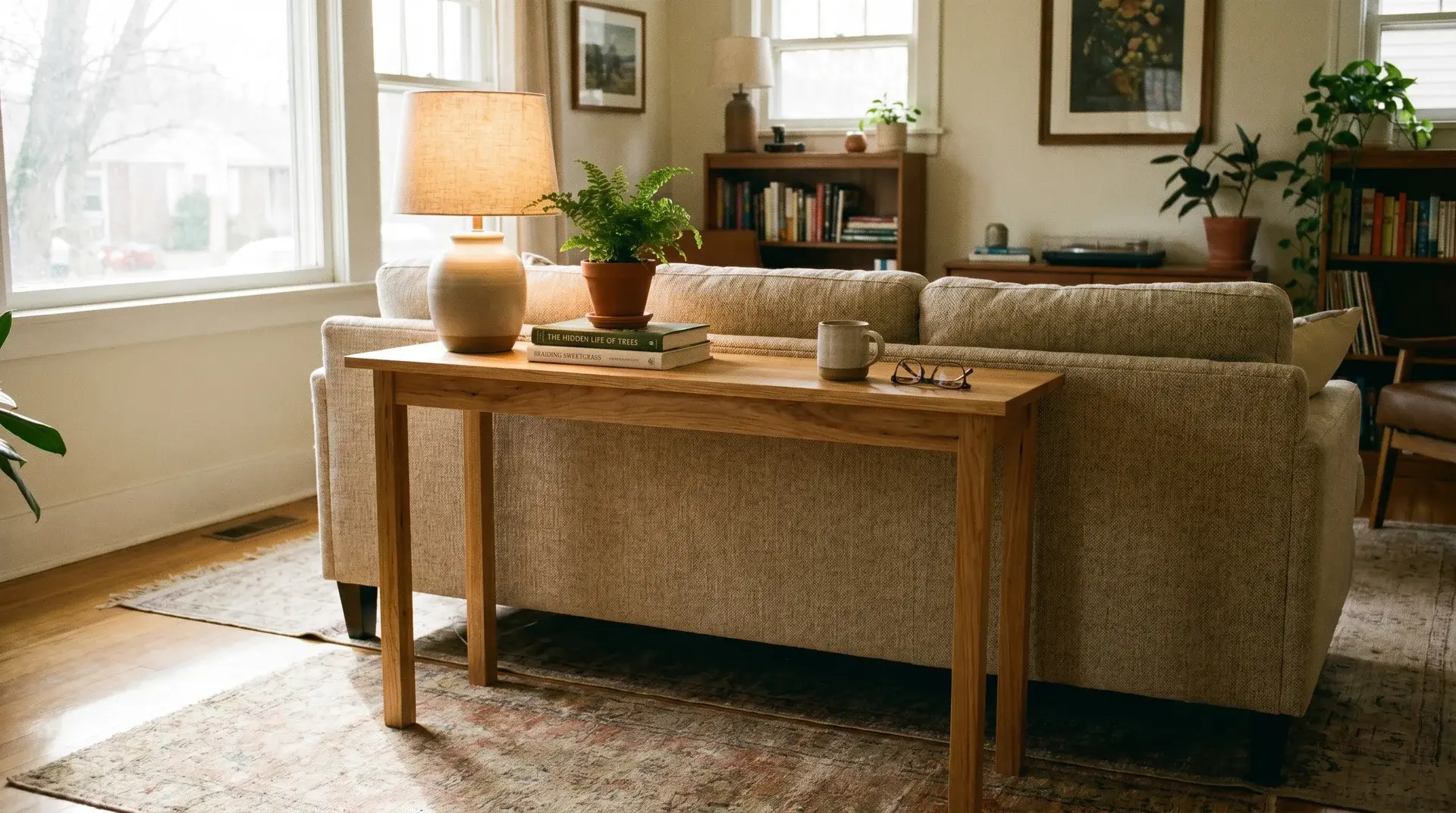
A flat top, four legs, nothing extra. This is the right choice when the room needs a surface and nothing else – a lamp, a tray, a few books. It sits quietly behind the sofa without pulling attention from the seating area. I default to this type in rooms that are already well-organized; adding storage here just creates more places for clutter to land.
- Material: Wood, metal, or wood-and-metal mix
- Best for: Rooms that need a clean surface, not additional storage
Sofa Table With Shelves
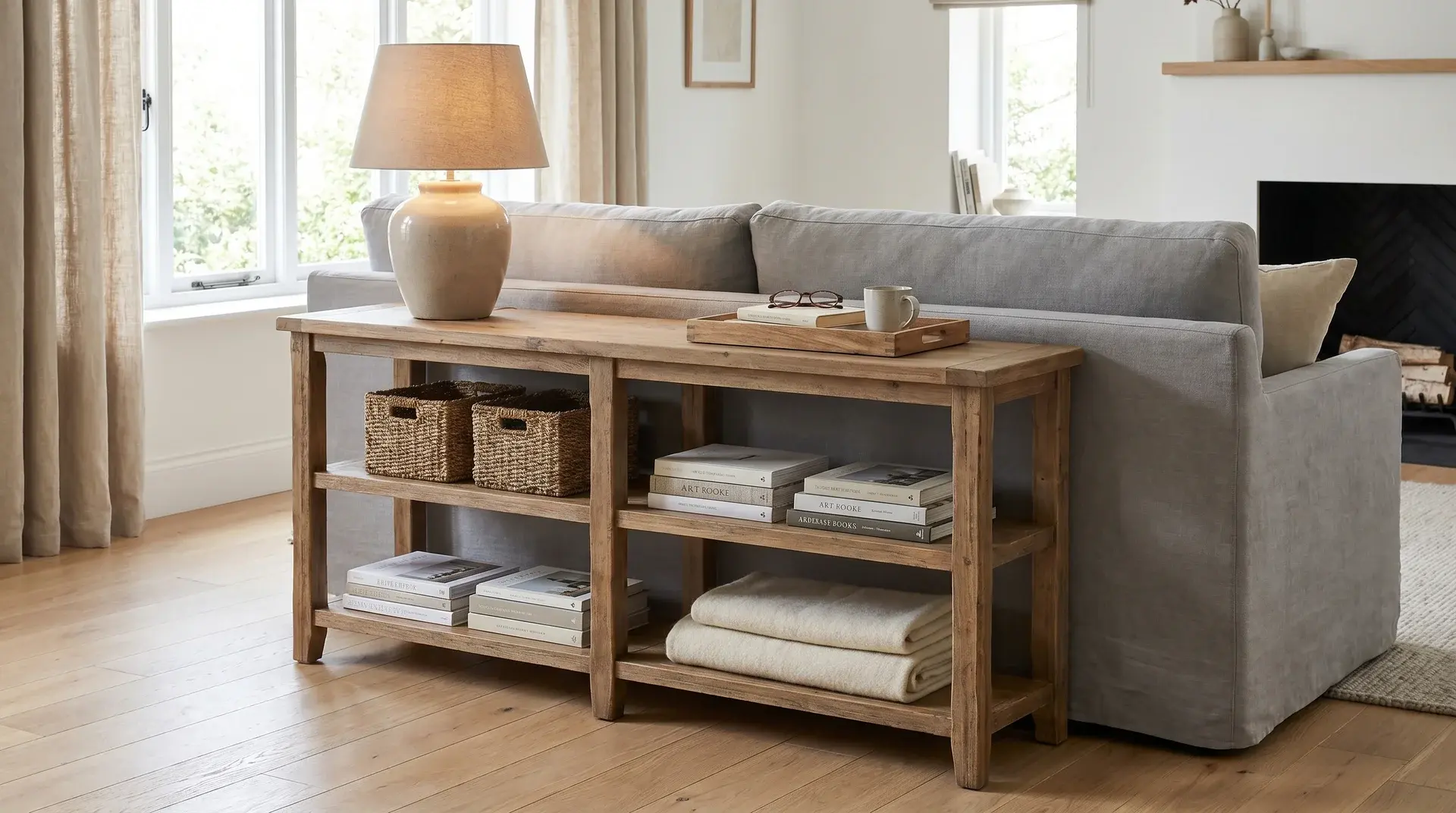
Open shelves below the tabletop hold baskets, books, and folded blankets. This works in rooms where everyday items pile up but a full cabinet would feel heavy. Keep in mind that open shelves show everything – this type rewards tidiness. Confirm the depth stays under 14 inches or it starts to feel like a bookcase, not a table.
- Material: Wood, metal frame with wood shelves, or rattan
- Best for: Rooms that need accessible storage without a large cabinet
Sofa Table With Drawers
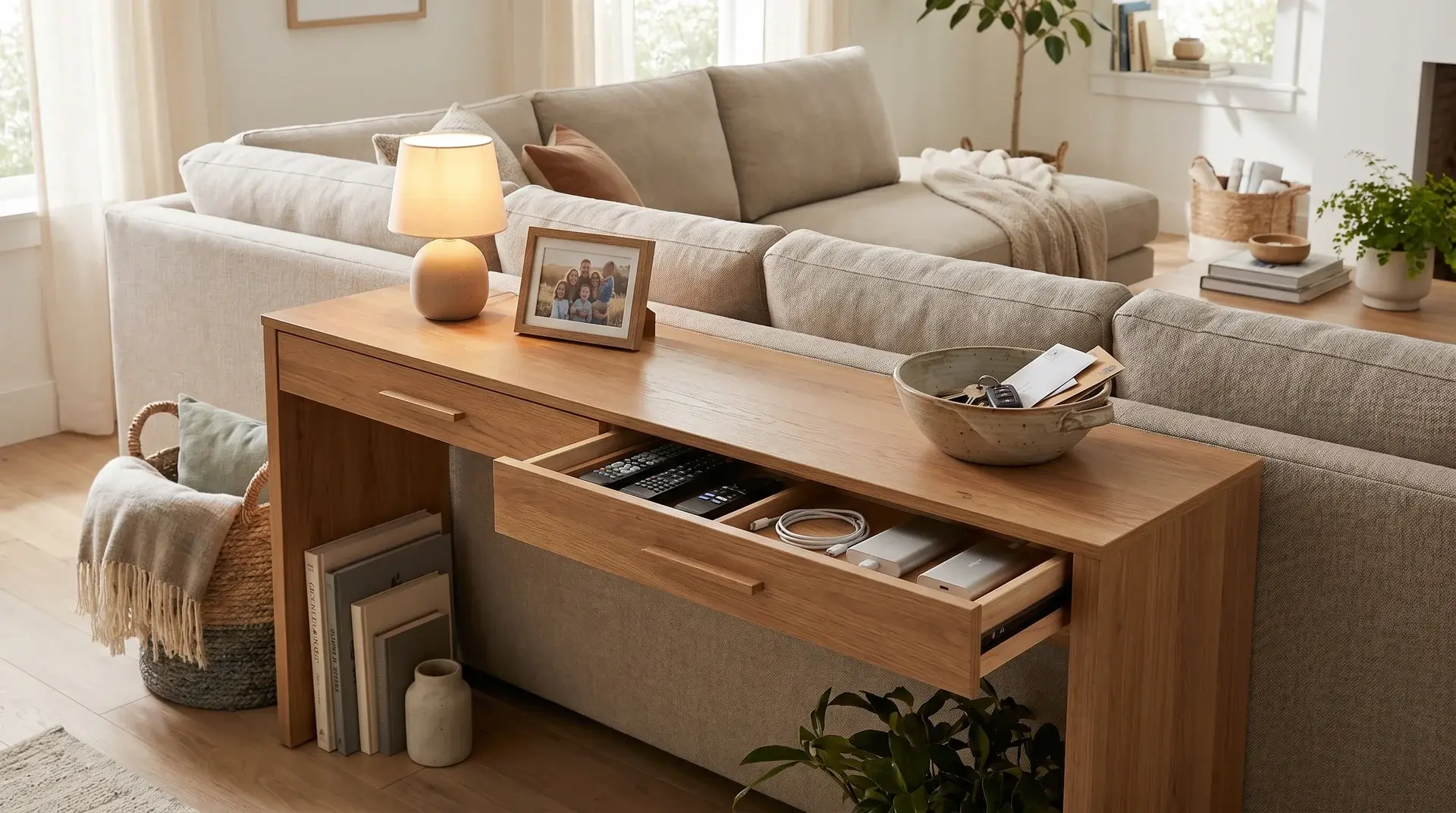
Drawers keep remotes, chargers, cords, and mail out of sight. This is the version I recommend for family rooms – it resets easily at the end of the day because there’s a place for everything. Before buying, check that the drawers open fully without hitting the back of the sofa cushions.
- Material: Solid wood, engineered wood, or painted wood
- Best for: Family rooms and homes with high daily item turnover near the sofa
Sofa Table With Outlets
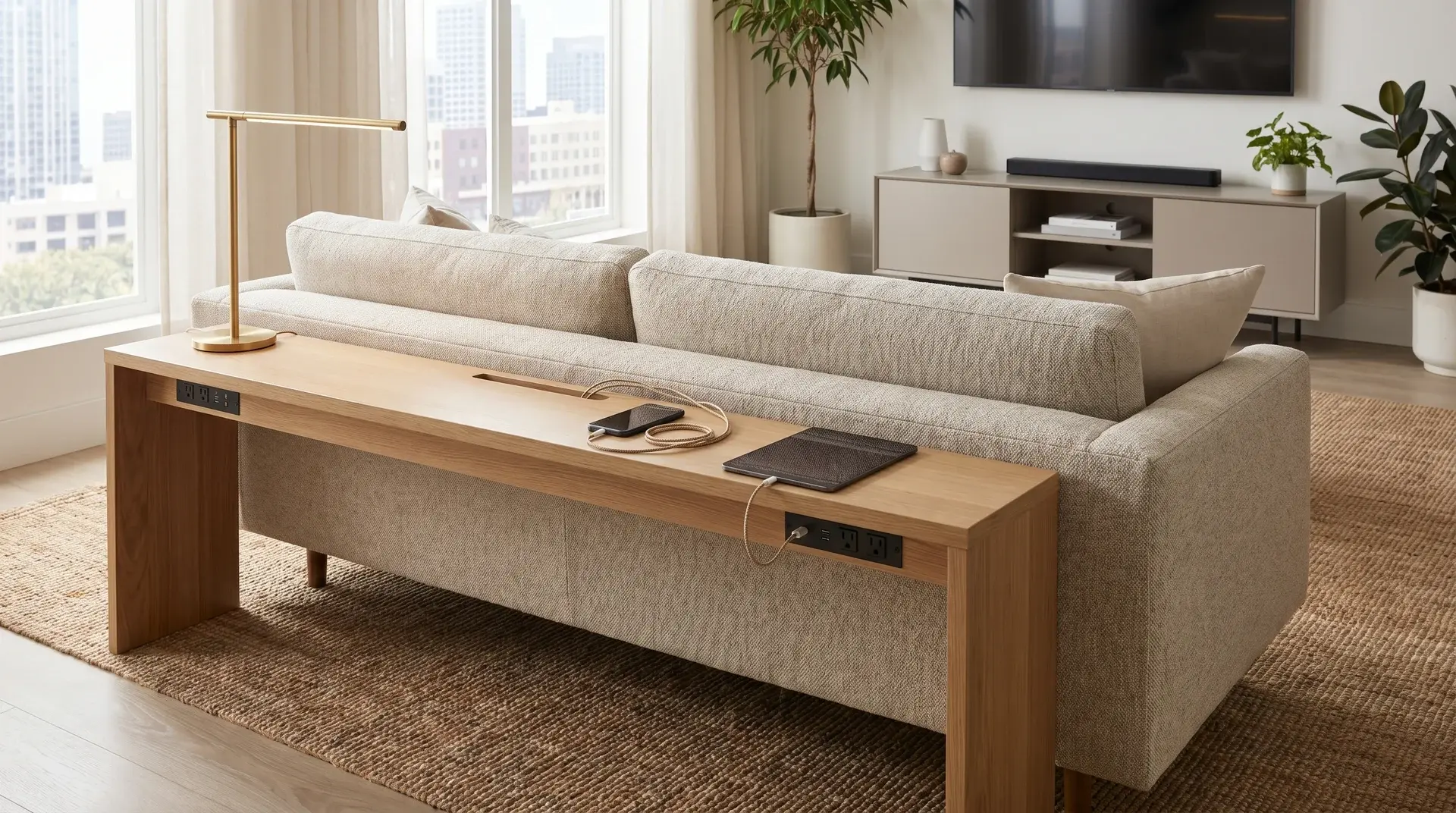
Built-in outlets and USB ports solve the cord problem in rooms where the sofa sits far from the wall. The lamp, phone, and tablet all have power without cords running across the floor. Measure the distance from the nearest wall outlet before choosing this type – the table still needs to plug into something.
- Material: Wood or metal with integrated power strip
- Best for: Apartments and family rooms where the sofa floats away from outlets
Sofa Table With Stools
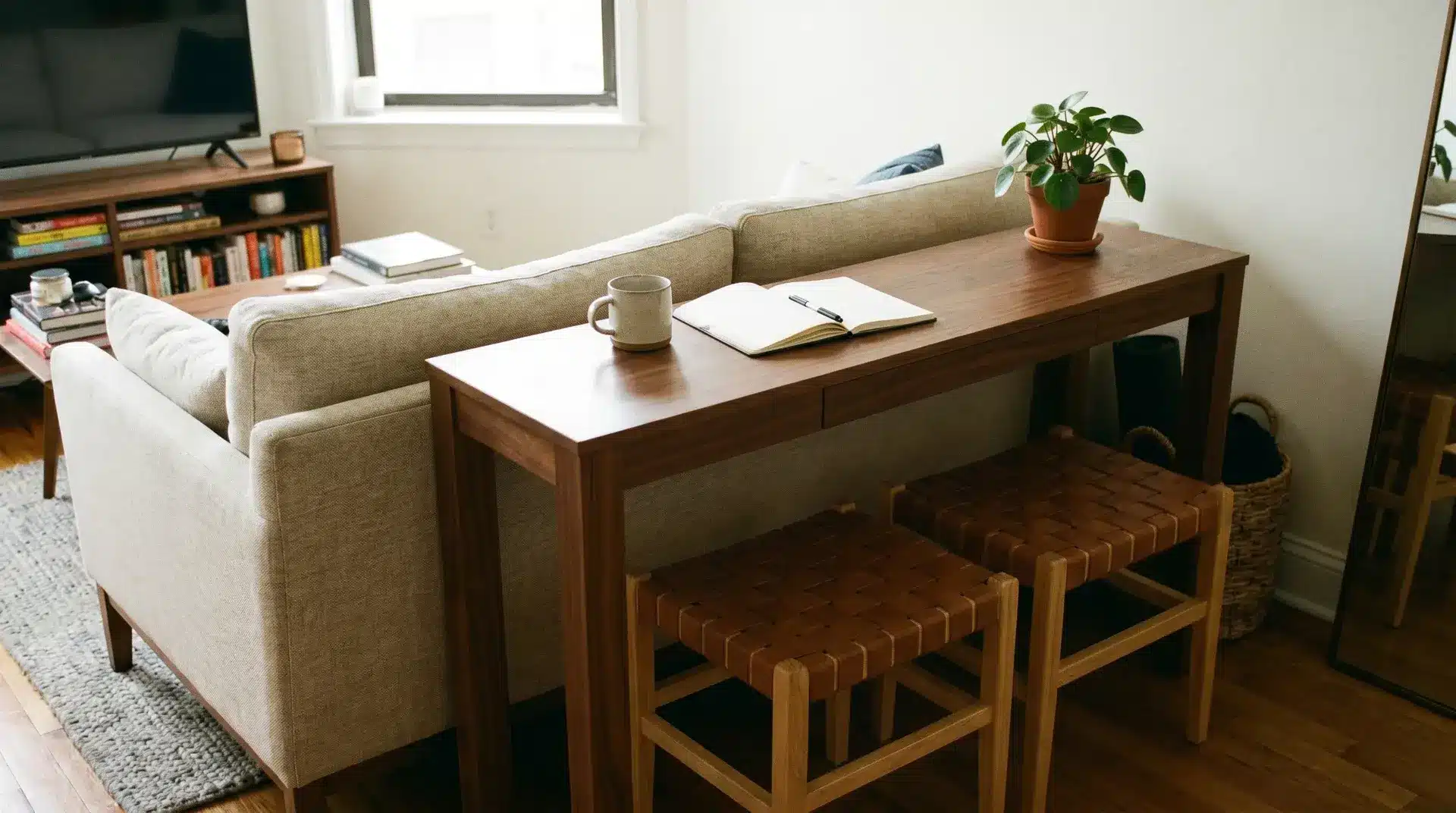
Stools tuck under the table and pull out when someone needs a seat or a surface for a laptop or snacks. This type earns its footprint in studios and small apartments where a table and extra seating need to share one piece. Confirm there is enough clearance to pull stools out fully without bumping the back of the sofa.
- Material: Wood, metal, or mixed with sturdy stools
- Best for: Studios, small apartments, and open-plan rooms that need flexible seating
Slim or Narrow Sofa Table
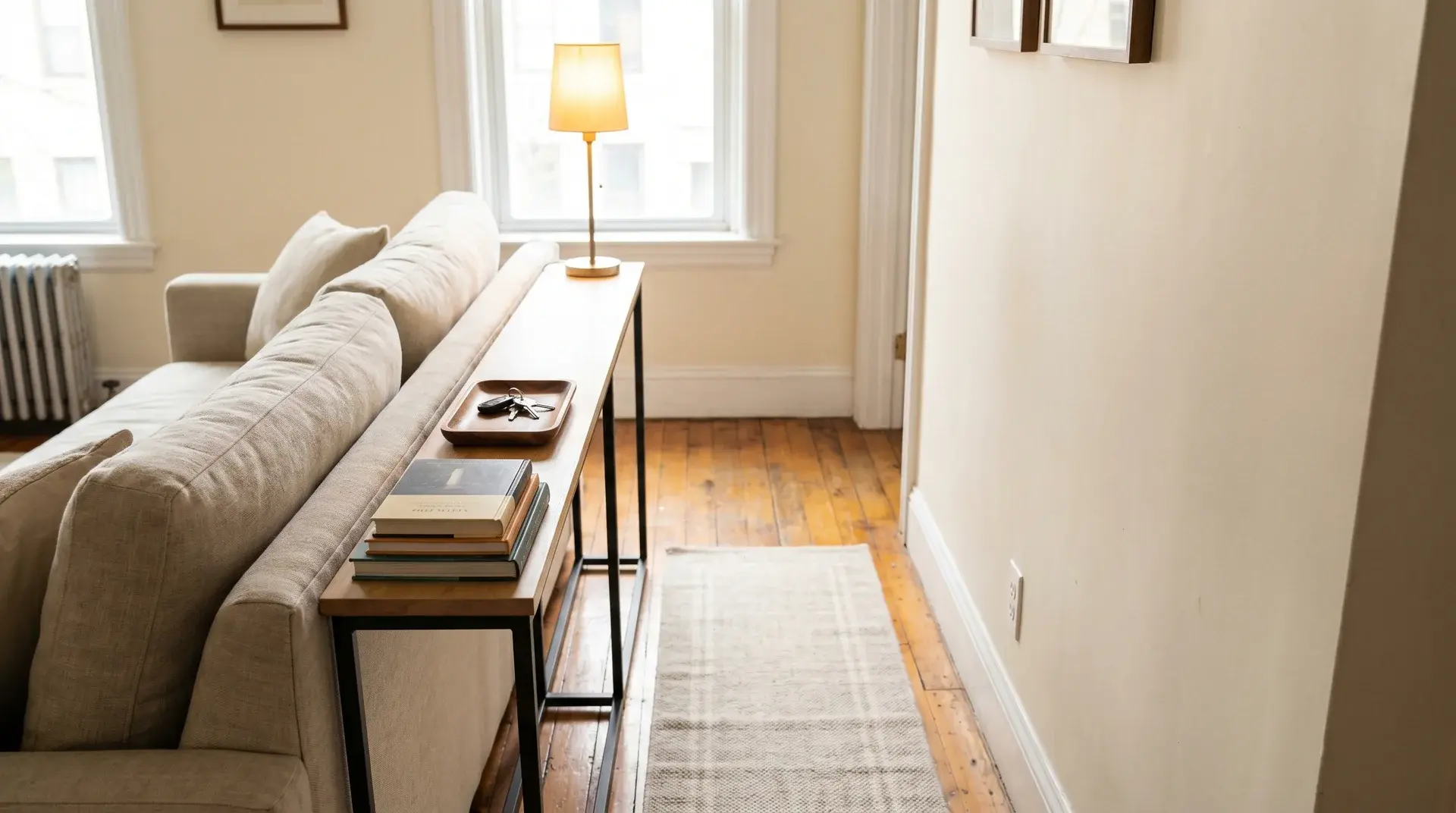
At 10 to 12 inches deep, a narrow sofa table fits behind a couch in spaces where a standard depth would close off the walkway. This is the version to choose when the path behind the sofa is less than 36 inches wide. It still holds a lamp and a tray – it just doesn’t crowd the floor.
- Material: Metal, slim wood, or wood-and-metal mix
- Best for: Narrow rooms, apartment layouts, and any walkway under 36 inches behind the couch
Storage Sofa Table
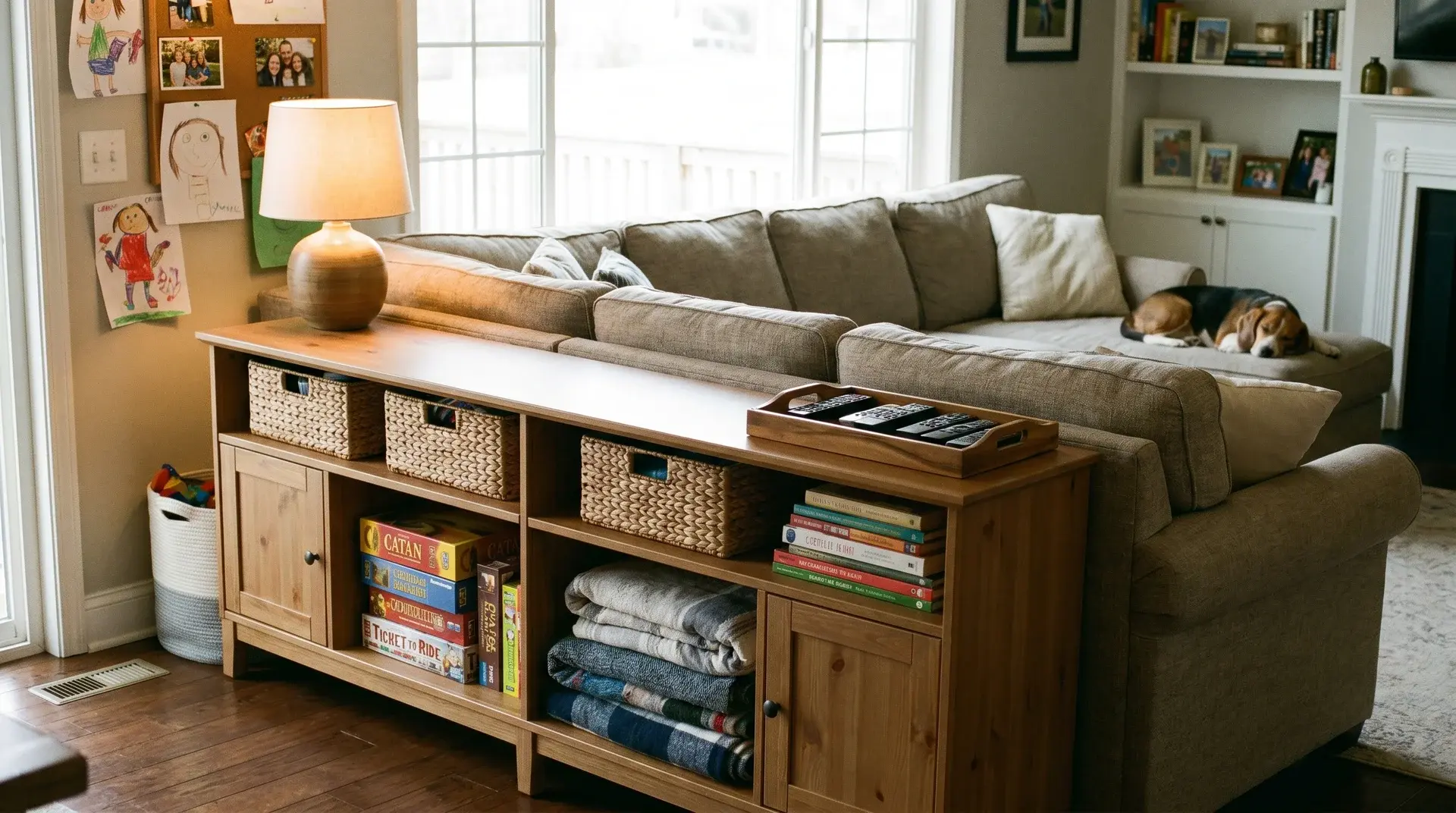
Combines shelves and drawers into one piece. This is the version that makes sense in a family room with kids, where blankets, games, books, and remotes need multiple homes. Open shelves on the bottom for baskets, a drawer or two for smaller items. It’s the most functional type – also the heaviest, so check weight if you move furniture often.
- Material: Wood or engineered wood with mixed storage
- Best for: Family rooms with high storage demand and frequent daily use
Live-Edge Sofa Table
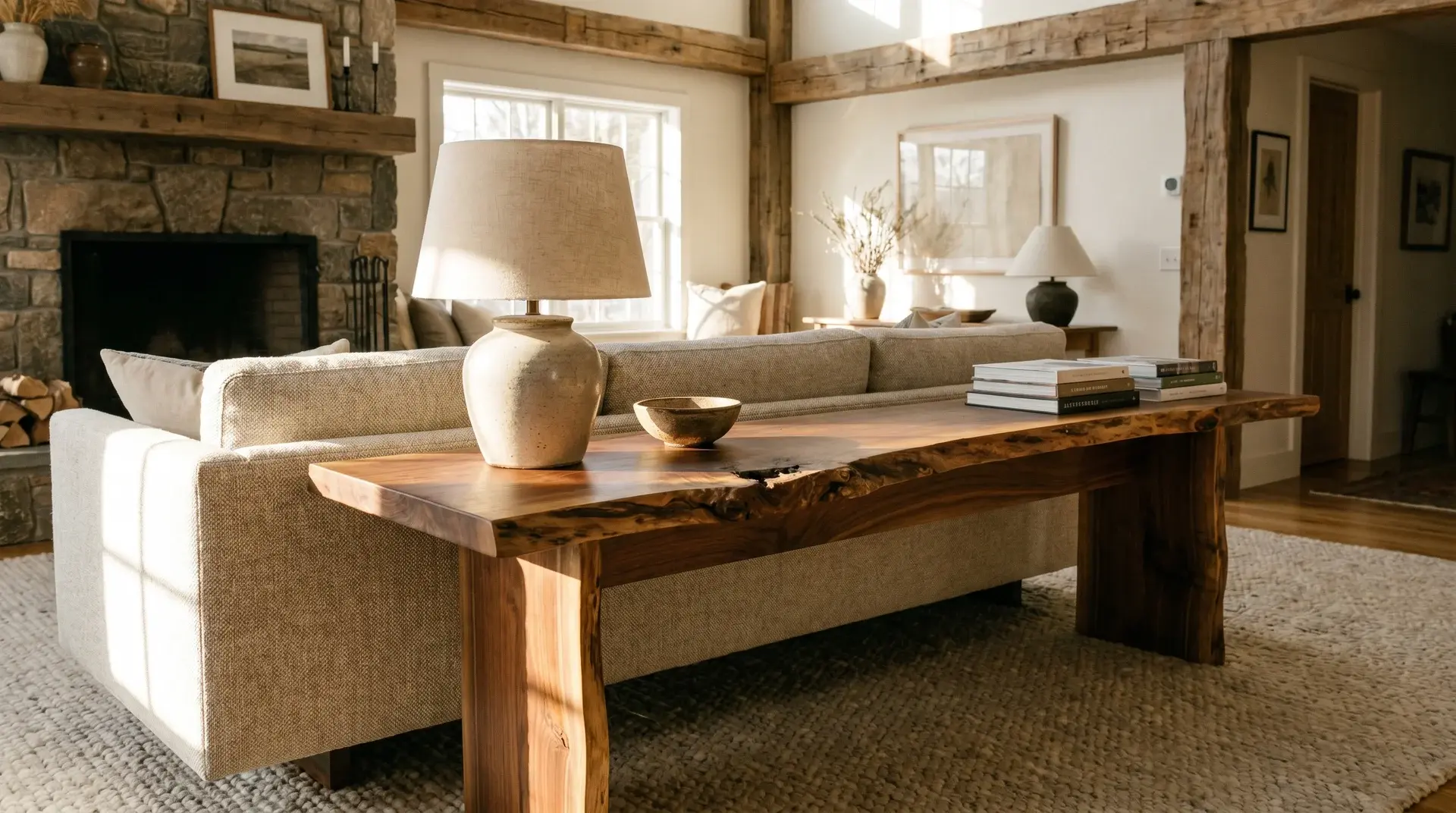
The natural outer edge of the wood slab is kept intact, so each table has a different shape. This looks best in rooms with warm or natural materials throughout. Since the table itself is a feature, keep styling minimal – a lamp, a bowl, one plant. This type works well in rustic, farmhouse, and warm modern rooms.
- Material: Solid wood slab, usually with metal legs
- Best for: Rustic, farmhouse, natural, or warm modern rooms
Glass Sofa Table
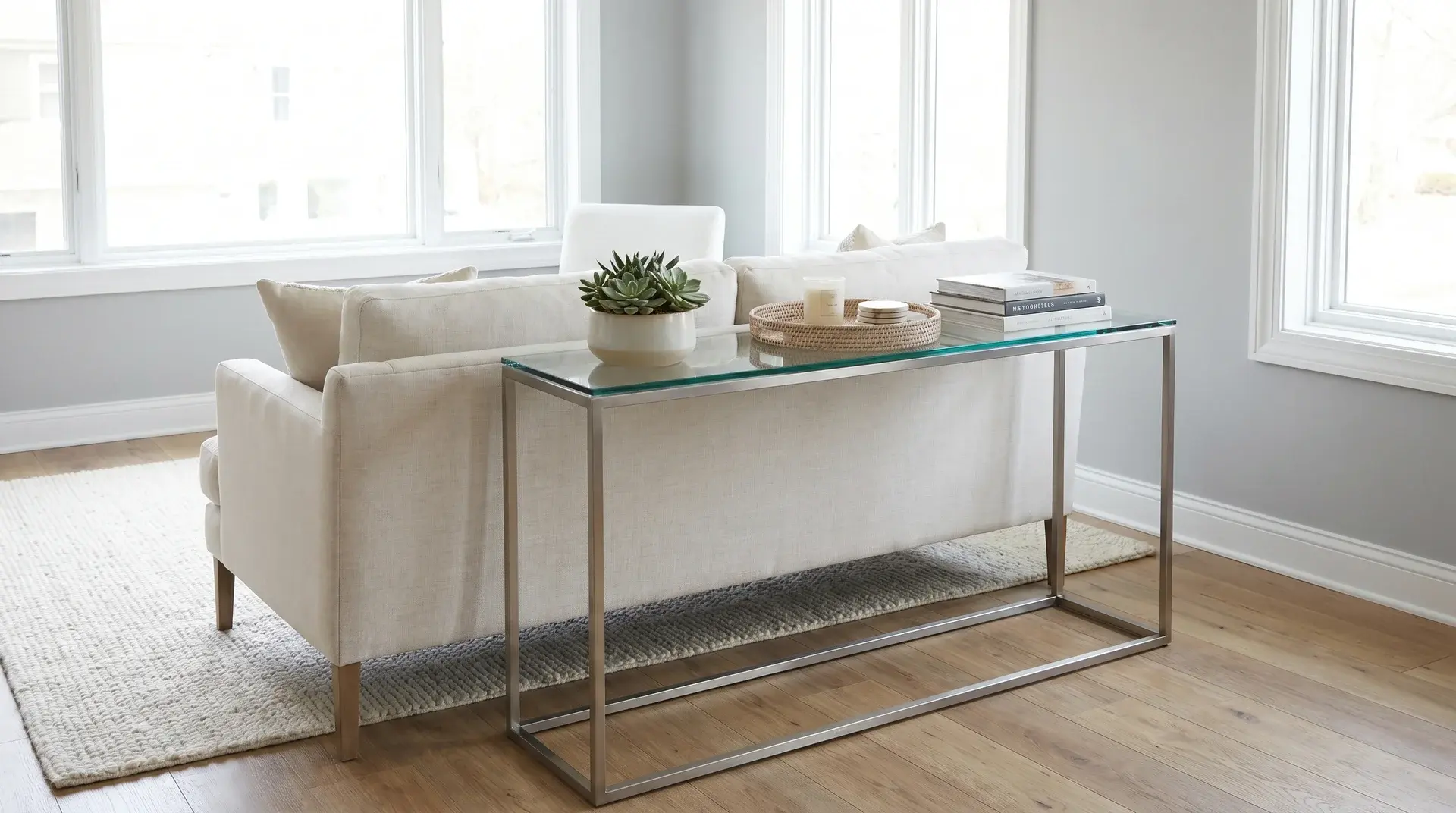
A glass top reads as lighter than solid wood or stone, which helps in small rooms that already have heavy furniture. It doesn’t visually break the room the way an opaque piece can. Choose tempered glass with rounded edges, especially in homes with kids or pets.
- Material: Tempered glass with metal or wood legs
- Best for: Small or modern rooms with heavier existing furniture
Metal Sofa Table
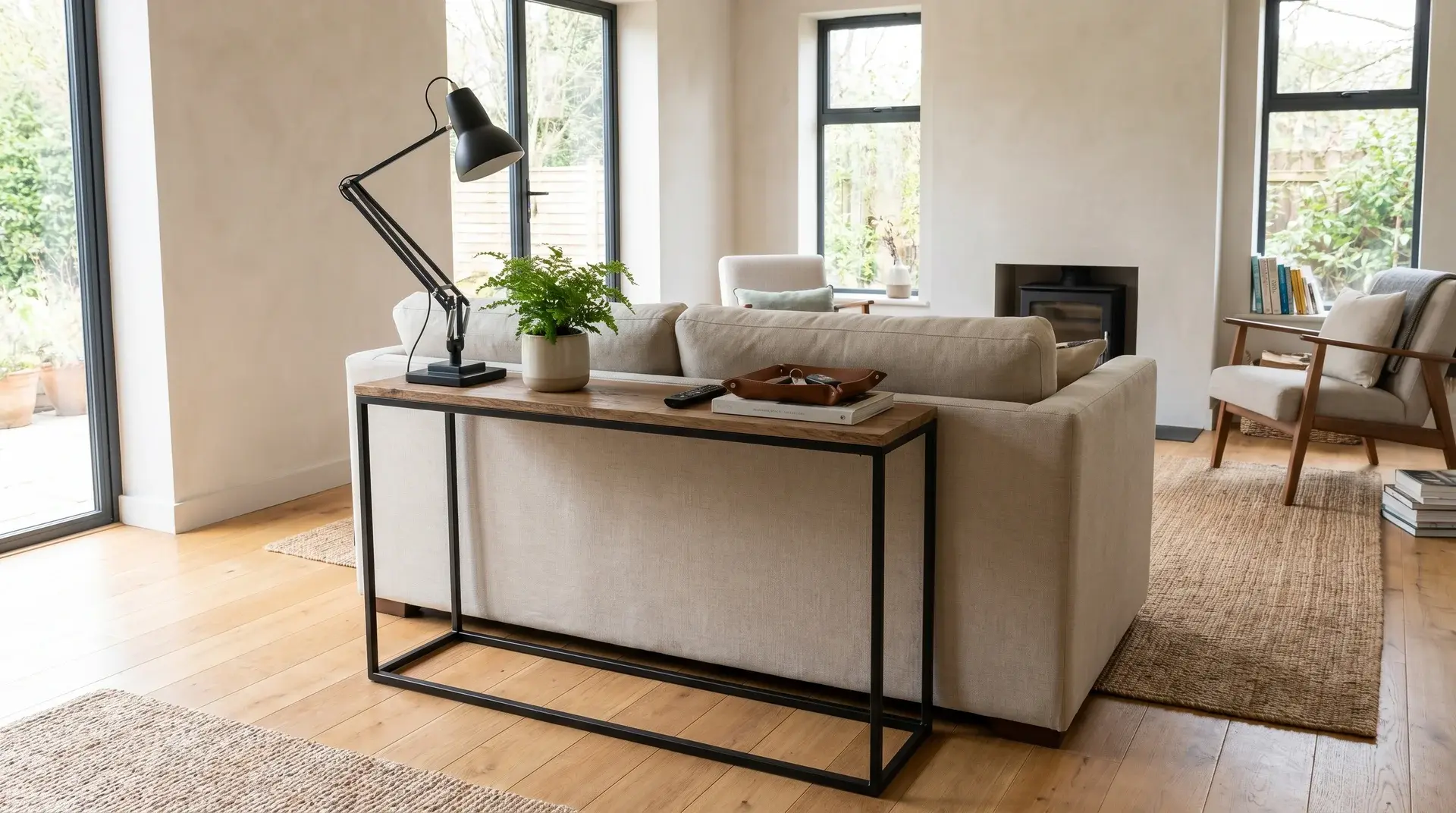
Open metal legs keep the floor visible, which helps in smaller rooms. Metal is also easy to clean – useful in high-traffic areas or homes with pets. Most metal sofa tables pair with a wood or glass top, which softens the industrial feel if that’s not the room’s style.
- Material: Steel or iron, usually with a wood or glass top
- Best for: Modern, industrial, and high-use rooms where durability matters
Rattan or Cane Sofa Table
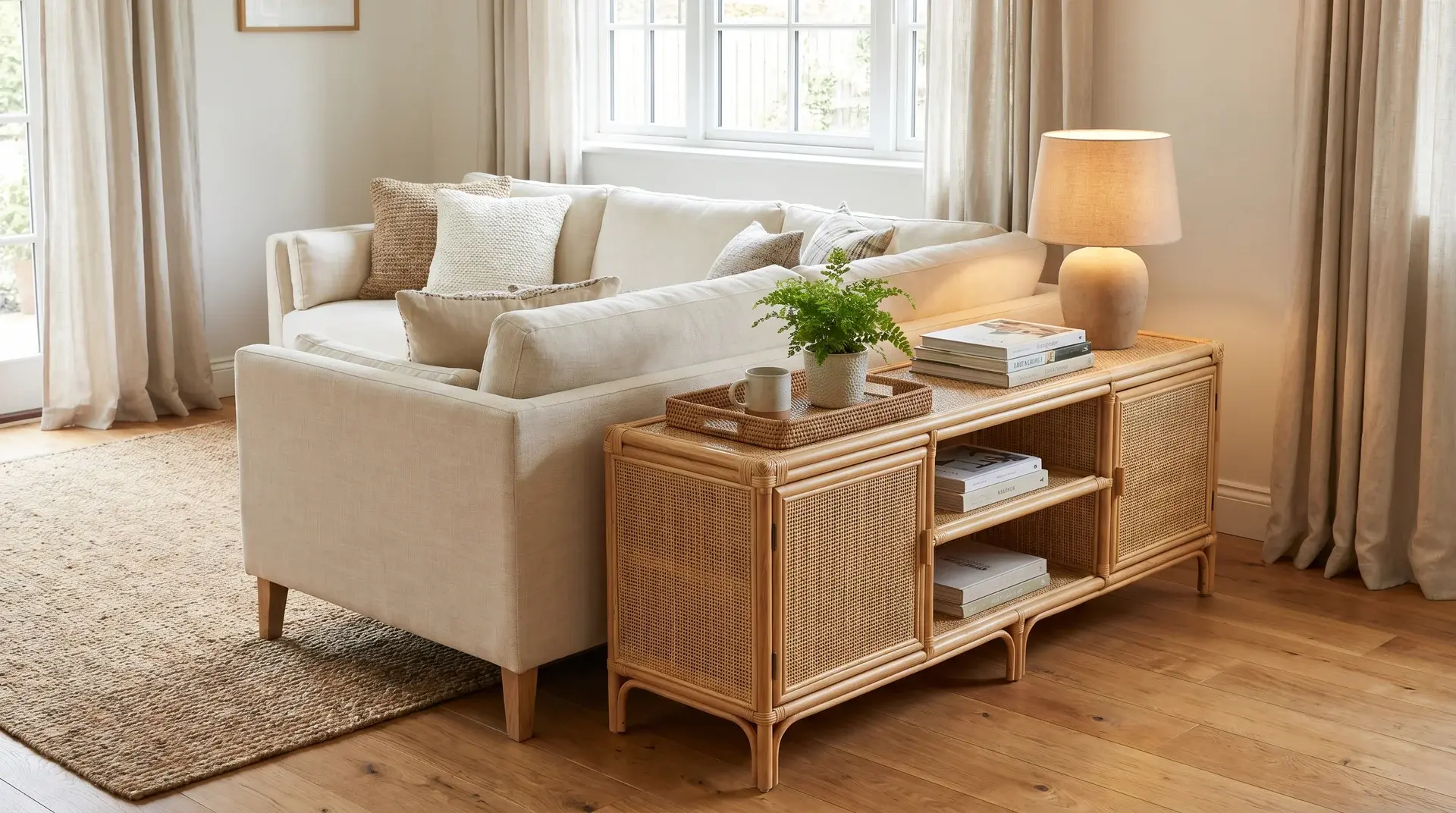
Rattan and cane bring softness to rooms where solid wood or metal feels too heavy. Good in sunrooms, coastal rooms, and casual living spaces. Keep it away from damp areas or anywhere it takes regular hard use – cane scratches and bends under sustained weight.
- Material: Rattan, cane, or wood with woven details
- Best for: Coastal, boho, farmhouse, and casual living rooms
Stone-Look Sofa Table
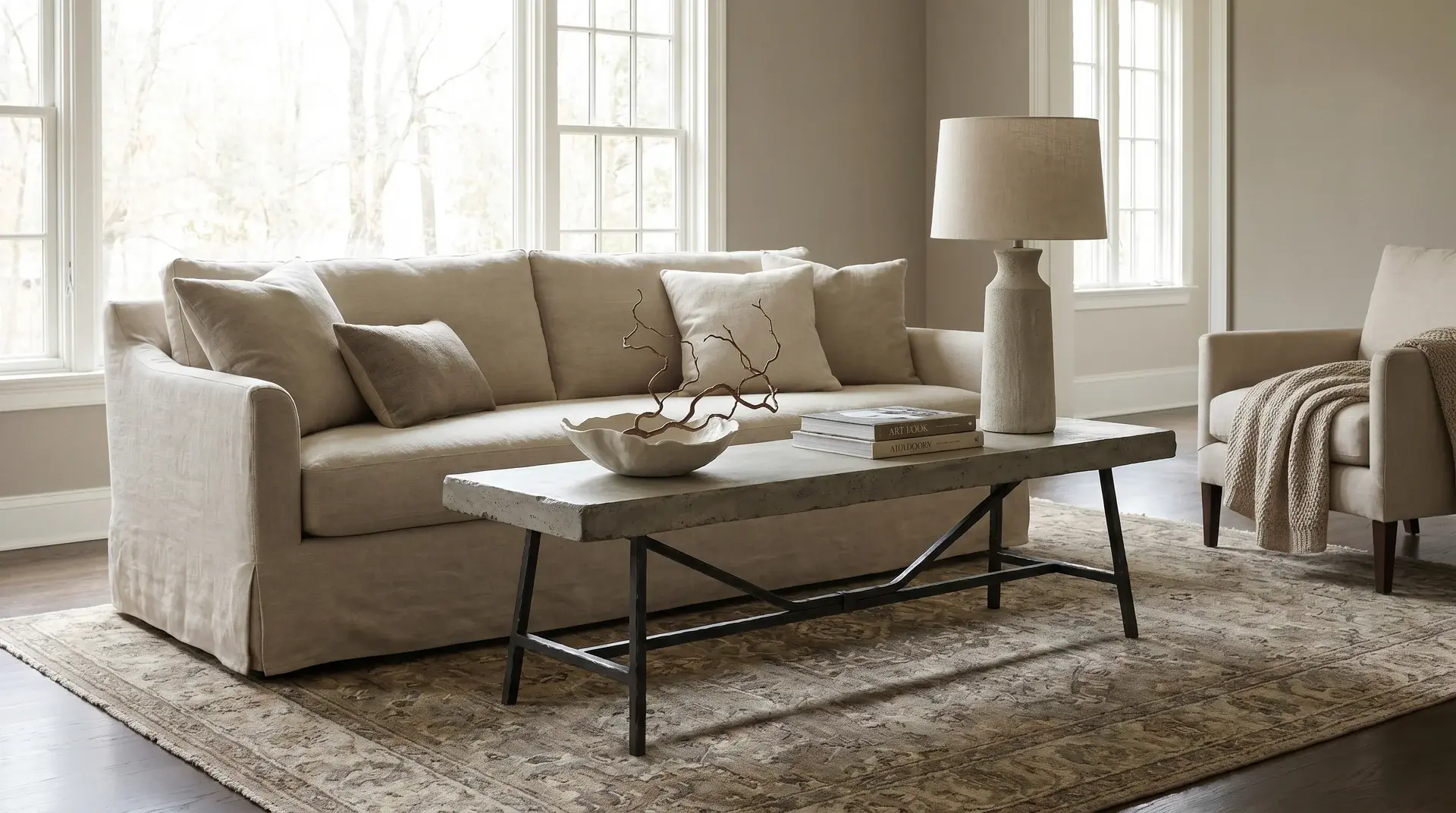
Faux marble and concrete-look tops carry more visual weight than glass or slim wood. This helps in larger living rooms where the sofa back looks too light or where the room reads as underfurnished. Real stone is available but adds significant weight – verify load capacity before ordering if the floor is on an upper level.
- Material: Faux marble, stone-look laminate, concrete-look, or real stone
- Best for: Larger living rooms and formal sitting areas
How to Choose the Right Sofa Table
Size comes first. Every other decision – material, storage type, style – is easier once you know the table fits the space. Here’s the process I use:
Step 1: Match the Height
The table should sit level with the sofa back or 1 to 2 inches lower. Measure from the floor to the top of the sofa cushions – that number is your ceiling. A table that sits several inches higher than the sofa back draws attention to itself; one that sits too low disappears visually and wastes the surface.
Step 2: Set the Length
A sofa table that spans the full length of the sofa tends to look too symmetrical – like a ledge, not a piece of furniture. Aim for half to two-thirds of the sofa length. For an 84-inch sofa, that means a table between 42 and 56 inches long. This gives the sofa visual breathing room on each side.
Step 3: Check the Depth Against the Walkway
The path behind a sofa needs at least 24 to 30 inches of clear walking space. Measure from the back of the sofa cushions to the nearest wall or furniture. Subtract your table depth from that number. If the result is under 24 inches, choose a slim sofa table at 10 to 12 inches deep instead of a standard 14 to 18 inches.
For more on clearance paths and how they affect furniture placement in open-plan rooms, the minimalist living room guide covers the 30-inch rule in detail.
Step 4: Decide on Storage Before Style
The biggest mistake I see is choosing a table for how it looks on a product page, then realizing there’s nowhere to put the remotes. Answer this first: what items currently pile up near the sofa? Remotes and chargers need drawers. Blankets and books work on open shelves. If the answer is “nothing, the room is tidy,” a standard top is enough.
Step 5: Check Edge Safety if You Have Kids or Pets
Rounded corners and a stable base matter more in active households than most furniture guides admit. Glass sofa tables with sharp corners and narrow legs get knocked over. If there are kids or large dogs in the house, eliminate those options first before comparing anything else.
Sofa Table Materials: What to Know Before Buying
The material determines how the table holds up over time, not just how it looks on delivery day. Here’s the honest breakdown:
| Material | Durability | Maintenance | Best Room Type |
| Solid Wood | High – scratches but refinishes | Occasional oiling or waxing | Most rooms; warmest finish |
| Engineered Wood (MDF/Veneer) | Medium – chips on edges under impact | Wipe clean; avoid standing water | Budget rooms with low daily wear |
| Metal | High – scratches but wipes clean | Minimal; occasional polish on brass | Modern, industrial, high-traffic rooms |
| Tempered Glass | Medium – strong but chips at edges | Fingerprints visible; needs frequent wiping | Small rooms where visual lightness helps |
| Rattan/Cane | Low to medium – scratches easily | Dusting; keep dry | Casual, coastal, and seasonal rooms |
| Faux Stone / Concrete-Look | Medium – surface-level scratching possible | Wipe clean; check weight before upper floors | Larger or formal living rooms |
Solid wood is the most forgiving over time – you can sand and refinish a scratch that would permanently damage engineered wood. If the budget is tight, metal frames with wood tops split the difference well.
Sofa Table Styling: What Actually Stays Tidy
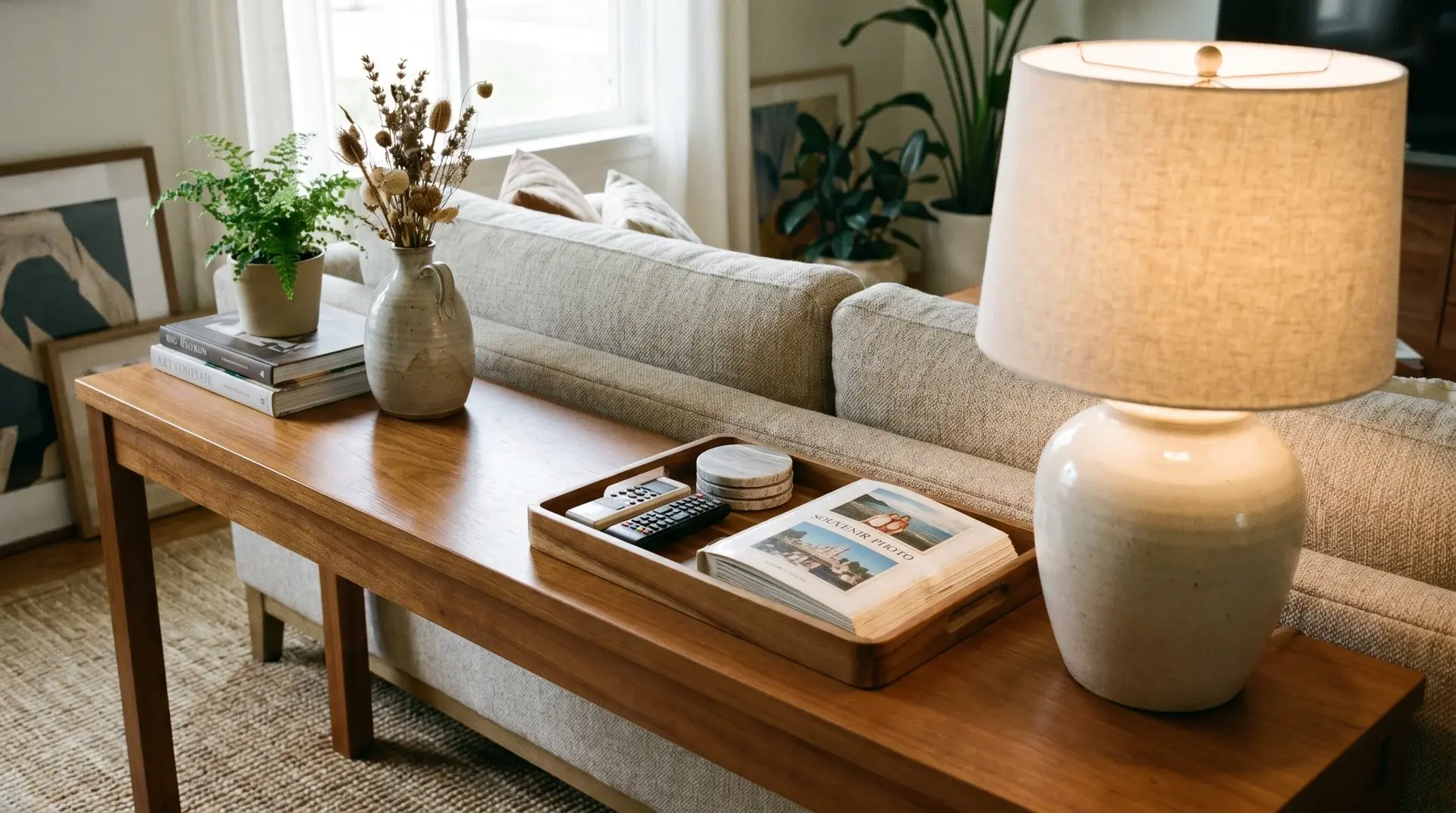
Styling a sofa table is easier when you start with function and add decor second – not the other way around. Most sofa table styling that looks cluttered within a week was styled backwards.
One Tall Piece as the Anchor
Start with one tall piece on one end: a lamp, a tall vase, or a ceramic candleholder over 12 inches. This gives the table a clear vertical anchor. Everything else stays lower. Without an anchor, the table reads flat regardless of how many objects are on it.
A Tray for Daily Items
Remotes, coasters, and phone chargers belong in a tray, not loose on the surface. A tray groups small items into one visual unit and makes the whole table easier to clear – you lift the tray, not six individual things. A 12- to 14-inch rectangular tray in a natural material (wood, rattan, or matte ceramic) works in most living rooms.
Vary the Heights
Three items at the same height read as a lineup, not a composition. Combine a tall lamp with a medium-height vase or plant and a low stack of books or a shallow bowl. Behind a floating sofa, keep the tallest piece under 30 inches so it doesn’t obstruct sightlines from across the room.
One Plant or Fresh Stems
A single plant softens the surface, especially on metal or glass tables that read cold without organic material. A small pothos in a terracotta pot on one end is enough. If you travel frequently or forget to water, dried stems in a simple bud vase require nothing.
Leave One Open Spot
A surface that’s fully covered is a surface that stops working. Leave at least one-third of the table top open for a book, a glass, or a phone. That gap also makes the styled pieces look more deliberate – crowded surfaces look accidental even when each item was chosen intentionally.
Do You Actually Need a Sofa Table?
Not every living room does. A sofa table earns its place when it solves a specific problem. Here’s a quick check:
| Get a sofa table if: | Skip it if: |
| The back of your sofa is fully visible from another area | The sofa is pushed against a wall |
| You need a lamp behind the seating area | You already have enough table surface nearby |
| Small items pile up near the sofa with nowhere to go | The room already has adequate storage |
| The sofa separates two zones in an open-plan room | The room feels full and adding furniture would crowd it |
| There is at least 24 inches of walkable space behind the sofa | The path behind the sofa is already tight |
If the room meets two or more of the left column conditions, a sofa table will likely improve both function and layout. If the sofa is against the wall and storage isn’t a problem, there’s no layout reason to add one.
Common Sofa Table Mistakes
These are the five errors I see most often – all fixable before purchase:
- Wrong height: Buying a table 4 or 5 inches taller than the sofa back. It looks like a bar table was placed behind a couch. Always measure the sofa back height first.
- Too long: A table that matches the sofa’s full length looks like a shelf, not furniture. Stay within two-thirds of the sofa length.
- Too deep for the walkway: An 18-inch-deep table in a narrow passage behind the sofa blocks movement. Measure the clearance before deciding on depth.
- Overloading the top: Six items that all compete for attention read as clutter. One anchor piece plus a few supporting objects is the right limit.
- Unfinished back panel: If the sofa floats and the table back faces the dining or kitchen area, make sure the table looks finished from that side. Some console-style pieces have a raw back edge meant to sit against a wall.
Frequently Asked Questions
These are the questions that come up most often once someone has measured their space and is deciding whether to commit.
What is a sofa table called?
It goes by several names: sofa table, couch table, behind-the-couch table, sofa console table, or console table. All describe the same piece – a narrow table placed behind a sofa.
What is the difference between a sofa table and a console table?
Console table is a broader category covering any long, narrow table used in hallways, entryways, or against walls. A sofa table is a console table sized and positioned specifically for behind a sofa – similar shape, specific placement.
How tall should a sofa table be?
Level with the sofa back or 1 to 2 inches lower. Measure from the floor to the top of the sofa cushions – that’s your maximum table height. Most sofa tables run 28 to 32 inches tall, which suits standard sofas with 30-inch back heights.
How long should a sofa table be relative to the sofa?
Half to two-thirds of the sofa length. For an 84-inch sofa, target 42 to 56 inches. A table matching the full sofa length looks rigid; one significantly shorter looks undersized.
Can a sofa table work with a sectional?
Yes, on the straight back section. Measure the linear run of the sofa back that faces a room or walkway and size the table to fit that segment – not the full sectional perimeter.
What can I use instead of a sofa table?
A slim console table, low bookshelf, narrow storage bench, or cube shelf unit all work behind a sofa. The best alternative depends on whether you need a surface, storage, or both.
How deep should a sofa table be for a narrow walkway?
10 to 12 inches. Measure the clear space behind the sofa and leave at least 24 to 30 inches of walking clearance. Anything over 14 inches deep starts to feel like furniture, not a background piece.
Should the back of a sofa table look finished?
Yes, if it faces a room. Floating sofas expose the table back to views from the kitchen or dining area. Choose a table finished on all sides, or check that the product description confirms a finished back panel.
Final Verdict: Does Your Room Need a Sofa Table?
If your sofa floats in an open room and the back edge looks unfinished, a sofa table is the most direct fix.
Measure the sofa back height, confirm at least 24 inches of walkable clearance behind it, then choose the type that matches your actual storage need – not the one that looks best in a product photo.
For most rooms, a standard or slim sofa table in solid wood or a metal-and-wood combination is the right starting point. Put a lamp on one end, a tray for daily items on the other, and leave at least a third of the top clear.