

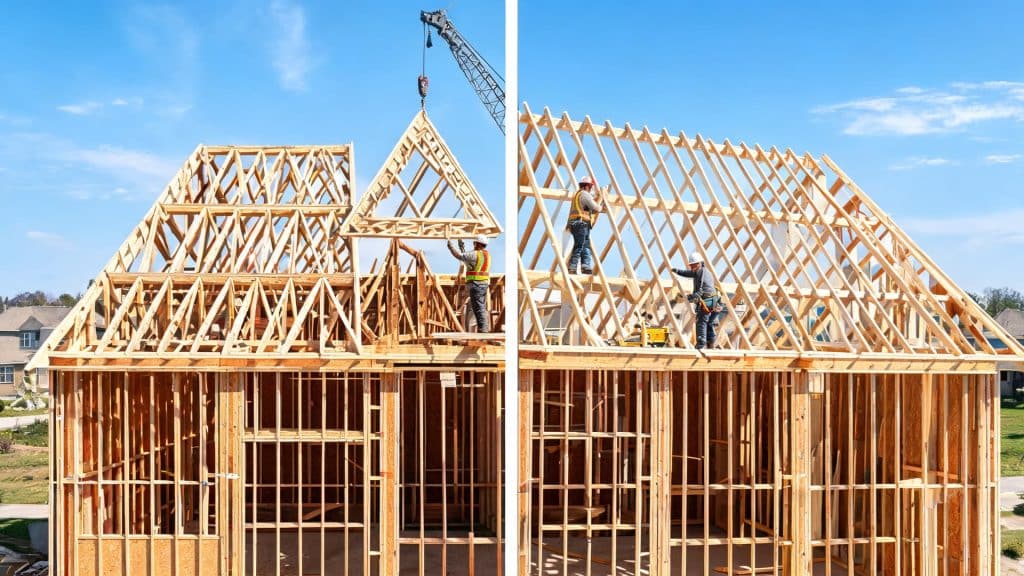


Roof trusses typically cost $1.50 to $4.50 per square foot of floor area installed. Rafter framing runs $3.00 to $6.00 per square foot once you include skilled labor. That gap is the starting point, not the whole story, and it is almost never the number that surprises homeowners most in a real build.
I’ve spent a decade tracking residential construction budgets, and roof framing decisions create downstream costs that don’t show up in the initial bid. The choice between roof trusses vs rafters affects your attic plans, your ceiling design, your build timeline, and what happens years later when you want to modify the space. Getting it wrong at the framing stage costs real money to fix.
This guide breaks down what trusses and rafters actually cost, where each system fits your project, and what to ask before your contractor orders materials.
| Cost Note: Figures in this article are estimates based on national averages from NAHB 2024 and HomeAdvisor/Angi 2025 data. Actual costs vary significantly by region, contractor, lumber market conditions, and project scope. Always get at least three quotes before committing to any project above $1,000. |
What are Residential Roof Trusses?
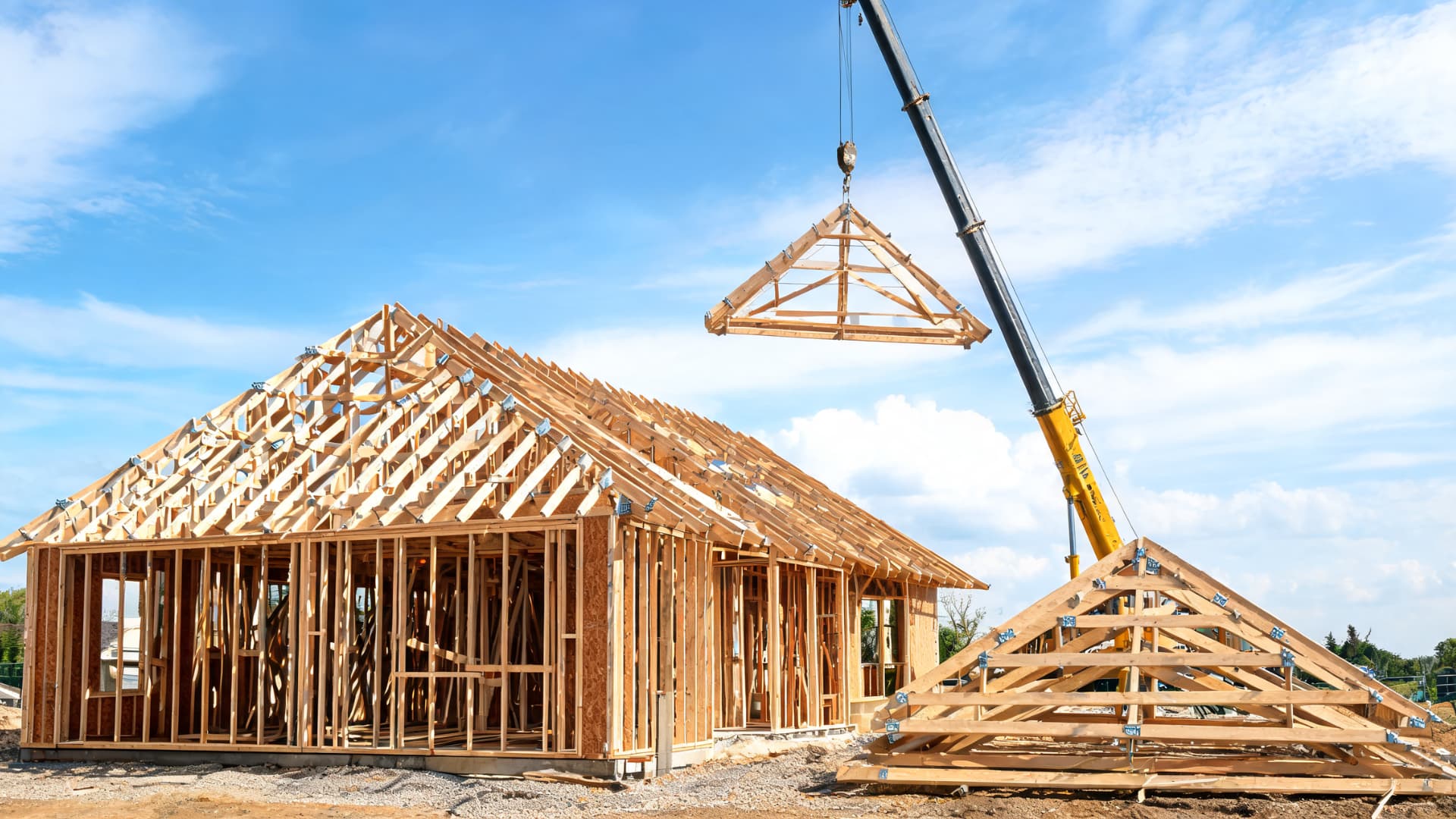
Residential roof trusses are pre-engineered framing systems manufactured off-site. A structural engineer designs each truss for the home’s specific span, pitch, and roof load before it leaves the factory.
The triangular web pattern of top and bottom chords and interior web members, connected by metal plates, distributes roof loads efficiently across the structure, typically without relying on interior load-bearing walls.
A crew can set trusses for an average-sized home in one to two days. The trade-off is planning: truss dimensions are locked in before fabrication, and changes after ordering are expensive.
Large trusses also require crane access on installation day, adding $400 to $900 to the job on lots with clear access. Where it isn’t, trusses may not be practical at all.
What is a Rafter?
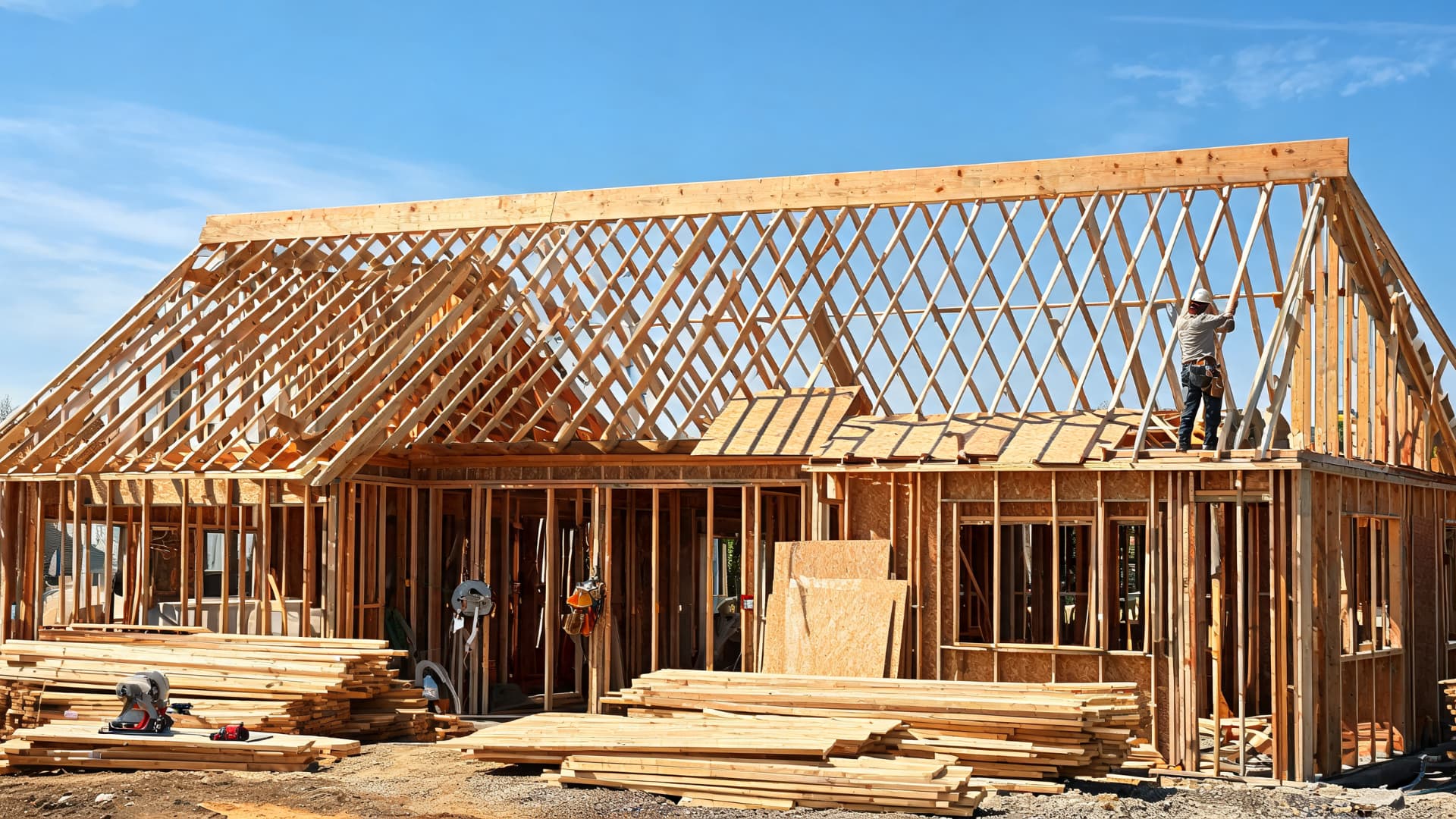
A rafter is a sloped structural beam that runs from the roof ridge down to the wall plate, forming the skeleton of the roof.
Rafters are cut and assembled on-site one at a time, which is why this method is called stick framing in the trades. Together, common rafters carry the roof deck, shingles, insulation, and all exterior loads from rain, wind, and snow down to the exterior walls.
Several rafter types appear in residential construction.
Common rafters run perpendicular from the ridge to the wall plate and are the primary structural members.
Hip rafters run diagonally from the ridge to an outside corner of the wall on hip roofs. Jack rafters are shorter members that connect to a hip or valley rafter rather than the main ridge.
A rafter tail is the portion of each rafter that extends past the wall plate to form the eave overhang. Rafter ties are horizontal members that connect opposing rafters near the wall plate to resist the outward thrust the roof load creates.
Because rafters don’t use the interior webbing of a truss, the space under a rafter roof stays open. That is the core advantage: usable attic space, vaulted ceilings, and mechanical access without structural interference.
The trade-off is labor. Each board is measured, cut, and fitted individually, and the quality of the finished roof depends heavily on the framing crew’s skill.
Roof Trusses vs Rafters: Cost Breakdown
The meaningful comparison is installed cost, not material cost alone. Material-only comparisons miss labor, delivery, crane rental, and the downstream effects on attic and ceiling plans.
| Line Item | Roof Trusses | Rafters | What Drives the Gap |
| Materials | $1.50–$4.50 per sq ft | $1.00–$2.50 per sq ft lumber | Trusses include engineering and factory fabrication |
| Installation labor | $0.80–$1.50 per sq ft | $2.00–$4.00 per sq ft | Rafter framing requires significantly more on-site carpentry hours |
| Crane rental | $400–$900 per day | Not required | Large trusses cannot be safely set by hand above a certain span |
| Engineering | Included in truss price | $300–$1,200 if custom design | Complex custom rafter roofs may need a structural engineer’s stamp |
| Total installed (typical home) | $3,500–$9,000 | $6,000–$14,000+ | Based on 1,500–2,500 sq ft floor area; range reflects pitch and design complexity |
These numbers hold for standard residential construction. A complex roof with multiple hips, dormers, or a steep pitch significantly changes both columns.
Trusses tend to be cheaper on a standard build, but the gap narrows when crane access is limited or scissor trusses are required for vaulted ceilings.
Main Differences Between Roof Trusses and Rafters
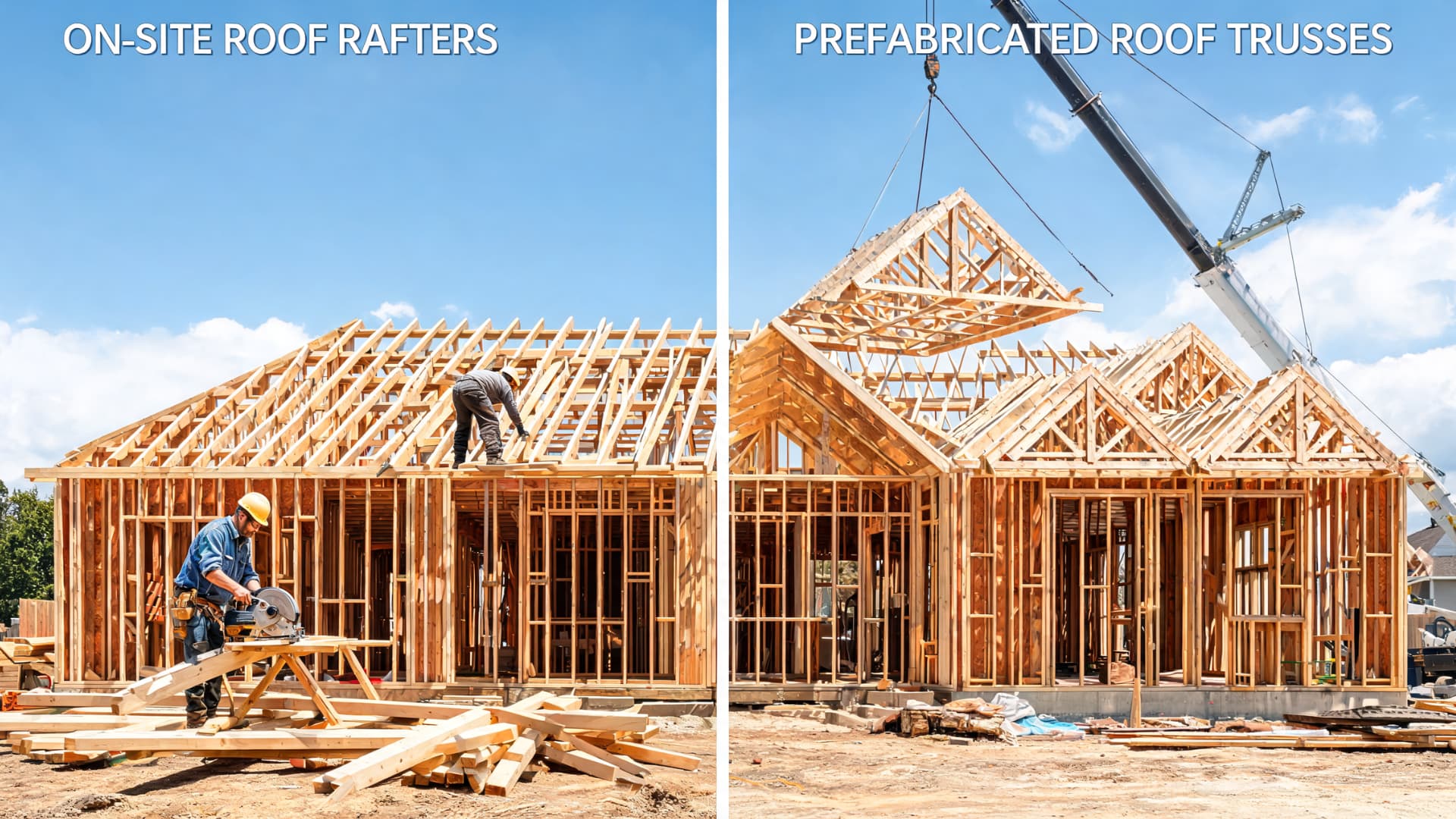
Beyond cost, the framing choice shapes what you can do with the space both during and after construction.
Attic Space and Ceiling Design
Standard residential roof trusses use interior web members that run through the center of the roof space. That webbing is structural and cannot be removed without engineering approval. It significantly limits what you can do with the attic: storage is difficult, finishing is impractical with standard trusses, and running mechanical systems requires reviewed penetration details.
Rafter framing leaves the attic open. Usable storage, finished attic space, vaulted ceilings, or mechanical access are all achievable without structural interference. Attic trusses are a specialized solution engineered with a raised bottom chord to create usable floor space, but they cost more than standard trusses and must be specified at the design stage, before fabrication.
Load-Bearing Wall Implications
Most residential roof trusses are designed to span from exterior wall to exterior wall with no interior load-bearing walls required. That is a real advantage in open-plan layouts and simplifies future wall removal.
Rafter roofs typically require a ridge beam or ridge board at the peak, and the load from that ridge transfers down through the structure via interior bearing walls or structural posts. This affects where walls can and cannot go on the floor below and makes interior wall removal more structurally complex in rafter-framed homes.
Design Flexibility and Timeline
Trusses are fabricated off-site as complete units. Once they arrive, setting them is fast: a full house can be framed in a day or two. The constraint is lead time. Truss fabrication typically takes two to four weeks after the roof plan is finalized, and any design change after that point costs extra and resets the clock.
Rafters are cut on-site, so there is no lead time to manage. The carpenter can adjust in real time if the structure isn’t perfectly plumb or square, and late design changes, such as a dormer addition or a ceiling height shift in one room, are workable during framing. The trade-off is schedule: rafter framing adds several days to the timeline on a standard home, more on a complex one.
Strength and Engineering
Neither system is inherently stronger.
A well-built rafter roof and a properly engineered truss roof both perform to code when installed correctly. Trusses distribute loads through triangular geometry, which makes them efficient and predictable for long spans.
Rafter performance depends more on field workmanship: correct sizing, proper spacing, ridge support, rafter ties, and collar ties all affect the final result.
The question that matters is not which is generically stronger, but whether the specified framing meets the load requirements for your roof’s span, pitch, snow load, and wind exposure. Ask that question directly before accepting any framing bid.
Pros and Cons: Roof Trusses vs Rafters
Here is the direct comparison across the factors that move real project budgets.
| Factor | Roof Trusses | Rafters |
|---|---|---|
| Installed cost (standard home) | Lower: $3,500–$9,000 typical | Higher: $6,000–$14,000+ typical |
| Installation speed | Faster: 1 to 2 days to set | Slower: several days to a week or more |
| Attic space | Limited by web members unless attic trusses are specified | Open and accessible |
| Vaulted or cathedral ceilings | Possible with scissor trusses, but must be designed in advance | Straightforward: the standard approach |
| Interior load-bearing walls | Often not needed: trusses span exterior to exterior | May require interior bearing walls or ridge beam support |
| Design lock-in | High: dimensions must be finalized before fabrication | Low: adjustments possible during framing |
| Future modifications | Engineering approval required for any alteration | More flexible: standard header-and-cripple approach applies |
| Crane required | Yes, for larger spans | No special equipment needed |
No framing choice is universally better. The right answer depends on the budget, roof design, attic plans, and whether the design is fully locked before the contractor orders materials.
When to Use Roof Trusses vs Rafters
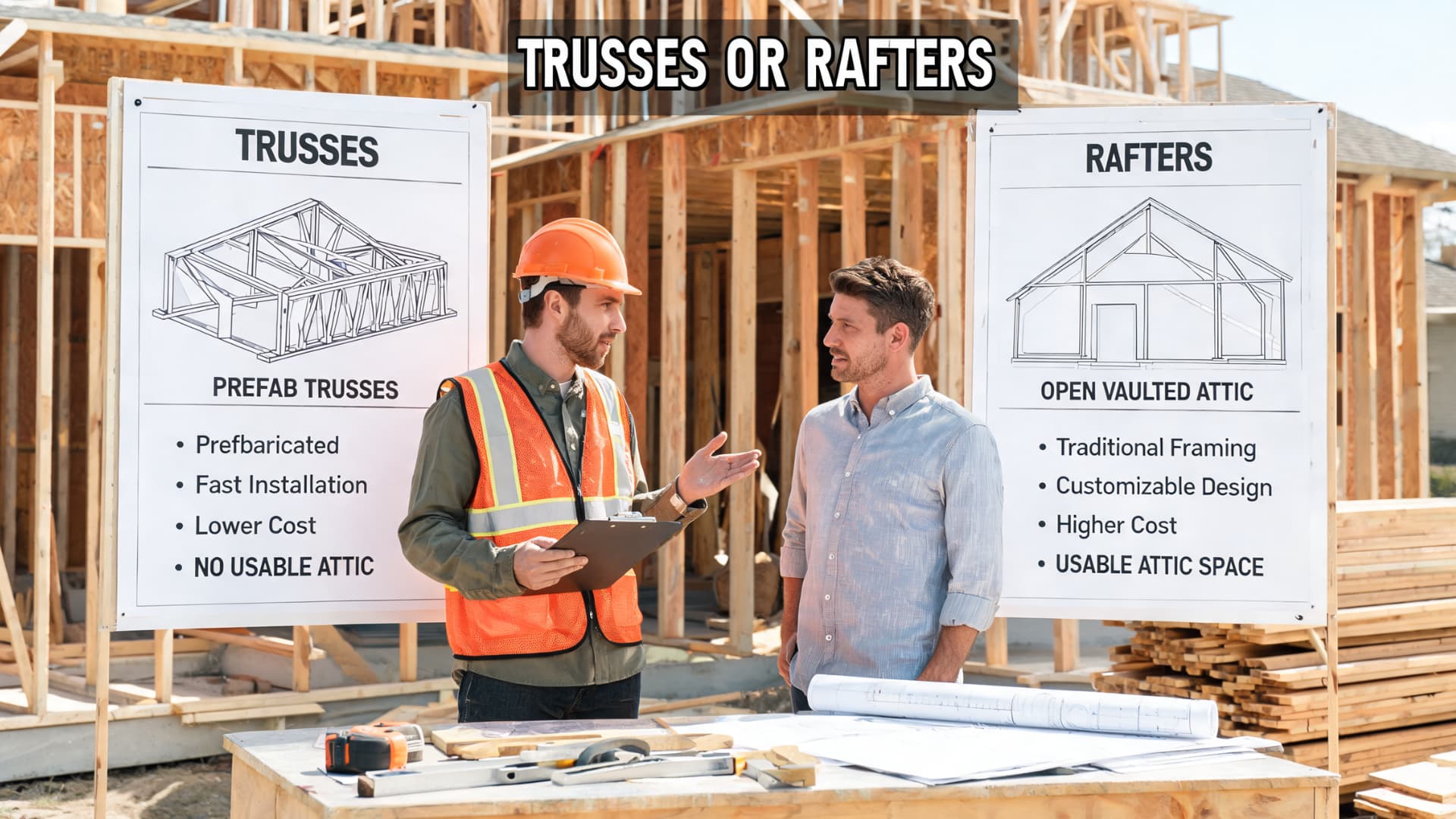
Here is where each system belongs in a real project, based on constraints that matter in the field.
| Project Type | Better Option | Why |
| Standard new home, simple roofline | Trusses | Faster to set, lower installed cost, consistent engineering |
| Custom home, complex roofline or dormers | Rafters | On-site flexibility accommodates irregular shapes and late design changes |
| Vaulted or cathedral ceiling | Rafters (or scissor trusses, if designed in advance) | Rafter framing creates open ceiling space naturally |
| Usable attic or planned attic conversion | Rafters or attic trusses | Standard trusses block usable floor space in the attic |
| Large span over 40 feet | Trusses | Engineered for long spans; rafters at these distances need costly LVL ridge beams |
| Older home renovation or addition | Rafters | Matching irregular existing framing is easier with stick framing |
| Tight build schedule | Trusses | Two to three days of framing vs a week or more for complex stick framing |
| Shed or outbuilding | Rafters for spans under 20 feet; trusses for larger spans | Small shed spans are easy to stick-frame; larger sheds benefit from truss engineering |
| Limited crane access on lot | Rafters | If the crane cannot reach the roof line, large trusses cannot be set safely |
A contractor who pushes one option without asking about your attic plans, ceiling design, and site access is missing part of the conversation. The framing decision affects work that happens months after the framing crew is gone.
Regional Cost Variation
Where you build moves these numbers more than most homeowners expect. Labor markets are the biggest driver.
Framing labor in California or the Northeast runs 40 to 60 percent higher than in the Midwest or Southeast.
Lumber prices are less regionally variable now than they were in 2021 and 2022, but truss delivery costs add up in rural markets where fabrication plants are far from the job site.
Three patterns worth knowing before you get bids.
In high-cost labor markets like California, the New York metro, and the Pacific Northwest, the labor savings from trusses are proportionally larger: cutting two to three days of skilled framing crew time saves more when the daily rate is $800 rather than $500.
In rural markets, confirm the truss delivery cost separately before comparing bids, as it isn’t included in a stick-framing quote. In snow-load regions such as the Mountain West, Upper Midwest, and New England, trusses must be engineered for local design snow loads.
This is standard practice at reputable plants, but verify it explicitly and ask for the load specification in writing.
Per the NAHB, framing and exterior finishes together account for roughly 30 percent of average construction costs on a new home.
For context on how that fits the full build, the construction cost per square foot breakdown covers how each phase contributes to the final number by region and building type.
Can You Modify or Replace Roof Trusses?
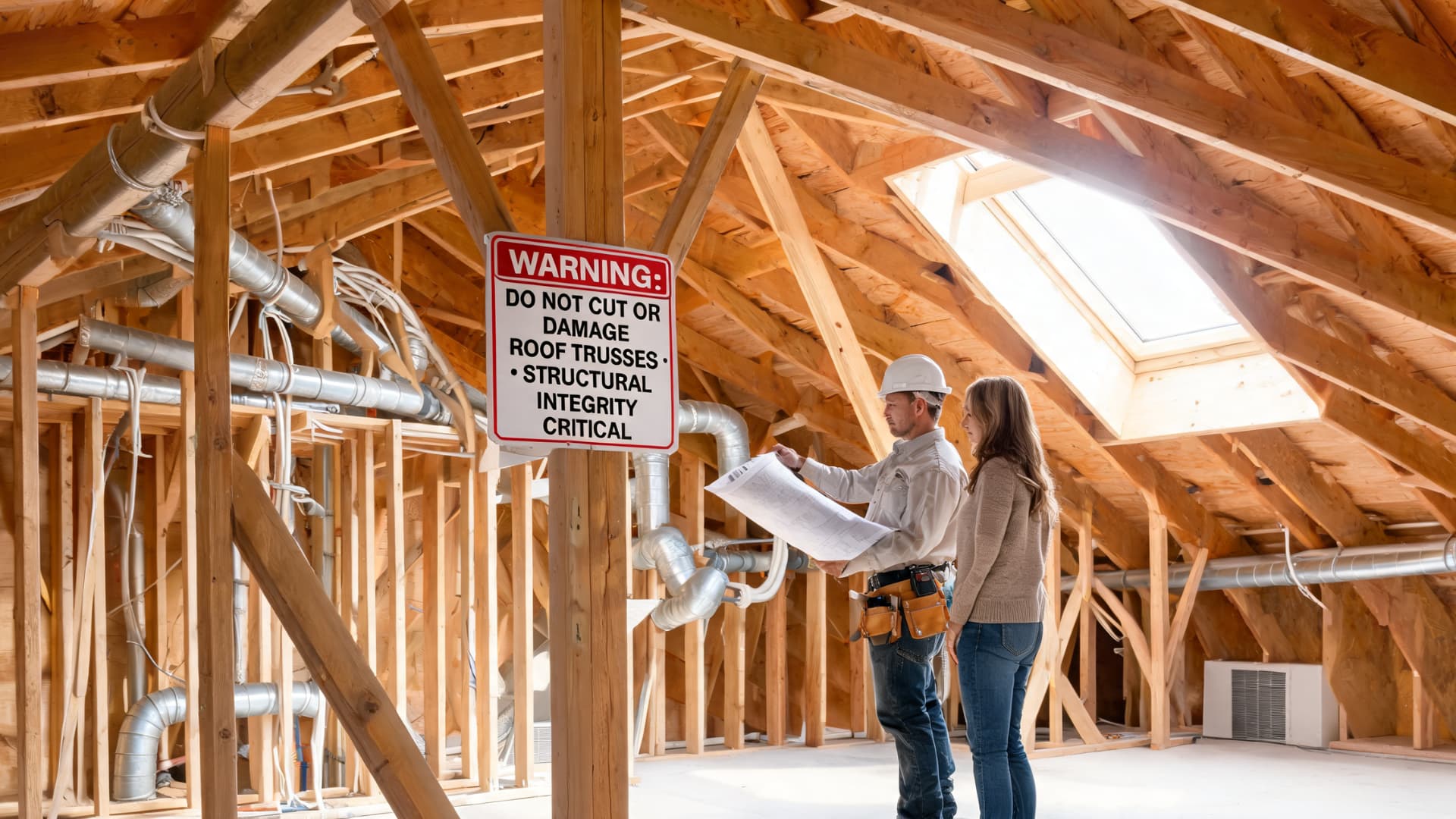
Modifying trusses and replacing them are two separate conversations, and both require more planning than most homeowners expect.
Roof trusses should never be cut, notched, drilled, or altered without written authorization from a structural engineer or the original truss manufacturer.
Every web member, chord, and connector plate has a specific role in the load path.
Removing a single piece without authorization alters how forces propagate through the entire system, and the failure may not be immediately apparent.
Inspectors find unauthorized truss modifications during re-inspections and home sales, and the remediation cost is high: $3,000 to $8,000 or more, depending on the scope.
HVAC runs, electrical, plumbing penetrations, and attic access openings all require reviewed and approved details before any truss member is touched.
| Safety Note: Never cut, notch, drill, or remove any member of a roof truss without a written repair or modification plan from a licensed structural engineer or the original truss manufacturer. Unauthorized modifications are a code violation in most jurisdictions and can compromise the structural integrity of the entire roof. |
Replacing rafters with trusses is possible during a full roof rebuild, but it is a major structural project, not a framing swap.
It requires a structural review of the existing walls, demolition of the existing roof, new engineering, permits, and inspection.
If the home’s interior walls currently carry roof load, those walls may need modification once trusses span exterior to exterior.
Budget for a full roof reconstruction, not a renovation line item, and engage a structural engineer before pricing the work.
If the remodel also involves full roof replacement, that is the right moment to evaluate whether a framing system change makes structural and financial sense.
Where Budgets Go Wrong
The framing decision itself is rarely where homeowners lose money. The problems come from the assumptions made around it.
Comparing material-only prices instead of installed cost.
Neither truss materials nor rafter lumber tells you what the roof actually costs. The number that matters is fully installed: materials, labor, crane, delivery, engineering, and permits are all included.
Not deciding on attic use before ordering trusses.
I’ve seen homeowners commit to standard trusses, get the roof on, and then realize they want a finished bonus room above the garage. Converting that space after the fact requires attic trusses or a full structural rework, typically $15,000 to $40,000. Decide before you order.
Missing crane cost in the framing bid.
The crane isn’t always included in the framing quote. On lots with trees, overhead utility lines, or narrow access, crane coordination adds time and cost beyond the standard lift rate. Ask whether it’s included and get a separate crane quote regardless.
Cutting trusses during renovation.
This is how a $5,000 HVAC project becomes a $20,000 structural remediation. Never alter trusses without written authorization from the manufacturer or an engineer.
Ignoring truss lead time in the build schedule.
Fabrication takes two to four weeks. If the framing crew arrives on schedule and the trusses are not ready, every trade that follows gets pushed back. Confirm the lead time before the project timeline is set, and order early.
What to Ask Your Contractor Before Signing
These five questions separate a well-scoped framing bid from one that surprises you mid-project.
- Is crane rental included in the framing bid, or billed separately? If included, ask for the line item. If separate, get a standalone crane quote for comparison.
- What is the truss fabrication lead time, and when does the design need to be finalized? Two to four weeks is standard. If your build schedule doesn’t account for it, the framing crew arrives before the materials do.
- Are the trusses engineered for my local snow load and wind zone? Ask for the design load specifications in writing and verify they match your local building code requirements. Do not assume.
- What does the attic space look like with this framing system? Ask for a cross-section sketch showing clear height and accessible area. If attic storage or a future room matters, have this conversation before accepting the bid.
- What permits are required, and who pulls them? Structural framing requires permits in essentially all jurisdictions. Any contractor who suggests otherwise is not someone you want on a structural project.
Frequently Asked Questions
These are the questions that come up most often from homeowners comparing bids or working through the roof framing decision for the first time.
How far apart are roof trusses?
Standard residential roof trusses are spaced 24 inches on center for most applications, though 16-inch spacing is used on some designs. The spacing is specified by the truss engineer based on the roof’s load requirements and roof decking thickness.
Can you replace rafters with trusses?
It is possible during a full roof rebuild, but it is not a simple swap. The project requires structural engineering, permits, full roof demolition, and an evaluation of the existing wall framing. Plan and budget for it as a major structural project.
Are trusses or rafters better for a shed?
For a shed under 20 feet wide, rafter framing is fast and cost-effective. For spans over 20 feet, trusses provide better structural efficiency and are easier to set without a large framing crew.
Summing Up
On a standard new build with a simple roofline, trusses are the practical default. The installed savings of $2,500 to $5,000 over rafter framing, combined with a faster frame-up, makes the choice straightforward when the roof design is locked and the attic is not part of the plan.
If you need a vaulted ceiling, usable attic space, or flexibility during the build, the higher cost of rafter framing buys you real options that standard trusses close off permanently once the roof goes on.
Make the attic decision before the contractor orders materials. Confirm site access for crane delivery if trusses are the plan. Understand what the lead time means for your build sequence.