


| Standard Dining Table Height | 28–30 inches (floor to tabletop) |
| Chair Seat Height | 17–19 inches |
| Seat-to-Tabletop Clearance | 10–12 inches |
| Apron Underside to Floor | 24–25 inches minimum |
| Counter Height | 34–36 inches |
| Bar Height | 40–42 inches |
The standard dining table height is 28 to 30 inches, measured from the floor to the tabletop surface. That number has been the industry benchmark long enough that most chair manufacturers design around it.
Most apron depths assume it, and most people building or buying a dining table treat it as settled, much the same way bar stool height follows its own set of benchmarks for counter and bar seating.
It mostly is. But “mostly” is doing a lot of work in that sentence, and the inch or two where it stops working is exactly where most build mistakes happen.
I’ve seen enough tables come through the workshop that sit right but feel wrong to know the number alone isn’t enough.
Height is a relationship: your chair, your apron depth, your floor, and the people eating at that table every night. Get the relationship right, and the table works for years. Get one element slightly off, and you’ll feel it at every long meal.
The Core Height Numbers for Dining Tables
Before anything else, here are the measurements that matter. These aren’t soft guidelines.
They’re the numbers that determine whether a chair clears the apron and whether someone can sit comfortably for two hours.
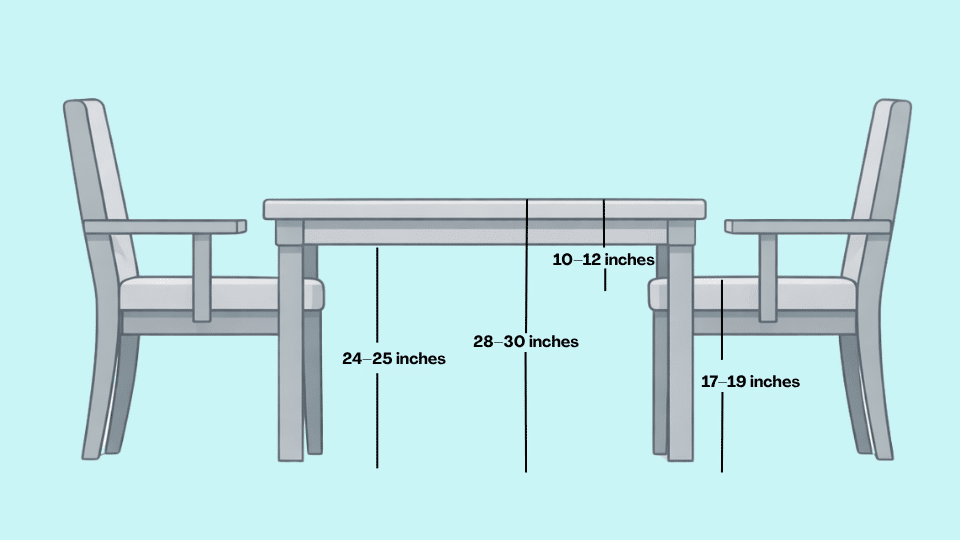
| Measurement | Standard Range |
| Table surface height | 28–30 inches |
| Chair seat height | 17–19 inches |
| Seat-to-tabletop clearance | 10–12 inches |
| Apron underside to floor | 24–25 inches minimum |
That last row is the one most guides skip. The apron underside-to-floor measurement matters more than the surface height for daily comfort, especially if your chairs have armrests.
Start With the Chair, Not the Table
The formula is straightforward: table height equals chair seat height plus 10 to 12 inches. That 10-to-12-inch range isn’t arbitrary. Ten inches produces a more relaxed seated posture. Twelve-inch suits people who prefer to sit upright. For long dinners, stay closer to 10.
If your chairs sit at 18 inches, your table should land between 28 and 30 inches. If your chairs sit at 19 inches, build to 29–31 inches. The relationship is what you’re designing, not a single fixed number.
One thing I’ve learned to always do: measure the actual chair, not the listed seat height on a spec sheet. Manufacturers measure inconsistently. Some measure to the top of the cushion, some to the frame.
That variation can be 1 to 2 inches, which is enough to shift your entire table height calculation. Measure the chair you’re actually using before you cut anything.
| Pro Tip: Set plywood on sawhorses at your target height, sit at it for a full meal, and see how it feels. It takes twenty minutes and will tell you more than any calculation. |
The Apron: The Measurement Most Builders Miss
The apron underside-to-floor measurement is where most dining table builds go wrong in ways that aren’t immediately obvious.
The standard surface height of 29 to 30 inches assumes a certain apron depth. If you’re running a deep apron for visual weight or structural rigidity, that apron’s underside can drop below the comfortable threshold before you realize it.
The target is 24 to 25 inches minimum from the apron’s lower edge to the floor. Below that, seated adults start to feel cramped in the thighs. Below 23 inches, it becomes genuinely uncomfortable for anyone with longer legs.
Armrests make this more critical. Measure the height from the floor to the top of the armrest, then compare it to your apron’s lower edge.
If the armrest height is greater than the apron underside height, the chair won’t push in cleanly. Allow at least a half-inch clearance between the armrest top and the apron underside.
More is always better. This is one of those problems that’s easy to design around before the build and nearly impossible to fix after.
Dining Table Height for Different Users
Standard numbers are a starting point. The people sitting at your table are the actual specification. Here’s how the numbers shift across different users.
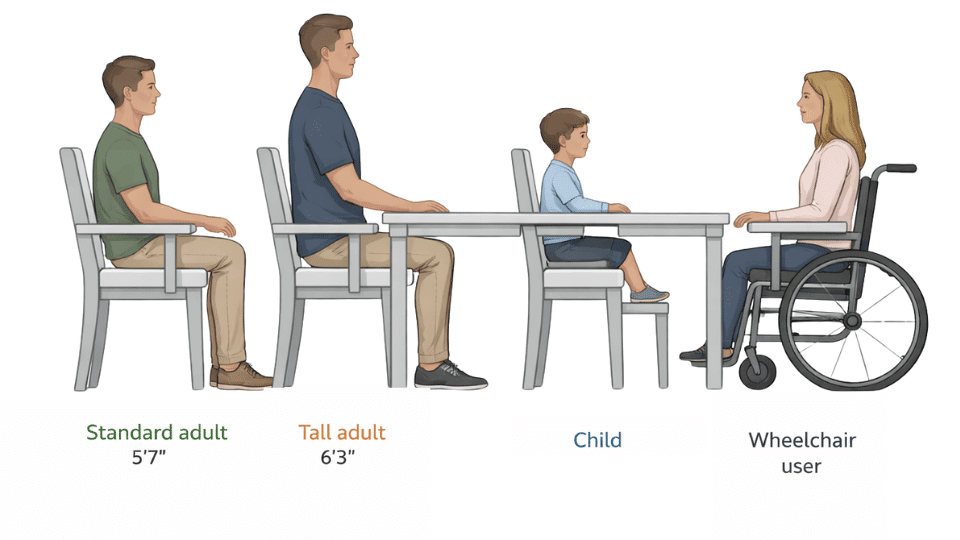
| User | Table Height | Seat Height | Notes |
| Standard adult | 28–30″ | 17–19″ | Works for most adults in the 5’4″–6’1″ range |
| Tall adult (6’2″+) | 30–31″ | 19–20″ | Raise both table and chair; raising only the table doesn’t solve legroom |
| Child (6–10 yrs) | 22–24″ | 12–14″ | Separate kids’ table or a booster seat at the adult table |
| Wheelchair user | 28–34″ | — | Minimum 27″ knee clearance underneath; ADA guideline |
| Mixed-height household | 29″ | 17–18″ | No perfect solution; 29″ is the workable middle ground |
For mixed-height households, adjustable leg feet only give you a quarter to a half inch of range. That’s for leveling, not bridging a meaningful height gap.
If you have both tall adults and shorter adults at the same table regularly, 29 inches is the realistic compromise height. It won’t be perfect for either end of the spectrum, but it won’t be actively uncomfortable for either.
For long meals, tighter clearances become a problem over time. Holiday dinners and extended gatherings are where a table that’s “fine for regular use” starts to feel wrong.
If you’re building for that kind of use, add clearance and keep the apron depth simple.
Dining Height vs Counter Height vs Bar Height
A lot of households eat at a kitchen island or a breakfast counter, not just a formal dining table.
If you’re planning or building one, kitchen island height follows its own set of rules that are worth understanding alongside these dining table numbers.
Each surface sits at a different height and needs a different seat to match. These are not interchangeable.
| Type | Table Height | Seat Height | Best For |
| Dining | 28–30″ | 17–19″ | Standard seated meals, long dinners, and formal dining rooms |
| Counter | 34–36″ | 24–26″ | Kitchen islands, casual eating, open-plan layouts |
| Bar | 40–42″ | 28–30″ | Standing bars, high stools, and entertainment spaces |
A counter-height table with standard dining chairs doesn’t work. Neither does a dining table with counter stools.
The seat-to-surface clearance falls outside the comfortable 10-to-12-inch range, and the whole fit feels wrong regardless of chair quality.
Before you decide which height to build, decide how you actually use the space and whether you’re eating, working, or doing both.
Community’s Words on Dining Table Heights
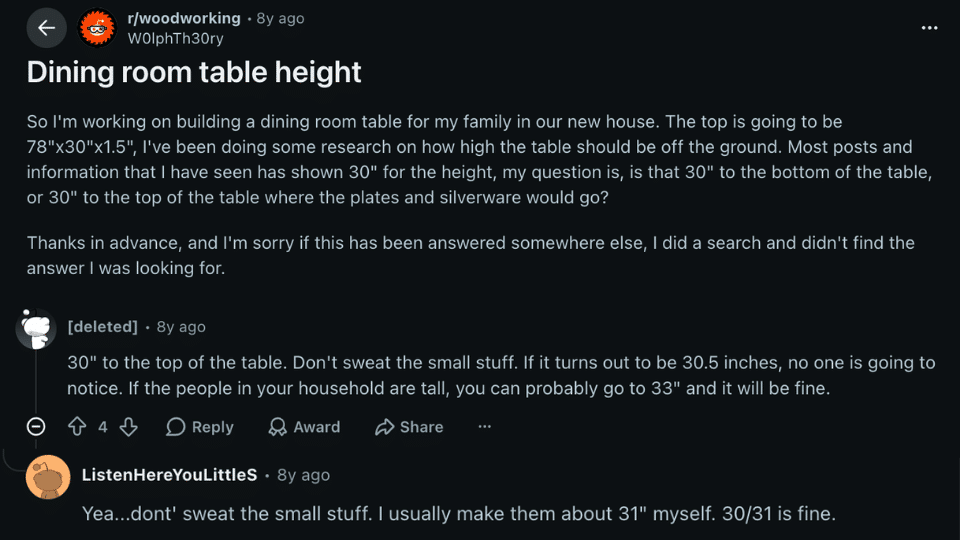
A Reddit discussion about the blog post “Dining room table height” centers on a builder unsure whether the standard 30-inch measurement refers to the tabletop or the clearance beneath it.
Most replies clarify that 30 inches typically means floor-to-tabletop, with minor variations (30–31 inches) considered negligible.
Commenters emphasize flexibility, suggesting a range of 28 to 33 inches depending on user height and chair compatibility, while encouraging practical testing over overthinking details.
Personally, this reflects how craftsmanship balances standards with real-life usability. Exact numbers matter less than comfort, proportions, and how the table actually feels during everyday use.
How Your Room Type Affects the Right Dining Table Height
The room itself introduces variables that affect which height works best in practice.
In apartments and open-plan condos, counter-height tables tend to feel less imposing and integrate better with kitchen islands and casual layouts.
In a dedicated dining room in a suburban or farmhouse home, the standard 30-inch table remains the most natural fit for a full chair set and extended meals.
That said, room type is context, not a rule. The people sitting at the table and the specific chairs you’re using will always matter more than what the floor plan suggests.
If you’re getting the height right for the chairs and the users, the room will work around it.
Build Mistakes That Actually Ruin the Fit
Most dining table height problems don’t come from bad math. They come from small assumptions that seemed reasonable during the build and turned out to be wrong. Here are the ones I see repeatedly.
- Trusting the listed seat height on a chair without measuring it yourself. Manufacturers measure seat height differently, top of cushion, frame, or compressed sit, with a 1-2-inch variation, affecting table-to-chair fit. Always measure the actual chair.
- Cutting legs to the final length before dry-fitting the top. Top attachment hardware, such as bolts, fasteners, and tenons, adds height you might not have considered. Dry-fit first, check height, then make cuts.
- Armrests are hitting the apron. A table and chair that are perfectly proportioned on their own can still be incompatible. Check armrest height against apron height before committing to your base design.
- Not accounting for chair leg splay. Chair legs angling outward reduce knee clearance underneath, which isn’t dramatic but noticeable on lower-clearance tables, especially with wider chairs.
- Building before the flooring is finalized. New hardwood, tile, or thick rugs can raise the floor ¼ to ½ inch after the table is complete, shifting the seat-to-table relation without touching the table. Know your final floor height before making final cuts.
Height problems are easier to prevent than fix. If a scenario fits you, do a mock-up first: set plywood on sawhorses at your target height, sit at it for a meal, and see how it feels.
It takes twenty minutes and reveals more than calculations.
Final Verdict
The standard dining table height is straightforward once you stop treating it as a single number and start treating it as a relationship among your chair, your top, your apron, your floor, and the people who’ll sit there daily.
Get the chair height first. Protect the underside clearance. Mock it up before you cut. Those three things alone will save most builders from the mistakes I’ve seen come through my workshop over the years.
If you’re building a dining table, I’d love to hear what you’re working on. Drop a comment below and share what you’re making.
Frequently Asked Questions
What is the standard dining table height?
The standard dining table height is 28 to 30 inches, measured from the floor to the tabletop surface. Most dining chairs are designed around this range, with seat heights between 17 and 19 inches.
How high should a dining table be for an 18-inch chair?
With an 18-inch seat height, your table should land between 28 and 30 inches. That gives you the 10-to-12-inch seat-to-surface clearance needed for comfortable seating. Measure the actual chair, not the listed height, before finalizing your table height.
What chairs fit a 30-inch dining table?
Chairs with a seat height between 18 and 20 inches work comfortably with a 30-inch table. That produces 10 to 12 inches of clearance between the seat and the tabletop. Verify armrest height against the apron underside before committing to chairs with arms.
What is counter height vs dining table height?
Standard dining tables sit at 28 to 30 inches. Counter-height tables sit at 34 to 36 inches and require stools with a seat height of 24 to 26 inches. Bar-height tables sit at 40 to 42 inches and require stools at 28 to 30 inches.
These heights are not interchangeable, and mixing the wrong chairs with the wrong table height produces a consistently uncomfortable setup regardless of quality.
What is the ADA-compliant dining table height?
ADA guidelines require a minimum of 27 inches of knee clearance underneath the table for wheelchair users, with a table surface between 28 and 34 inches.
The apron design matters here as much as the surface height. A table at 30 inches with a deep apron that drops to 22 inches underneath doesn’t meet the clearance requirement, even though the surface height does.
Can I adjust a dining table that’s too tall or too short?
If a table is too tall, you can trim the legs if the construction allows it. Remove the top, trim each leg evenly, reassemble, and recheck.
If the table is too short, furniture risers are the practical fix. Adjustable leg levelers give only a quarter to a half inch of range; they’re for leveling an uneven floor, not correcting a meaningful height mismatch.
Does rug thickness affect dining table height?
Yes, in practice. A thick area rug raises the chair legs by up to an inch, while the table legs may sit on the bare floor at the rug’s edge.
That shifts the seat-to-table relationship without changing either piece of furniture. Always mock up your height with the rug in place before making final cuts.