

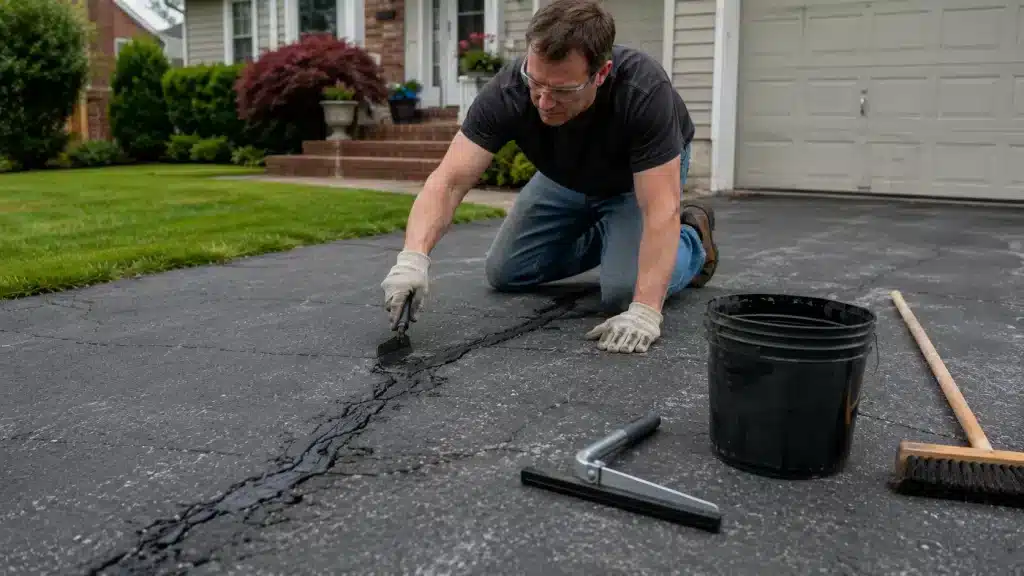


Most driveway repair cracks start small enough to step over. A year later, they’re wide enough to catch a tire edge, and the repair bill has gone from $150 in materials to a conversation with a contractor about full resurfacing.
I’ve watched that sequence happen enough times to know where it goes wrong: people recognize the crack and then wait for it to get “bad enough” to deal with. By the time it looks bad, the base has usually started to move.
This guide covers what causes driveways to crack, how to read whether yours needs repair, resurfacing, or replacement, the full step-by-step DIY driveway repair process for both asphalt and concrete, a realistic cost breakdown, and the factors that push those numbers up or down. The goal is to help you make the right call before the repair window closes.
| Cost Note: Figures in this article are estimates based on national averages. Actual costs vary significantly by region, contractor, materials, and project scope. Always get at least three quotes before committing to any project above $1,000. |
Why Driveways Crack: The Mechanics Behind the Damage
A driveway doesn’t crack because it’s old. It cracks because water found a way in. Everything else is downstream of that. Here’s how the cycle runs:
Water infiltration
Rain and snowmelt enter hairline cracks on the surface, sit in the base layer, and soften the ground underneath.
Once the base loses density, the surface above it cracks further under ordinary vehicle weight. The surface crack isn’t the problem. It’s the entry point for what becomes the real problem.
Freeze-thaw pressure
Water expands roughly 9% when it freezes. A narrow crack that collects moisture and sits through a cold night comes out the other side slightly wider.
Do that cycle forty times across one winter in a northern state, and a hairline crack becomes a structural gap.
This is why driveway repair matters more in cold climates. Not because the pavement is weaker, but because the physics are more aggressive.
Surface aging and UV breakdown
UV radiation dries out asphalt binder over time, making the surface brittle and more prone to cracking under load.
Concrete slabs can shrink slightly as they cure over years, opening control joints and creating new moisture entry points. Neither process is fast, but neither one stops on its own.
Asphalt vs. Concrete Driveways: What Changes the Repair Approach
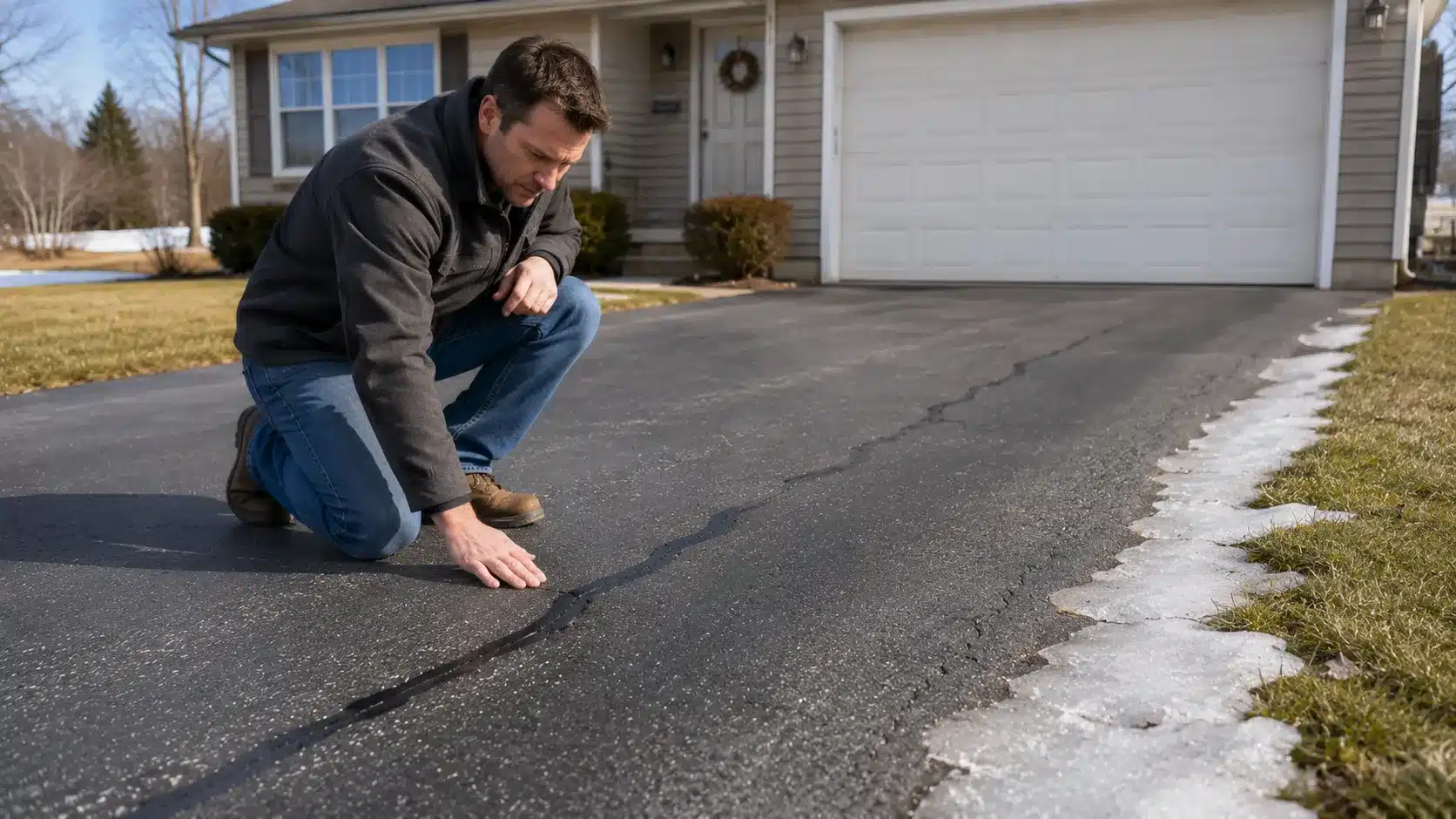
Before you buy anything, you need to know what your driveway is made of. Asphalt crack filler won’t bond to a concrete slab.
Concrete patching compound won’t hold on asphalt. The wrong product means the repair fails in one season, sometimes faster.
| Feature | Asphalt Driveway | Concrete Driveway |
| Material | Bitumen and aggregate mix | Cement, sand, and gravel |
| Appearance | Black or dark grey | Light grey or tan |
| Common damage types | Cracks, potholes, alligator cracking, surface erosion | Spalling, scaling, hairline cracking, edge breakout |
| DIY repair product | Elastomeric crack filler, cold patch, polymer resurfacer | Concrete crack filler, hydraulic cement, concrete resurfacer |
| Sealer required | Yes, every 2 to 3 years | Optional but recommended |
| Typical lifespan with maintenance | 20–30 years | 30–50 years |
| Primary repair cost driver | Surface area and damage depth | Slab thickness and crack pattern |
Asphalt is more flexible, which helps it handle minor ground movement without cracking, but it needs regular sealing to stay water-resistant.
If your asphalt driveway was installed less than 90 days ago, wait before applying any sealer. The binder needs time to fully cure, and sealing too early traps off-gassing and weakens the bond.
Concrete is harder and longer-lasting, but when the ground shifts under it, the cracks follow specific patterns.
Control joints and slab edges are typically the first places to show it, and both tell you something about the base beneath.
Repair, Resurface, or Replace? Reading the Right Answer from Your Driveway
This decision saves or wastes more money than any product choice you’ll make. Getting it right matters before you spend anything.
Repair: Isolated Damage with a Sound Base
If you have a few cracks under an inch wide, a pothole or two, or a limited rough patch, repair is the right call. The base is still solid.
You’re filling specific damage and sealing against water, not rebuilding anything. Most DIY driveway repair projects fall here, and materials run $100 to $250 for a standard two-car driveway.
Resurface: Widespread Wear with the Base Still Intact
If the whole surface looks worn or faded, or shows many hairline cracks, but the driveway isn’t sinking, heaving, or soft underfoot along the edges, resurfacing can add five to eight years.
A new layer goes over the old one. The key qualifier is a stable base. Don’t waste money resurfacing a driveway that sinks slightly at the edges or holds standing water after rain.
That water is sitting on a compromised base, and a new surface coat will fail in one season on top of it.
Replace: structural base failure
Replacement is the answer when sections are sinking or heaving, the base has softened, drainage is broken, or more than a third of the surface is cracked and uneven. No amount of patching changes that outcome. If replacement opens the question of switching materials entirely, paver costs vary significantly by type and square footage, and it’s worth knowing before you commit to like-for-like asphalt again.
Recognizing Alligator Cracking Before It Becomes a Replacement Decision
There’s a damage pattern worth knowing by name: alligator cracking.
It looks like a network of interconnected cracks forming irregular polygons across the surface, similar to dried mud or, as the name suggests, the texture of alligator skin.
It almost always signals base failure underneath, not just surface aging.
Standard crack filler doesn’t solve alligator cracking. The surface cracks are a symptom of a base that has lost density and support.
If you fill them without addressing the cause, the pattern returns within a season. Small sections of alligator cracking can sometimes be cut out, the base rebuilt, and the area cold-patched.
Widespread alligator cracking across more than a third of the driveway is a replacement signal.
| Pro Tip: Walk the edges and corners of your driveway on a dry day. Press down with your heel. Any flex or soft give underfoot indicates base saturation, even if the surface looks intact. That’s your real repair signal, not the visible crack width. |
Driveway Repair DIY: Step-by-Step
Asphalt driveway repair isn’t just filling cracks and spreading a coat on top. The order of operations matters because each step creates the conditions the next one needs to work.
Dirt weakens filler. Open cracks compromise resurfacing. Oil stops new material from bonding. Do these in sequence, and the repair holds. Skip steps, and you’ll be doing it again.
Tools and Materials
| Cleaning & Prep | Crack & Pothole Repair | Resurfacing |
| Wire brush | Liquid elastomeric crack filler | Polymer-modified asphalt resurfacer |
| Leaf blower or stiff broom | Trowel-grade filler | Bonding agent |
| Scrub brush | Cold patch asphalt (for potholes) | 4-inch paintbrush |
| Garden hose with spray nozzle | 2-inch putty knife | Wide squeegee |
| Pressure washer | Wide putty knife/trowel | Cordless drill with paddle mixer |
| Household bleach & degreaser | Caulking gun (if filler uses cartridge) | Work gloves and safety glasses |
Step 1: Pull weeds and clear loose debris
Remove weeds growing from any crack, taking the roots where you can. Roots left behind will push through fresh filler. Clear loose surface debris around damaged areas before brushing or washing.
Step 2: Loosen packed material from cracks
Use a wire brush to break up compacted dirt, gravel, and old filler from wider cracks. Follow with a leaf blower to clear the cracks out.
A blower reaches into gaps where a broom can’t. The goal is open, clean crack edges, not just a swept surface.
Step 3: Kill algae and biological growth
Mix one gallon of household bleach with four gallons of water. Apply with a scrub brush and let it sit for about 10 minutes.
No heavy scrubbing needed. Rinse with fresh water, then use the hose nozzle to flush remaining debris out of the cracks.
Step 4: Pressure wash (optional but worth it)
Pressure washing removes embedded dirt that a broom and hose miss. A cleaner surface means better adhesion for filler, bonding agent, and resurfacer.
Let the driveway dry fully before applying any repair product. Visually dry isn’t always dry. Give it several hours on a warm day.
Step 5: Fill narrow cracks with liquid elastomeric filler
For cracks up to about half an inch wide, use liquid elastomeric crack filler. Cut the nozzle to about a quarter inch. Move backward while slightly overfilling the crack, adjusting speed for depth.
Smooth the bead with a 2-inch putty knife. Elastomeric filler stays flexible after curing, which matters. A rigid fill in a flexible surface cracks again at the repair edge.
Step 6: Patch eroded areas, larger cracks, and potholes
Use trowel-grade filler for cracks up to about one inch wide and eroded surface areas. For potholes deeper than an inch, use a cold-patch asphalt product.
Remove all loose material from the pothole first. Square up crumbling edges with a chisel until you’re working against solid pavement.
Fill in lifts for deep holes rather than one pour, compacting each layer. Smooth the patch flush with the surrounding surface.
Step 7: Treat oil stains before sealing
Clean oil-stained areas with a degreaser, then apply a bonding agent over the treated spot before resurfacing.
Oil residue stops the resurfacer from bonding. Skipping this step produces a soft spot that peels within one season. The bonding agent dries clear.
Step 8: Mix and apply the resurfacer
Mix the resurfacer with a cordless drill and paddle mixer attachment before pouring. Even the texture before application matters.
Unmixed product spreads unevenly and cures with soft spots. Brush the driveway edges first with a 4-inch paintbrush for control near curbs, borders, and lawn edges.
Then pour and spread from the top of the driveway toward the street, using a wide squeegee in steady back-and-forth passes.
Keep a wet edge moving. If a section dries before you reach the overlap, you’ll have a visible seam and a weak bond at that line. Two people make this step significantly easier: one to pour, one to spread.
Keep all traffic off the driveway for a minimum of 24 to 48 hours. Check the product label, as cure times vary by formulation and temperature.
How to Repair Concrete Driveways
Concrete driveway repair follows the same principle: clean, fill, protect. But the products are different, and applying asphalt products to concrete is a mistake that won’t hold. Concrete needs cement-based materials.
| Damage Type | Right Repair | What to Do |
| Hairline and narrow cracks | Concrete crack filler | Clean loose material, blow out dust, fill the crack, smooth flush with a putty knife |
| Surface scaling and spalling | Concrete resurfacer | Sound slabs only, no heaving. Keep the slab damp (not wet) before applying for adhesion |
| Broken edges and deep holes | Hydraulic cement or patching compound | Patch the structural damage first, let it set fully, then decide whether resurfacing makes sense on top |
One more thing specific to concrete: if your slab shows cracking along multiple control joints or across slab boundaries, the ground beneath may be settling unevenly. Patching the surface won’t stop that movement.
If you’re weighing whether concrete is even the right long-term material for your situation, the comparison between stamped concrete and alternatives is worth knowing before you invest in repairs.
When to Call a Contractor Instead of Doing It Yourself
Most driveway repair on isolated cracks and potholes with a sound base is DIY territory. A few conditions change that calculation.
Call a professional when cracks are wider than one inch across most of the surface.
Call one if any section sinks or flexes underfoot, if visible alligator cracking covers more than a quarter of the surface, or if drainage is pooling toward the foundation of your house.
Potholes that reappear within a season of patching are also a contractor signal.
These conditions require base work: excavation, gravel replacement, and proper grading. That goes beyond what a DIY surface repair can address.
Professional driveway repair costs $300 to $1,000+ for targeted work, and full resurfacing or replacement typically starts at $2,000 and scales with the job’s size. Get at least three quotes before committing to anything above $1,000.
DIY Driveway Repair Cost Breakdown
| Repair Stage | Typical Product | Approx. Cost | Notes |
| Cleaning | Bleach, degreaser, scrub brush | $5–$20 | Pressure washer rental adds $40–$80/day |
| Crack filling (under ½ in.) | Liquid elastomeric filler | $8–$20 per tube | One tube covers 30–60 linear ft |
| Patching (cracks up to 1 in. / potholes) | Trowel-grade compound or cold patch | $15–$40 per bucket | Coverage varies with damage depth |
| Oil stain treatment | Degreaser + bonding sealer | $10–$25 | Required step. Skipping causes failure |
| Resurfacing | Polymer asphalt resurfacer | $20–$75 per pail | One pail covers 250–500 sq ft |
| Sealcoating | Asphalt driveway sealer | $20–$50 per pail | One pail covers 250–500 sq ft |
For a standard two-car driveway of 400 to 600 square feet, a complete DIY driveway repair and resurfacing project runs roughly $100 to $250 in materials when damage is moderate.
Larger driveways or deeper damage push that range higher, and tool rental adds $40 to $100 if you don’t already own a pressure washer or drill.
Factors That Push the Price Up or Down
Two driveways with identical surface cracks can have very different repair costs depending on what’s going on underneath.
Surface area scales cost almost directly. More square footage means more filler, more resurfacer, more sealer.
Damage depth matters more than crack count. A surface crack is cheap. A two-inch-deep pothole needs multiple fill lifts and significantly more material.
Driveway material affects both product cost and long-term maintenance frequency. Asphalt products generally cost less upfront, but asphalt driveways need sealing every two to three years.
Drainage problems are the hidden cost driver. If water is pooling because the slope is off or the base is soft, no surface repair lasts, and drainage correction adds real cost.
Tool ownership changes the equation significantly. If you already have a pressure washer, drill, and squeegee, you’re paying almost entirely for materials.
Product grade matters too. Budget elastomeric and polymer products cost less upfront but don’t perform as well through freeze-thaw cycles. Mid-grade products hold better and typically justify the price difference in cold-climate states.
How Long Does Driveway Repair Last?
A well-prepped crack fill on an asphalt driveway can hold for two to five years before needing attention.
A full resurfacing job on a sound base, done correctly and sealed afterward, can add five to eight years to the driveway’s life. Concrete patch repairs on stable slabs often last longer still.
What shortens that lifespan:
- shallow prep before filling
- patching over a soft or shifting base
- skipping the sealer after resurfacing, driving on the repair before it fully cures
- repeated freeze-thaw cycles without seasonal maintenance
A useful habit is to walk the driveway in early spring after the last hard freeze. Look for new cracks, soft edges, or spots where last year’s repair has shifted. A small top-up caught then is a fraction of the cost of a repair left to a second winter.
Most homeowners in cold-climate states who sealcoat their asphalt driveways every two to three years significantly reduce the rate of new crack formation.
Mistakes That Cause Driveway Repairs to Fail
Most driveway repair failures trace back to steps that happened, or didn’t happen, before the first product went on. The surface looked ready, the filler looked easy, and one skipped step later the repair is peeling by spring.
Skipping the cleaning step. Filler applied over dirt, algae, or debris doesn’t bond. The surface needs to be clean and completely dry before anything else goes on.
Repairing on a wet surface. Moisture under a filler prevents adhesion. After rinsing or pressure washing, wait several hours, not just until it looks dry.
Using the wrong filler for the crack size. Liquid elastomeric filler is for cracks under half an inch. Trowel-grade or cold patch is for wider gaps and potholes. The thinner product in a deep gap shrinks and cracks again.
Ignoring oil stains. Resurfacer won’t bond to oil. The degreaser-and-bonding-agent step on stained areas is not optional. Skip it, and that spot fails within one season.
Applying resurfacer too thick. Thicker isn’t stronger. Applying it beyond the label’s coverage rate causes uneven curing and surface cracking. Follow the spread rate.
Working in the wrong weather. Most driveway repair products require 50 to 90°F and dry conditions. Cold temperatures slow curing. Rain before the product sets washes it off entirely. Direct high heat dries the surface before you can spread it evenly.
Breaking the wet edge. Letting the squeegee edge dry before completing a pass creates a visible seam and a weak bond at the overlap. Keep it moving.
Frequently Asked Questions About Driveway Repair
These come up consistently once someone is standing in front of an actual crack, trying to figure out what to do.
How do you repair cracks in a concrete driveway?
Clean the crack thoroughly, blow out all dust, and apply a concrete-specific crack filler, not asphalt filler. Smooth it flush with a putty knife. For wider cracks, use hydraulic cement or a patching compound. For surface spalling across a stable slab, a concrete resurfacer applied over a damp (not wet) surface is the right call.
How do you repair cracks in an asphalt driveway?
Clean and dry the crack completely, apply liquid elastomeric filler for gaps under half an inch, and trowel-grade compound for wider damage. Smooth flush, let it cure, then sealcoat the full surface to protect the repair. Don’t use concrete products on asphalt. The materials are chemically incompatible.
How do you repair large cracks in a concrete driveway?
Remove all loose material, undercut the crack edges slightly if possible for better mechanical adhesion, and fill in stages with hydraulic cement or a structural patching compound. Let each lift set before adding the next. Smooth flush and allow full cure before traffic.
How do you repair large cracks in an asphalt driveway?
Use trowel-grade filler or cold patch asphalt for cracks wider than half an inch. Fill in layers for deep gaps, compacting each one. For cracks approaching or exceeding one inch wide across a significant area, assess the base. Widespread large cracks usually signal base movement, not just surface wear.
How do you repair driveway cracks yourself?
Clean thoroughly, remove weeds and debris, dry completely, fill with the right product for your material and crack width, and seal when done. The cleaning and drying steps are where most DIY repairs fail, not the filling itself.
Does homeowners insurance cover driveway repair?
Only if the damage came from a covered sudden event: a falling tree, storm impact, or vehicle accident. Normal aging, frost heave, and surface cracking are maintenance, not claims. Document the cause with photos and check your specific policy before making repairs.
How long should I stay off a repaired driveway?
At least 24 to 48 hours for most products. Check the label. Walking on it too early leaves marks. Driving too soon can damage the repair before it bonds properly.
Why do driveway cracks keep coming back after repair?
Usually, because the cause wasn’t addressed. A soft base, drainage that pulls water under the surface, or incomplete cleaning before filling are the common culprits. Filler closes the gap but can’t stop ongoing base movement. If the same crack returns within a season, the problem is underneath the surface, not in the filler you used.
Summing Up
DIY driveway repair works when the base is solid and the damage is surface-level.
If you’ve got isolated cracks under an inch wide, a pothole or two, and a driveway that doesn’t flex or hold water, you can handle this with a weekend and $150 to $250 in materials.
The freeze-thaw cycle won’t wait for you to get around to it, and every season you leave a crack open makes the next repair more expensive.
Before you buy anything, walk the edges of your driveway and press down with your heel. If it’s firm, you’re in repair territory.
If it gives, get a professional to look at the base before you spend money on the surface. That’s the one decision worth making before anything else.