

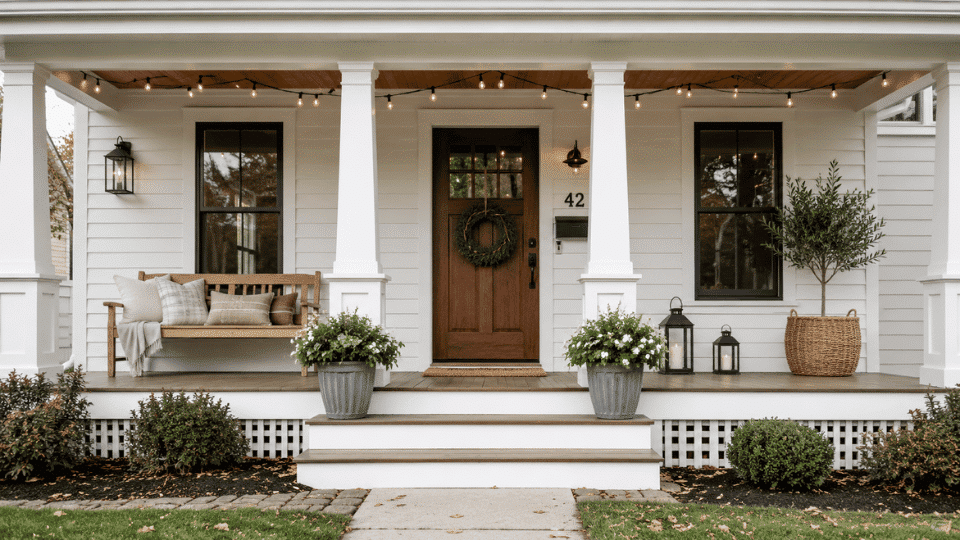


A front porch should do more than hold a wreath and a mat. It should make daily life easier, soften the entry, and give the house a clearer first impression.
These front porch decorating ideas are built as complete setups, not loose styling tips. I focused on porches people actually live with: tiny stoops, baby gear, older adults, privacy needs, renters, plants, reading corners, and seasonal curb appeal.
You will also find small front porch ideas that respect tight spaces rather than crowding them. The goal is simple: give you porch ideas that look good because they work.
| Cost Note: Figures in this article are estimates based on national averages. Actual costs vary significantly by region, materials, and project scope. Always get at least three quotes before committing to any project above $1,000. |
Before You Decorate, Decide What Your Porch Needs to Do
A porch can look pretty and still fail if it blocks the door, crowds the steps, traps rainwater, or ignores how the household uses the entry.
Good front porch decorating starts with the boring details first. Check the door swing, walking space, porch depth, weather exposure, light, and the path guests naturally take.
A tiny stoop may only need one strong planter, a mat, a wreath, and better lighting. A deeper porch can handle seating, storage, layered plants, or a private corner.
Once the function is clear, the decor feels intentional instead of random. That is where outdoor decor starts looking personal, not copied from a seasonal aisle. With that in mind, here are setups built for real situations.
Front Porch Decorating Ideas for Privacy, Comfort, and Daily Life
These porch ideas solve everyday problems first, then make the space beautiful through better placement, sizing, materials, and outdoor decor choices.
1. The Fog-of-War Privacy Screen
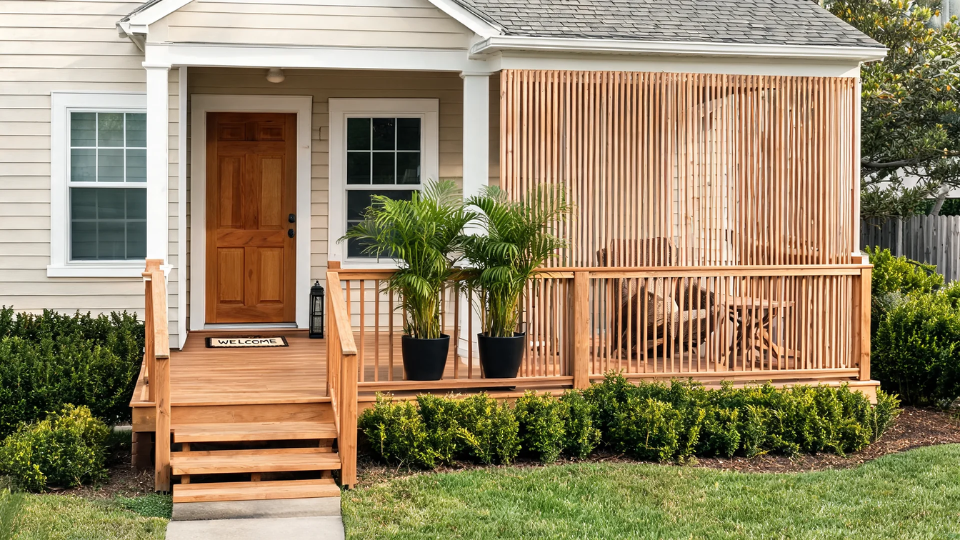
Mount a horizontal cedar slat panel, about 6 ft wide and 4 ft tall, against your street-facing railing using angle brackets. Choose slats with half-inch gaps, so it breathes instead of walling you in.
Angle it 10 degrees inward so it reads like a design choice, not a defensive fence. Flank the steps with two Areca palms in dark resin planters. The fronds should spill loosely over the top edge of the panel.
From the chair, you see layered green against warm wood. From the pavement, there is nothing interesting to inspect.
- What you need: 2 Areca palms, two 14-inch dark resin planters, one pre-cut cedar slat panel, exterior angle brackets, and 4 railing mounting clamps.
- The non-obvious bit: The 10-degree inward angle signals intention rather than paranoia.
- Cost: $180 to $240, depending on palm size.
2. The Sit-and-Stay Porch for Older Adults
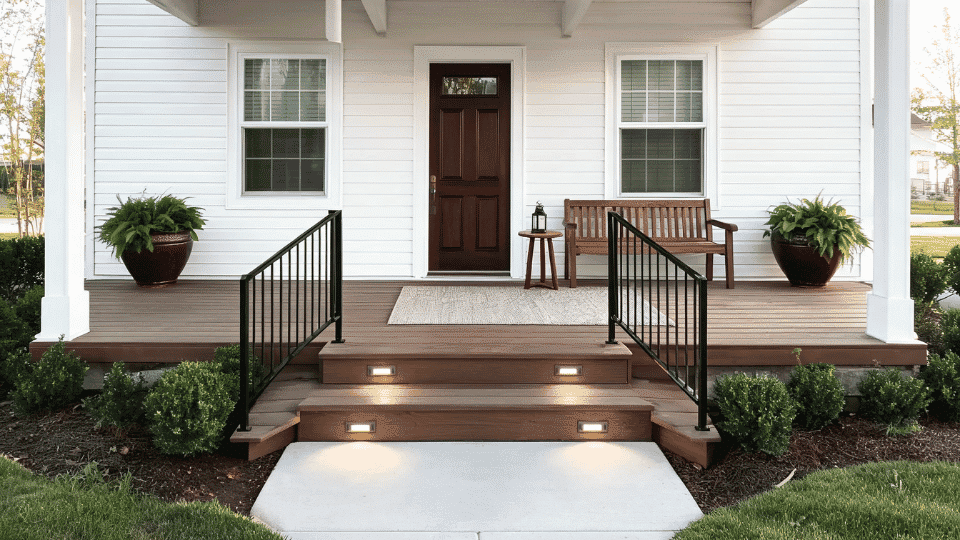
Place a 48-inch bench with arms against the wall closest to the door, but not in the door swing. Choose a seat height between 17 and 19 inches, so sitting and standing feel easier. Add a side table on the dominant-hand side, about 18 inches wide, for glasses, keys, tea, or a book.
Use a flat outdoor rug instead of a thick layered mat. Add two low-glare solar step lights and two heavy planters pushed tight to the porch corners. The porch should feel calm, steady, and easy to move through.
- What you need: 48-inch bench with arms, a flat 4 x 6 ft outdoor rug, an 18-inch side table, 2 solar step lights, and 2 heavy planters.
- The non-obvious bit: The arms matter more than the cushion because they help someone push up safely.
- Cost: $220 to $450, depending on bench quality.
3. The Package-Proof Porch
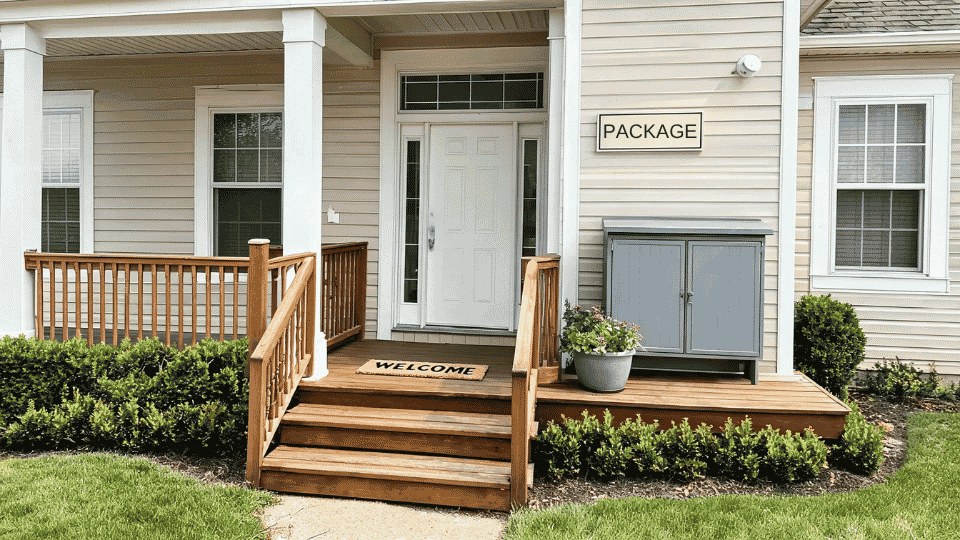
Place a small weatherproof delivery cabinet on the right side of the porch, around 30 to 36 inches wide, so it sits off to the side and does not block the front door. Choose one with closed gray doors and a flat top, so it looks neat against the siding and blends in more like porch storage than a parcel bin.
Add a simple “PACKAGE” sign above it so delivery drivers know exactly where to leave boxes. Put one medium planter beside the cabinet, so the setup feels styled while still keeping the entry steps and front door clear.
- What you need: A 30- to 36-inch weatherproof delivery cabinet, a package sign, a medium planter, and a slim outdoor tray or cushion for the cabinet top.
- The non-obvious bit: A clear package sign makes the drop-off spot obvious, while closed cabinet doors keep parcels hidden from the street.
- Cost: $150 to $320.
4. The Renter-Friendly Porch With No Drilling
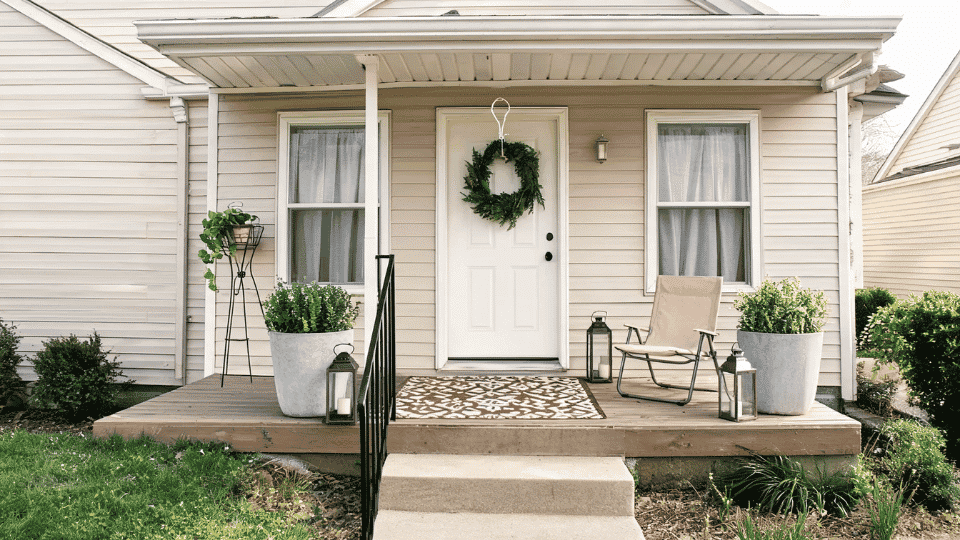
Use only freestanding pieces: a rollable outdoor rug, weighted planters, battery lanterns, a removable wreath hanger, and a folding chair if the porch is deep enough. Add height with a freestanding plant stand instead of mounted shelves.
For privacy, place a trellis inside a heavy rectangular planter and grow jasmine, ivy, or faux outdoor greenery through it. Nothing permanently touches the wall, railing, or doorframe, but the porch still feels layered.
- What you need: Removable wreath hanger, outdoor rug, weighted planter, battery lanterns, folding chair, freestanding plant stand, or planter trellis.
- The non-obvious bit: Weight replaces drilling. Heavy planters let renters add height, privacy, and structure safely.
- Cost: $90 to $220.
5. The Working Doorstep for Tiny Porch Charm
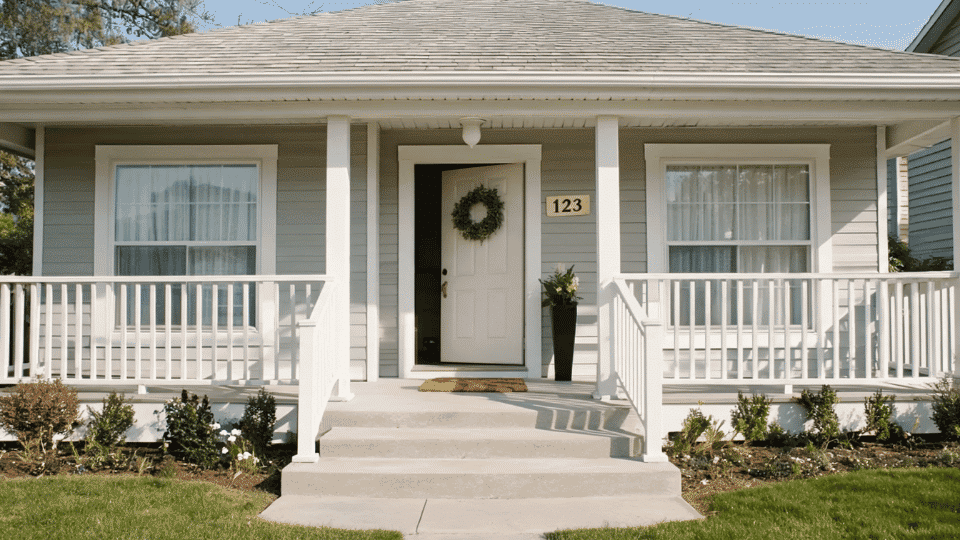
Use only one side of the door. Place a 24 x 36-inch coir mat underfoot, then set one narrow planter, no wider than 10 to 12 inches, on the side where the door does not swing. Add a small wreath, around 18 to 20 inches, and a clean house number plaque.
Do not add chairs, baskets, layered rugs, or double planters. The goal is a finished entry that still leaves room for feet, packages, and the door.
- What you need: 24 x 36-inch mat, 10 to 12-inch planter, 18 to 20-inch wreath, house number plaque, compact light source.
- The non-obvious bit: One styled side looks more expensive than two cramped sides.
- Cost: $70 to $160.
Front Porch Decorating Ideas for Plants, Hobbies, and Personality
These ideas give the porch a stronger identity, whether the goal is greenery, herbs, reading space, vintage character, or a bolder aesthetic. Each one works because the decor choice has a function behind it.
6. The Cottage Herb Garden Porch
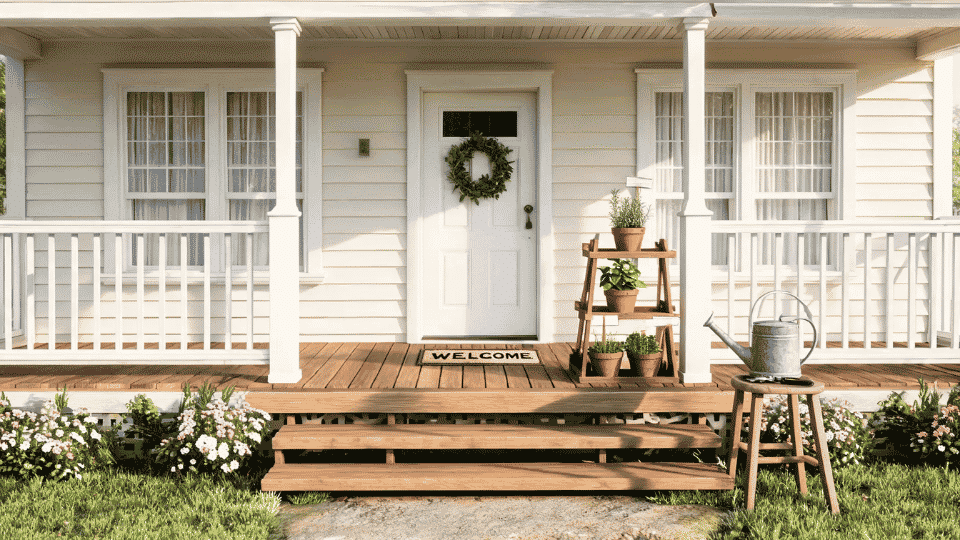
Place a 3-tier plant stand near the kitchen-side door or the sunniest porch wall. Use 6 to 10-inch pots for rosemary, thyme, basil, parsley, oregano, and chives. Keep mint in its own pot because it spreads aggressively.
Add a small stool for a watering can and snips. The porch now smells good, looks soft, and gives you something useful before dinner.
- What you need: 3-tier plant stand, 6 to 10-inch herb pots, plant markers, watering can, garden snips, rosemary, thyme, basil, parsley.
- The non-obvious bit: Put herbs near the door, not the prettiest corner, or they will not get used.
- Cost: $80 to $180.
7. The Front Porch Reading Nook
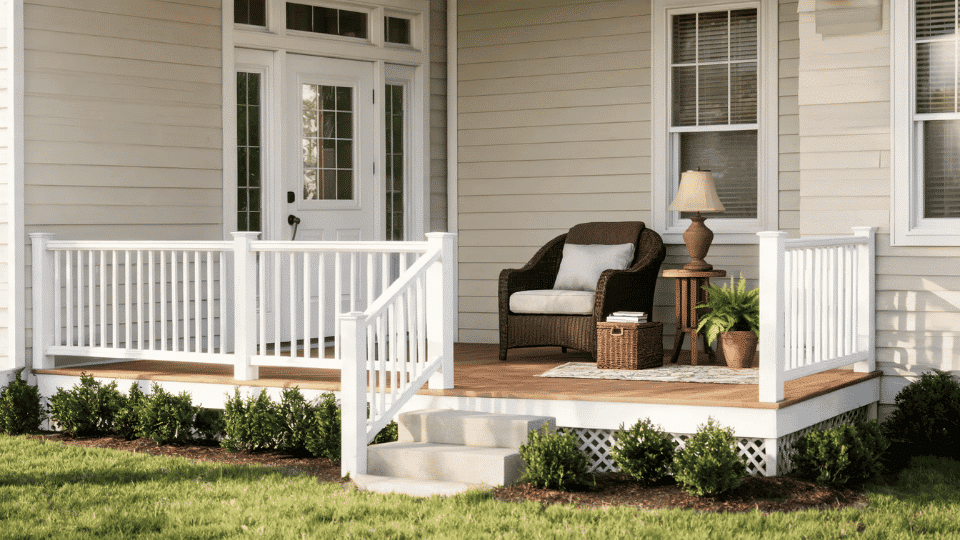
Place one deep chair, at least 30 inches wide, in the quietest corner of the porch. Add an 18 to 22-inch side table on the hand you naturally reach with. Place a covered basket underneath for books, a throw, or bug spray.
Use a small outdoor rug to frame the nook and a clip-on rechargeable lamp if there is no outlet. This should feel like a one-person retreat, not leftover patio furniture.
- What you need: 30-inch deep chair, 18 to 22-inch side table, covered basket, 4 x 6 ft rug, rechargeable lamp, cushion.
- The non-obvious bit: The table side matters because comfort depends on small repeated movements.
- Cost: $180 to $380.
8. The Symmetry Porch for Graceful Kept Spaces
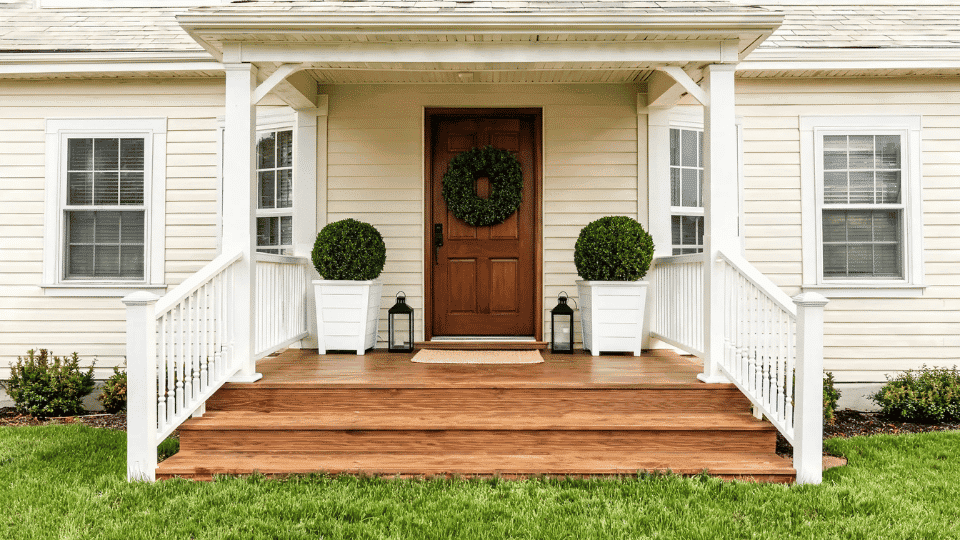
Place two matching planters on either side of the door, each 18 to 22 inches wide. Add matching lanterns in front of them, but keep them smaller than the planters. Center a 22 to 26-inch wreath on the door and align the mat with the doorframe.
Use boxwood, olive trees, hydrangeas, or topiaries. This works best when every object has a twin or a clear center point.
- What you need: 2 matching planters, 2 matching lanterns, a centered wreath, an outdoor mat, and boxwood or topiary plants.
- The non-obvious bit: Symmetry only works when the mat is centered too; otherwise, the whole setup feels slightly off.
- Cost: $140 to $300.
9. The Salvage and Reclaimed Porch
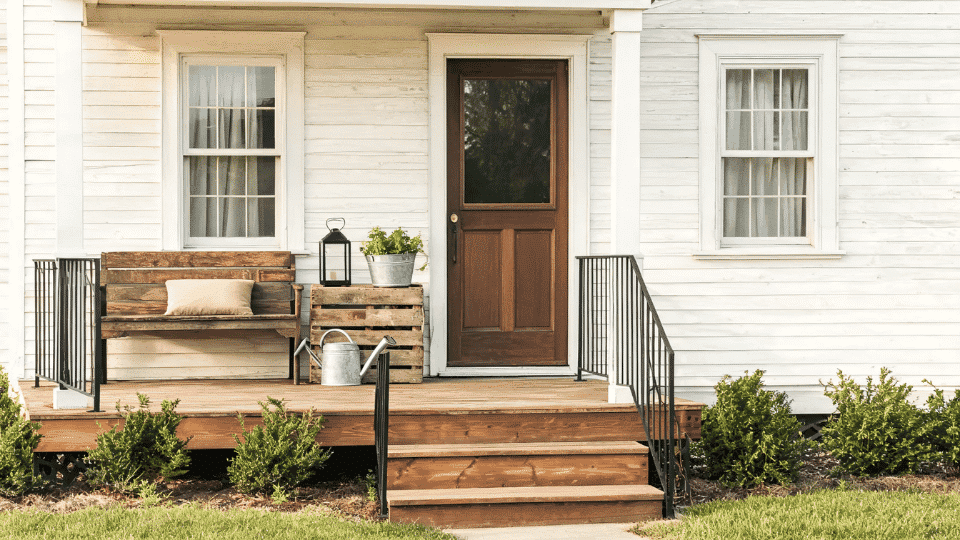
Start with one reclaimed anchor: a weathered bench, an old church pew, a vintage metal chair, or a wooden crate table. Add only two smaller vintage pieces, such as a galvanized planter and an old watering can.
Keep cushions plain and modern, so the porch does not become a junk-shop display. The charm should come from age, texture, and patina, not from piling up every thrifted object.
- What you need: Reclaimed bench or chair, vintage crate, galvanized planter, old watering can, plain cushion, and one modern lantern.
- The non-obvious bit: One modern piece keeps reclaimed decor looking curated instead of accidental.
- Cost: $90 to $260, depending on what is thrifted.
10. The Maximalist Tropical Porch
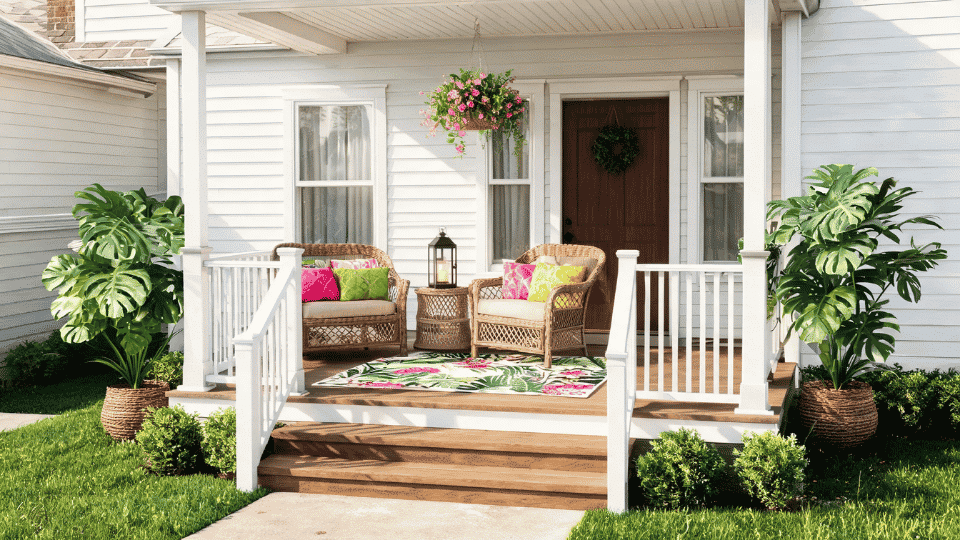
Use two oversized leafy plants, at least 4 to 5 ft tall, as the back layer. Add rattan or cane seating, a patterned outdoor rug, and cushions in two strong accent colors. Hang one basket overhead if the porch is covered.
Keep the plants big and the accessories fewer. The porch should feel lush and vacation-like, not like every tropical print was used at once.
- What you need: 2 large leafy plants, a patterned outdoor rug, rattan seating, 2 to 3 cushions, a hanging basket, and a warm lantern.
- The non-obvious bit: Tropical style needs scale more than clutter; big leaves do the heavy lifting.
- Cost: $240 to $520.
Seasonal Front Porch Decorating Ideas That Still Look Intentional
These seasonal setups satisfy the aesthetic side without turning the entry into a pile of disposable decorations. The rule is the same as every other setup here: the entry still has to work when the decor goes up.
11. The Zero-Maintenance Winter Porch
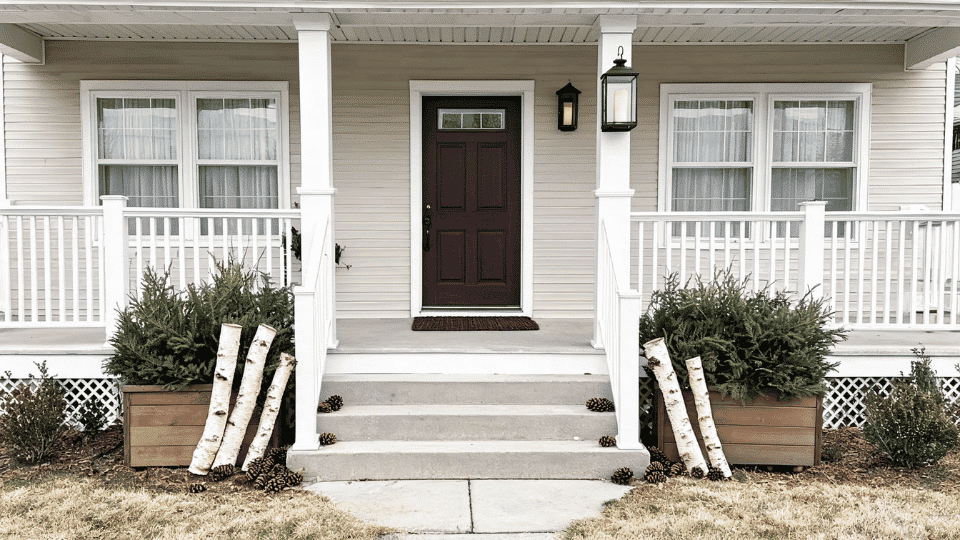
Fill two 18-inch planters with evergreen branches, cedar, pinecones, and birch logs. Use real greenery if the weather is cold enough to preserve it, or use high-quality faux stems on exposed porches.
Add one lantern with a battery candle and a sturdy mat. For tiny porches, use one planter and one lantern. The look should feel wintery, not overly holiday-specific.
- What you need: 18-inch planters, evergreen branches, cedar stems, birch logs, pinecones, a lantern, and a battery candle.
- The non-obvious bit: Birch logs add height when flowers are out of season.
- Cost: $80 to $180.
12. The Spring Basket Porch
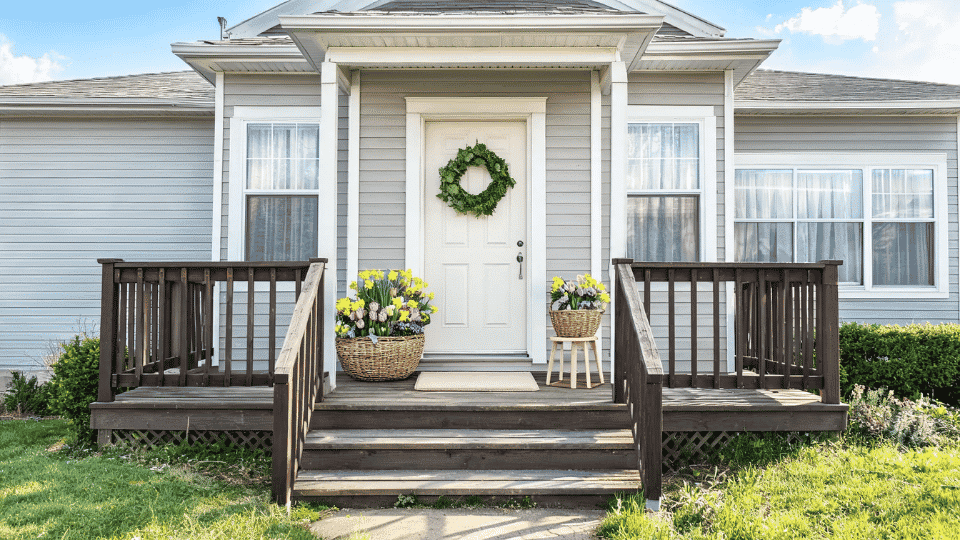
Use two woven baskets as planters: a large one on the floor and a smaller one on a stool. Fill them with tulips, daffodils, pansies, hyacinths, or realistic faux spring stems.
Add a grapevine wreath with only one ribbon color. Keep the flowers gathered near the door instead of spreading tiny pots everywhere. The porch feels fresh, not busy.
- What you need: 2 woven baskets, a small stool, spring flowers or faux stems, a grapevine wreath, and a light mat.
- The non-obvious bit: Baskets need hidden plastic liners, or watering will ruin them fast.
- Cost: $75 to $170.
13. The Summer Coastal Porch
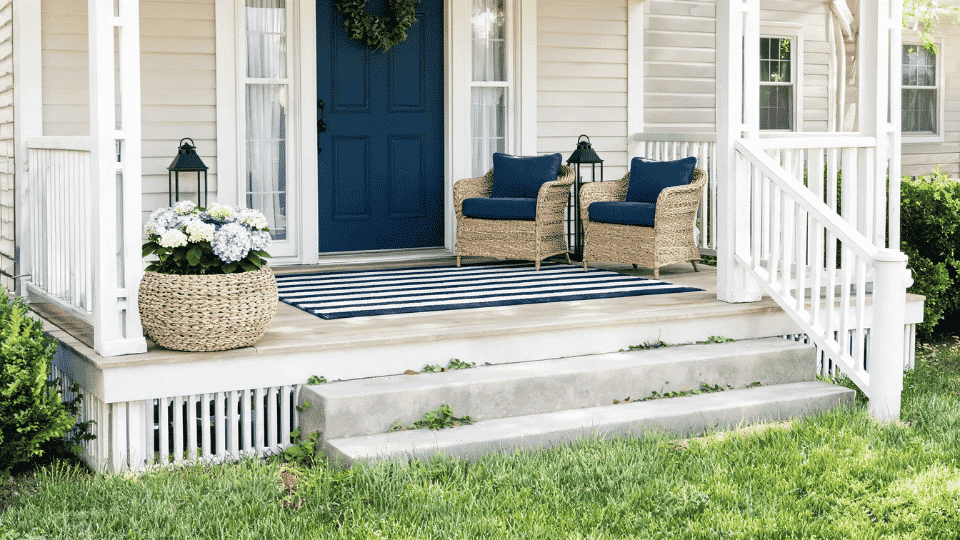
Start with a striped outdoor rug, then add one woven planter and either two compact chairs or one small bench. Use white, navy, tan, pale blue, or weathered wood.
Add grasses, palms, or hydrangeas instead of beach signs. The porch should suggest summer through texture and color, not seashells, anchors, or word art.
- What you need: Striped rug, woven planter, compact chairs or bench, simple lanterns, grasses or hydrangeas, 2 cushions.
- The non-obvious bit: Coastal decor looks better when it avoids literal beach objects.
- Cost: $170 to $360.
14. The Fall Harvest Porch That Still Looks Neat
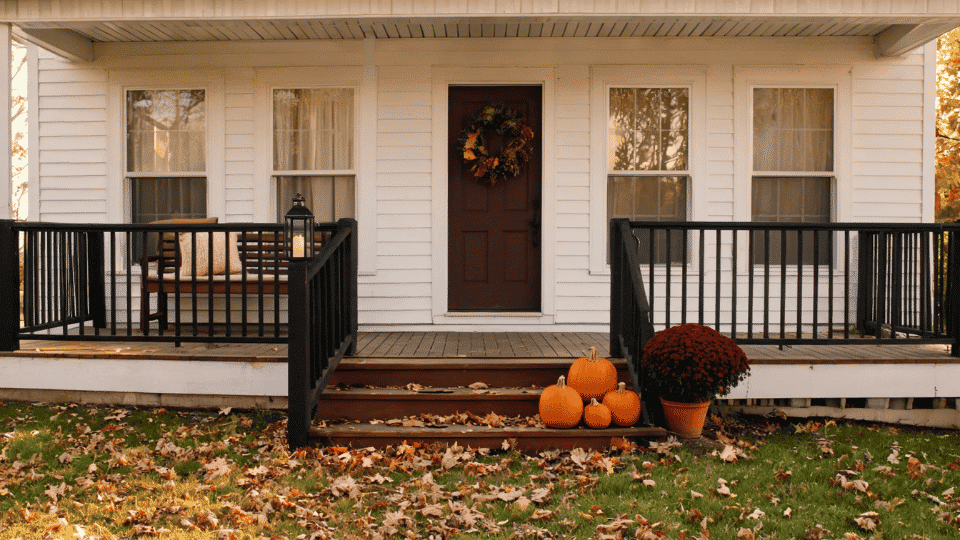
Group three to five pumpkins in one corner, using a mix of sizes and soft color variations. Add one mum planter, one natural wreath, and one lantern.
For a large porch, add corn stalks only if they can stand upright without brushing the walkway. Do not line every step with pumpkins. One controlled harvest cluster looks warmer and more expensive.
- What you need: 3 to 5 pumpkins, mum planter, natural wreath, lantern, optional corn stalks, warm pillow for seating.
- The non-obvious bit: A single cluster photographs better and keeps the steps usable.
- Cost: $70 to $180.
15. The Polished Halloween Porch
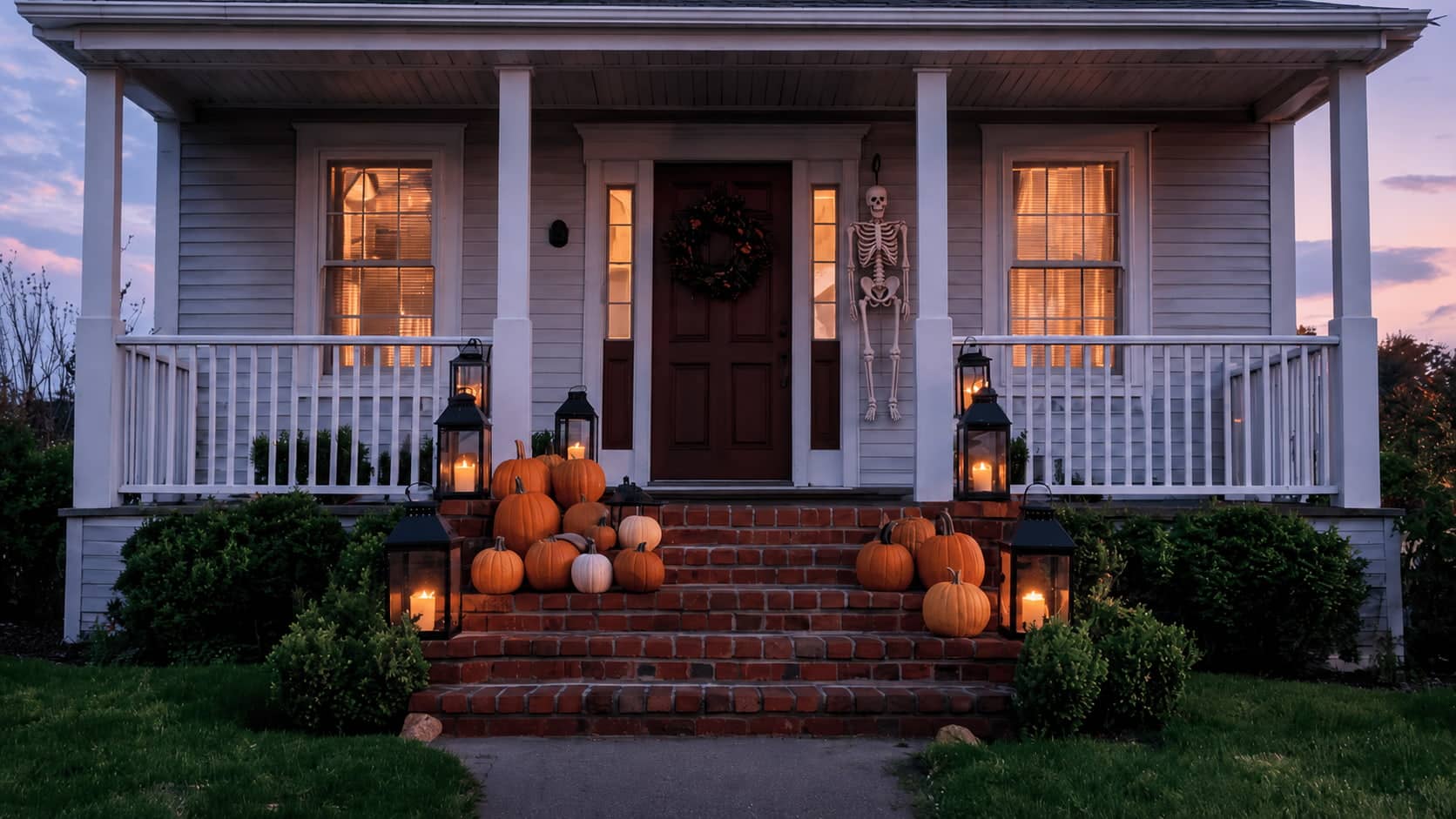
Choose one spooky focal point: a skeleton in a chair, a crow-covered wreath, a ghost by the steps, or a webbed corner.
Keep everything else restrained with black lanterns, matte pumpkins, dark greenery, and warm orange light. This porch feels festive without becoming a full haunted-house scene. It works especially well for homes that still want curb appeal in October.
- What you need: One Halloween focal piece, black lanterns, matte pumpkins, a dark wreath, battery lights, and optional faux webbing.
- The non-obvious bit: One focal scare is stronger than twelve scattered Halloween objects.
- Cost: $60 to $160.
16. The Classic Christmas Evergreen Porch
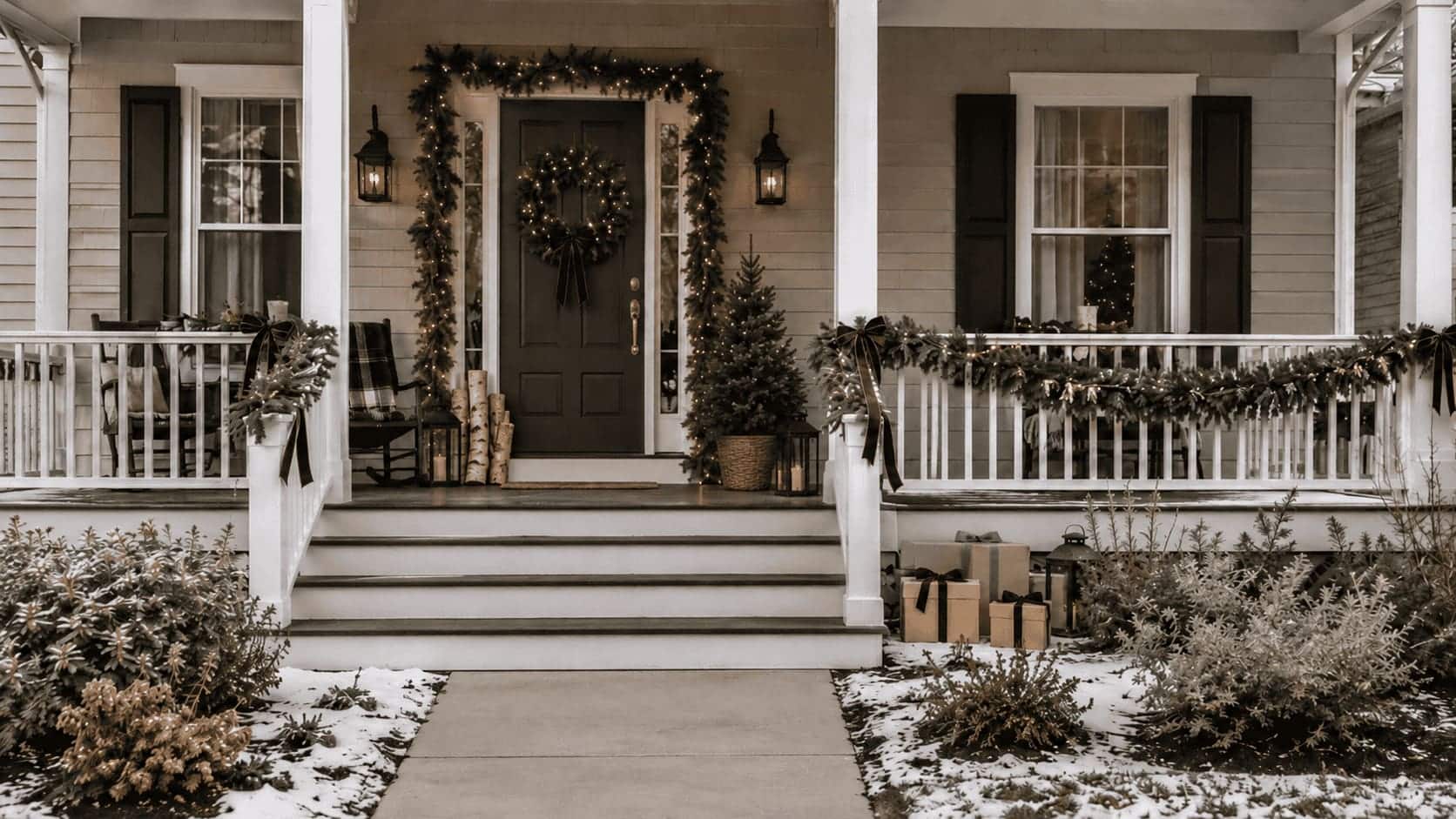
Frame the door with evergreen garland if the porch is covered, then add a 22 to 26-inch wreath and two lanterns at the base. Use velvet ribbon in burgundy, navy, forest green, or deep red.
Add birch logs or wrapped faux gifts only where they will not block the entry. For tiny porches, skip the garland and use one wreath, one planter, and one lantern.
- What you need: Evergreen wreath, garland, 2 lanterns, velvet ribbon, birch logs, warm white lights, and optional faux gifts.
- The non-obvious bit: Garland looks best when it has enough depth around the doorframe, not when it is squeezed flat.
- Cost: $120 to $300.
How to Choose the Right Front Porch Idea for Your Home
The right front porch decorating idea depends less on trends than on size, weather, privacy, household routines, and how often the entry is used. Four questions get you to the right setup faster than browsing photos.
- Use porch depth first. If the porch is under 5 ft deep, avoid chairs and benches. Focus on a mat, a slim planter, a wreath, a light, or vertical decor.
- Match the idea to your real life. Choose privacy if the porch faces neighbors, storage if packages pile up, and greenery if the entry feels hard or bare.
- Respect weather exposure. Covered porches can handle cushions, baskets, and layered rugs. Exposed porches need weatherproof planters, sturdy mats, and fewer soft pieces.
- Pick one main mood. A porch can be cottage, classic, tropical, moody, rustic, seasonal, or minimal. Too many moods make the outdoor decor feel confused.
Start with the setup you can maintain. A porch designed for real life will always look better than one styled only for photos.
Front Porch Decorating Mistakes That Make the Space Less Useful
A decorated porch still needs to work as an entry, so the prettiest pieces can become problems when placed incorrectly. These are the mistakes that show up most often and are easiest to avoid.
- Choosing furniture that is too deep. Large chairs and benches can block the walkway, especially on narrow porches. Seating needs enough depth to feel natural without cutting the clearance path below 36 inches.
- Blocking the door swing. Planters, lanterns, baskets, and pumpkins should never sit where the door opens or where guests naturally step.
- Using too many tiny decorations. Small signs, mini pots, and scattered objects often look messy from the street. Larger, fewer pieces usually look cleaner.
- Forgetting nighttime lighting. Warm lighting near the door, steps, or seating makes the porch safer and more inviting after sunset.
- Using indoor pieces outside. Indoor rugs, untreated wood, and delicate fabrics fade, warp, or trap moisture quickly on exposed porches.
Frequently Asked Questions About Front Porch Decorating
What is the cheapest way to decorate a front porch?
One clean doormat, one healthy plant, one door wreath, and better lighting cover the entry first and cost less than replacing the seating. Matching finishes, such as black metal or warm wood, also make budget pieces look more intentional.
How do I decorate a small front porch without it looking crowded?
Work one side of the door only. A 10 to 12-inch planter, a coir mat, and an 18-inch wreath are enough for a stoop under 4 ft deep. Every item you add after that should earn its place by replacing something, not sitting beside it.
What plants work best on a covered front porch?
Ferns, boxwood, and topiaries hold up well in covered low-light conditions. For color, impatiens and caladiums work in shaded spots. On sunny exposed porches, rosemary, ornamental grasses, and lavender handle heat and drought better than most flowering annuals.
How often should front porch decor be changed?
Keep permanent pieces such as planters, rugs, lanterns, and seating in place year-round. Swap smaller accents only: wreaths, flowers, ribbons, pillow covers, or pumpkins as the season changes. A full seasonal overhaul is rarely necessary.
What colors work best for front porch decor?
Brick exteriors pair well with cream, olive, black, and warm wood. White siding takes green, navy, terracotta, or charcoal. Gray homes usually look better with contrast such as black, burgundy, cedar, or soft yellow. Pull the secondary color from the front door, not from a seasonal trend.
Can I decorate a front porch without plants?
Yes. Use texture instead: a rug, wreath, lanterns, baskets, cushions, house numbers, or a painted door. If the porch gets poor light, high-quality faux greenery can also work when used sparingly.
What is the best outdoor rug size for a front porch?
For a typical 6 x 10 ft covered porch, a 4 x 6 ft rug works well. For a stoop or entry under 4 ft deep, a 24 x 36-inch coir mat is the safer choice. The rug should sit fully under any seating with at least 6 inches of clearance from the edge to the railing.
Final Decor
The best front porch decorating ideas begin with how the space is used, then build the style around that purpose.
A porch can offer privacy, hold baby gear, help older adults sit safely, grow herbs, welcome packages, or create a quiet reading corner.
Small front porch ideas can still feel complete when the scale is right and the walking path stays clear. I always trust a porch more when every piece has a reason to be there.
My suggestion is to choose the setup that matches your space first, then adjust the colors, plants, and seasonal details around it.