

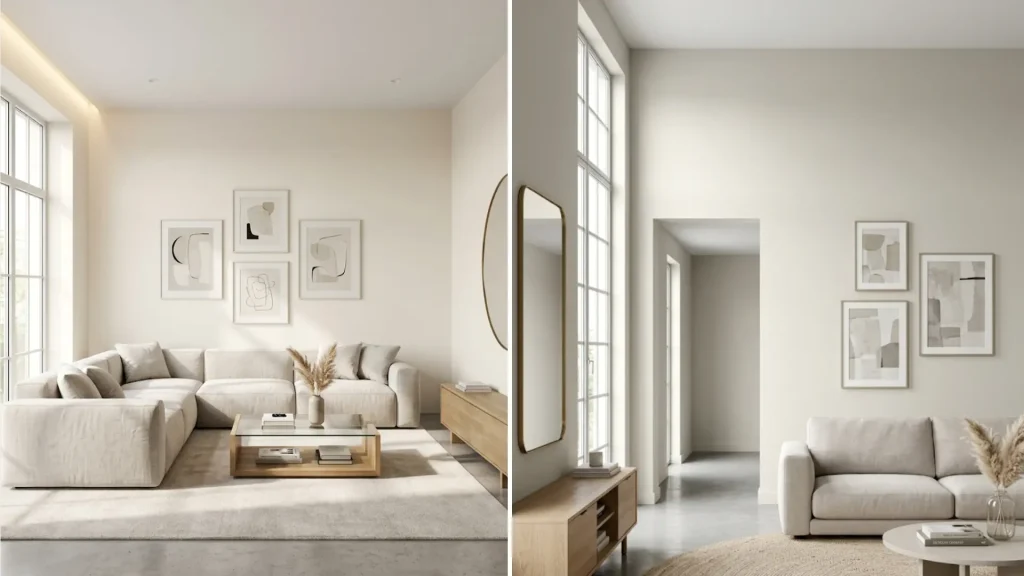


Picking between Greek Villa and Alabaster should feel like a simple decision. It rarely is.
Both are warm Sherwin-Williams whites, both read soft and livable on the chip, and both end up on shortlists for nearly every room where the goal is “not too stark, not too creamy.”
But once they hit the wall, they behave quite differently. Understanding the Greek Villa vs Alabaster distinction comes down to one key detail: their undertones are not the same, even though they look close on paper.
I have watched clients choose Greek Villa expecting a quiet neutral and get a noticeably warm, creamy room instead. I have also seen Alabaster in rooms where it looked perfect, and in rooms where it read muddy next to the trim.
The difference between those outcomes was almost never the paint. It was the light, the floors, and the fixed finishes around it. That is what this article will actually help you sort out.
Greek Villa vs Alabaster: Side by Side
Before getting into how each one behaves in a room, here is a direct comparison of the technical specs. These numbers are the starting point, not the decision.
| Feature | Greek Villa SW 7551 | Alabaster SW 7008 |
| Color family | Warm white | Warm white |
| LRV | 84 | 82 |
| Undertones | Yellow-beige | Yellow-beige with a gray base |
| On-wall character | Bright, creamy, warmer | Softer, more muted, more stable |
| Light stability | Shifts noticeably in warm or evening light | Holds closer to its chip color across conditions |
| Main risk | Reads creamy or yellow-warm under incandescent bulbs | Can look dull or flat beside cool or bright whites |
| Works well on | Walls, trim, cabinets, exteriors | Walls, trim, cabinets, ceilings, whole-house use |
The two-point LRV gap matters less than the undertone difference. Benjamin Moore Greek Villa runs warmer and shifts more. Alabaster is steadier. That distinction drives almost every room-use recommendation below.
The Undertone Difference That Actually Matters

This is the part most articles get wrong by calling both colors “warm white with beige undertones” and leaving it there. They are not the same.
Greek Villa has yellow-beige undertones. That warmth is visible, and it intensifies as light changes. In a south-facing room in the afternoon, or under warm incandescent bulbs in the evening, Greek Villa can look noticeably creamy. If you were hoping for something that reads closer to white, that shift can feel like a surprise.
Alabaster also has yellow-beige warmth, but there is a gray component in its base. That gray is its stabilizer. It keeps Alabaster from drifting too far into cream territory, which is why it holds its character across a wider range of light conditions.
In a bright room, it still reads as white. In a dim room, it warms up without turning yellow. That behavior is why so many designers reach for Alabaster as a whole-house neutral: it is predictable in a way that Greek Villa is not. The Alabaster full color goes deeper into how that gray base performs across real rooms.
The practical difference is this. Greek Villa gives you more visible warmth. Alabaster gives you warmth that stays controlled. Which one you want depends entirely on what your room already has going on around it.
How Each Color Responds to Light
Lighting is not just a variable. For these two whites, it is the deciding factor. Test both in your room before committing to either one.
| Light Condition | Greek Villa | Alabaster | Better Pick |
|---|---|---|---|
| North-facing rooms | Holds brightness well in cool, indirect light | Can read slightly muted or soft | Greek Villa |
| South-facing rooms | May look creamy or yellow-warm by afternoon | Stays balanced, does not shift much | Alabaster |
| East-facing rooms | Bright and warm in morning light, cooler by afternoon | Calm and soft throughout the day | Greek Villa for brightness, Alabaster for softness |
| West-facing rooms | Turns creamier as afternoon sun hits it | May lean warmer or beige in late light | Test both carefully |
| Warm incandescent bulbs | Pushes into noticeable cream territory at night | Warms up but stays controlled | Alabaster |
| Cool LED or daylight bulbs | Reads cleaner, more white | Holds its soft character without going gray | Both can work |
Never judge either color from a single wall or a single time of day. Paint a large sample board, prop it upright against the wall, and check it in morning light, afternoon light, and with your actual room lamps on.
The cool white vs daylight bulb how bulb color temperature interacts with warm whites like these two.
Which One Is Brighter and Which One Is Warmer?
Greek Villa is brighter. Its LRV of 84 means it reflects more light, which helps darker rooms feel more open. If the room needs lift, Greek Villa is the more direct tool for that job.
Alabaster is warmer in a different sense. Its warmth is quieter, more settled. It does not push the room toward cream the way Greek Villa can. That is actually why many people describe Alabaster as feeling “cozy” rather than “warm.” The gray component in its base keeps the warmth from dominating.
So the simple version is: choose Greek Villa when the room needs brightness, and choose Alabaster when the room needs softness without visual shift. If you want a white that is lighter and more energetic, Greek Villa. If you want a white that behaves the same in every corner of the house from 7am to 9pm, Alabaster.
How Fixed Finishes Change Both Colors
The biggest mistake I see is choosing a white paint without looking at what stays in the room. Floors, tile, counters, and trim are not neutral. They pull undertones out of the wall color, sometimes dramatically.
- Warm wood floors tend to support both colors. Greek Villa reads richer alongside pale or natural oak. Alabaster pairs well with medium and darker-stained wood because its gray component keeps it from fighting the floor. The wall color and wood floor exactly how warm whites interact with different stain tones.
- Gray or cool floors create contrast against either color’s warm undertones. That contrast makes both look creamier than they do in isolation. If your floors are cool-toned and you want a white that does not read beige, test Alabaster first. Its gray base gives it more resilience against cool surroundings.
- Cool marble with blue or white movement will pull the warmth out of both colors and make their undertones visible. Test samples directly against the stone before choosing.
- Warm bulbs at night are the most common source of surprise. A room that looked clean and balanced at noon can look like a different color by 8pm under incandescent light. This is especially true for Greek Villa. If your room has warm bulbs and warm floors together, Alabaster is the safer pick.
Greek Villa vs Alabaster by Room
Greek Villa and Alabaster can both work throughout the home, but each one performs better in certain spaces. The right choice depends on light, finishes, and the mood you want.
1. Living Room
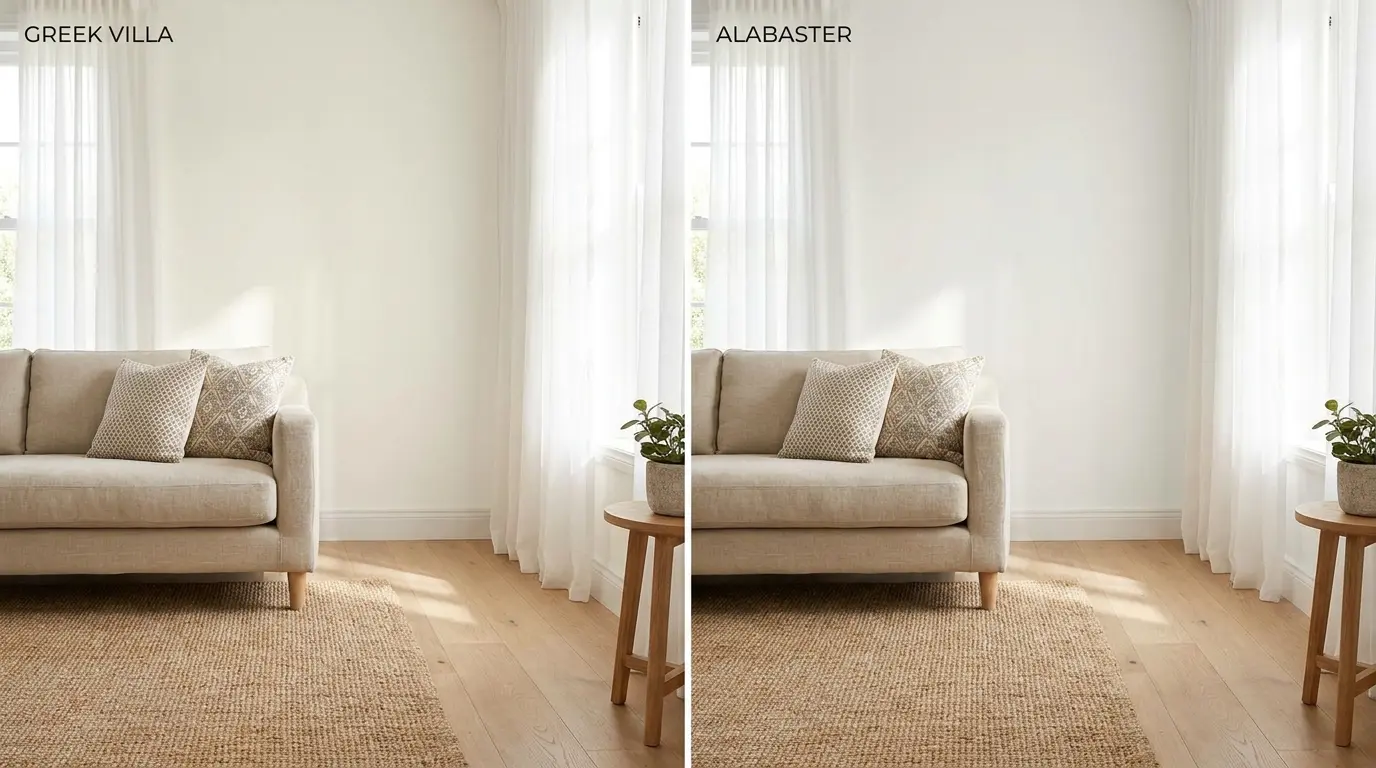
Greek Villa works well in living rooms that feel heavy, shaded, or north-facing. The extra brightness lifts the room without pushing it toward a stark or cold white. It pairs well with natural linen, pale wood, and black or iron accents.
Alabaster is the better choice when the living room already has good light and you want the walls to sit quietly behind furniture, rugs, and artwork. It will not compete. Rooms with warm wood floors, layered textiles, and earthy neutrals consistently look settled with Alabaster on the walls.
2. Kitchen
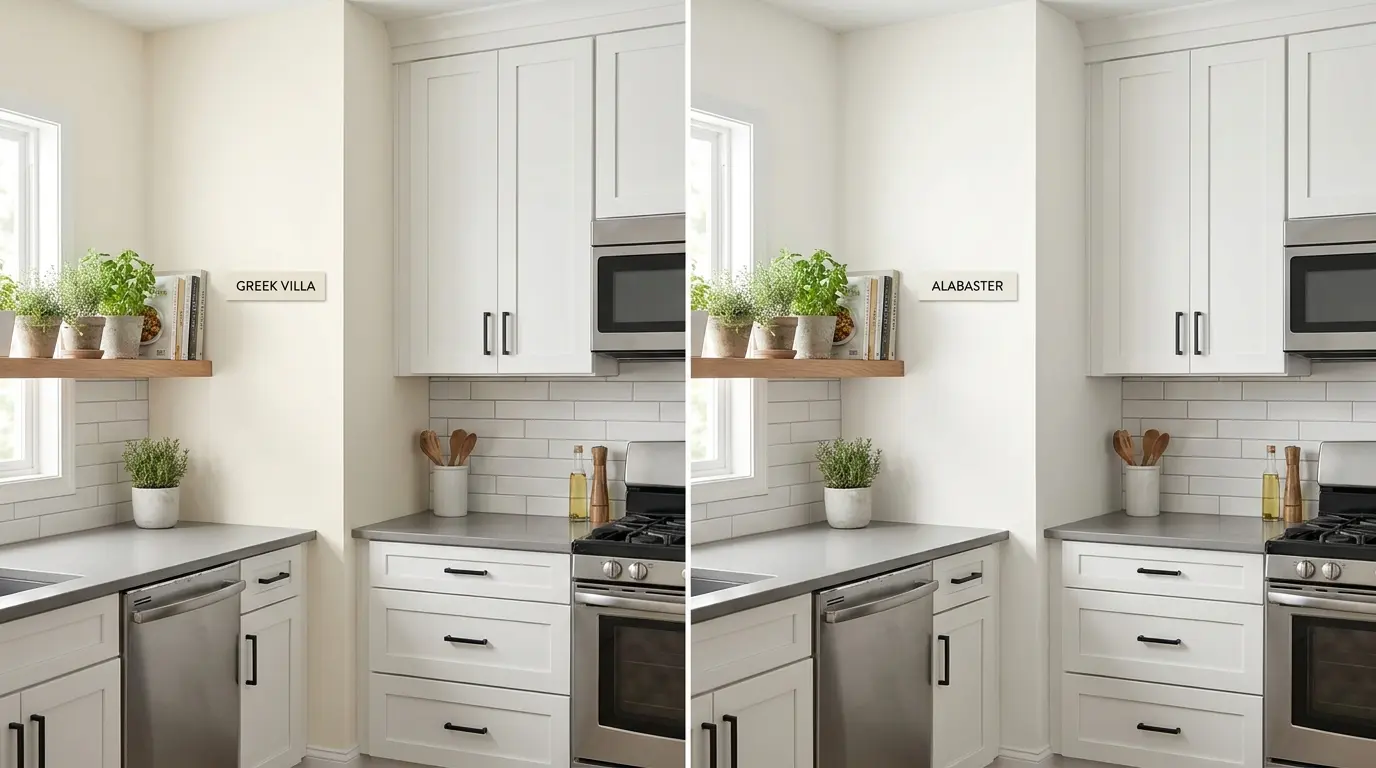
Kitchens are high-contrast environments. Cabinets, counters, backsplash, and hardware all sit close together, which means undertones become visible faster here than in any other room.
Greek Villa works well in kitchens with wood shelving, black or matte hardware, and natural stone counters. It reads clean and bright without going sterile. Alabaster is better when the kitchen has cream-colored tile, brass hardware, warm countertops, or traditional shaker cabinets. Its softer warmth keeps the room from feeling too bright or clinical.
3. Bedroom
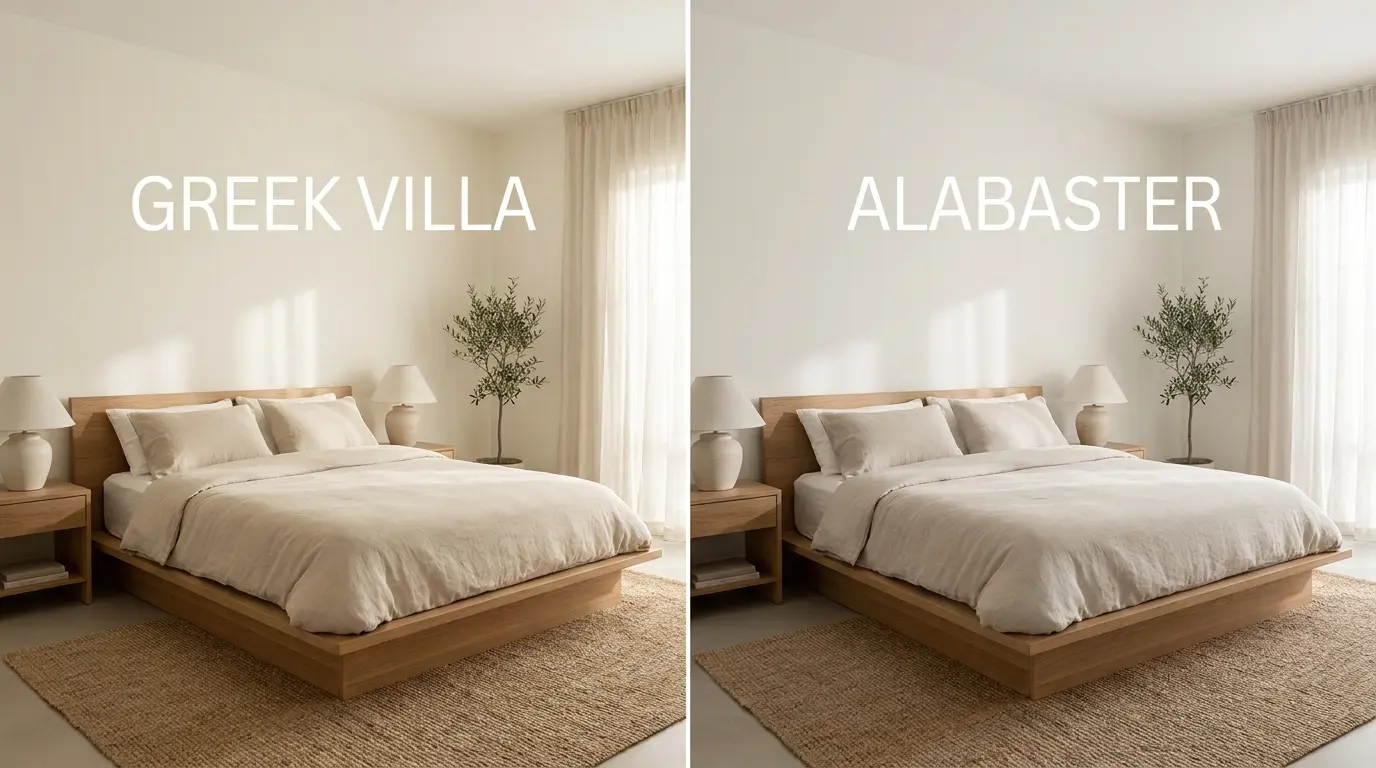
Bedrooms need to work in morning light and under evening lamps. That dual requirement is where Alabaster often outperforms Greek Villa. Its more stable undertone means it reads soft and livable at night without looking like a different color than it did in the morning.
Greek Villa is still a good bedroom choice in low-light rooms, particularly small or shaded spaces that need more brightness. But in a bedroom with warm bulbs and warm bedding, it can feel unexpectedly creamy by evening. If comfort and stability are the goal, Alabaster is the more reliable pick.
4. Bathroom
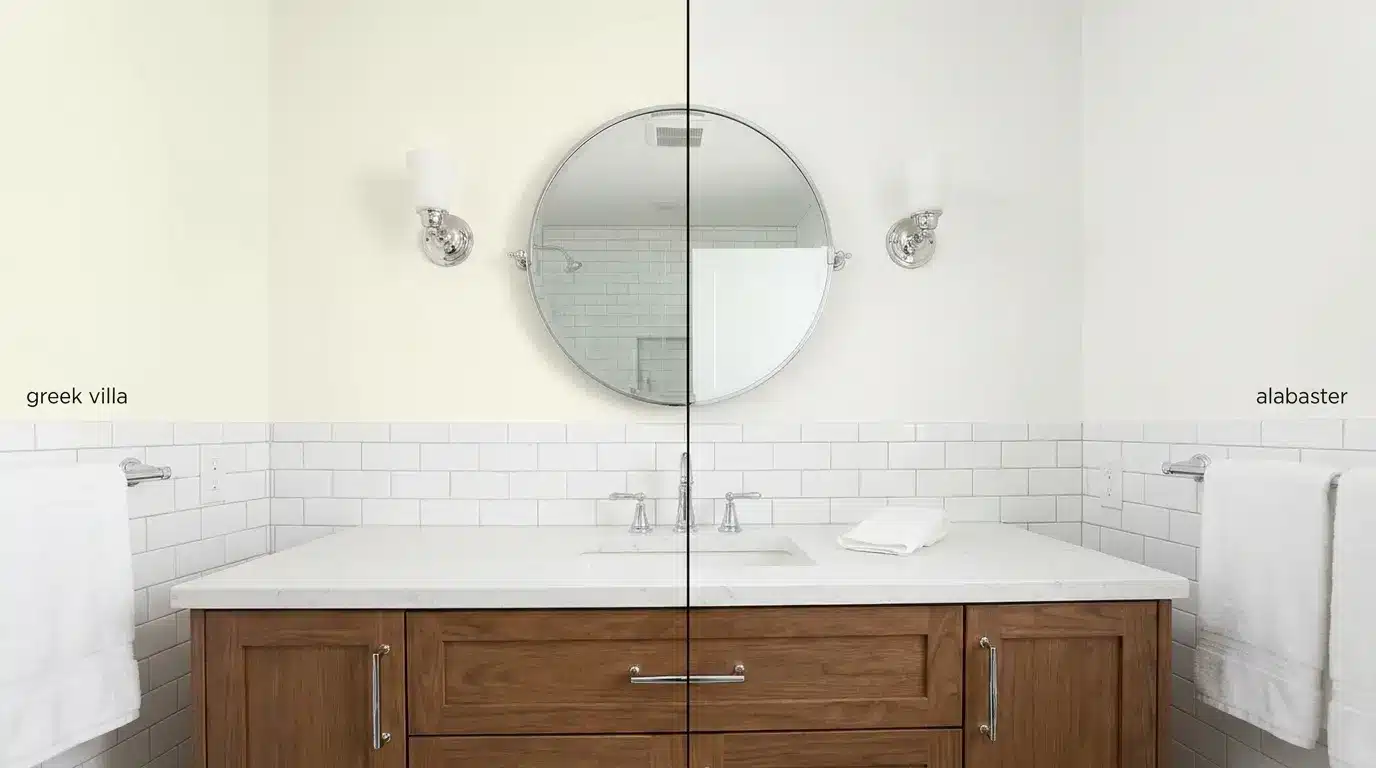
Bathrooms amplify undertones faster than almost any other room because tile, mirrors, and vanity finishes all react to the wall color. Greek Villa performs well with warm tile, wood vanities, and lighter stone where a brighter, cleaner white is needed.
Alabaster holds better beside cream or beige tile, warm stone, and natural wood accents. Both need to be tested against cool marble before committing. The gray movement in white marble can make either white read distinctly beige or cream depending on the stone’s exact undertone.
5. Trim and Doors
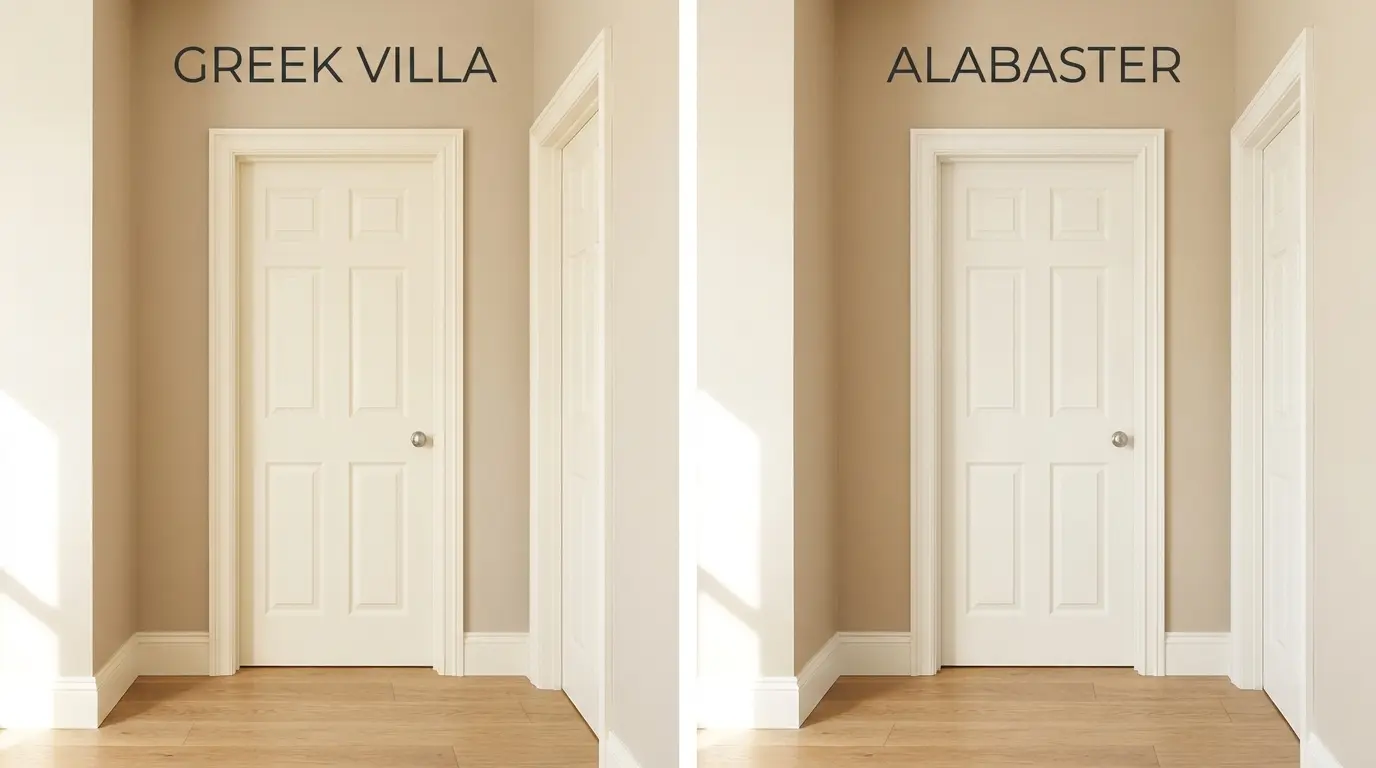
Using either color on trim and walls together (in different sheens) can work well. Greek Villa creates a warm-white edge that reads clean beside beige, greige, and soft taupe wall colors. Alabaster on trim gives a creamier, gentler border and blends naturally with warm wall colors and wood floors.
One thing to check before choosing: if your trim will be next to a brighter white on ceilings or adjacent rooms, Alabaster can sometimes look flat or slightly yellow by comparison. Test the trim color beside whatever white is on the ceiling before committing.
6. Exterior
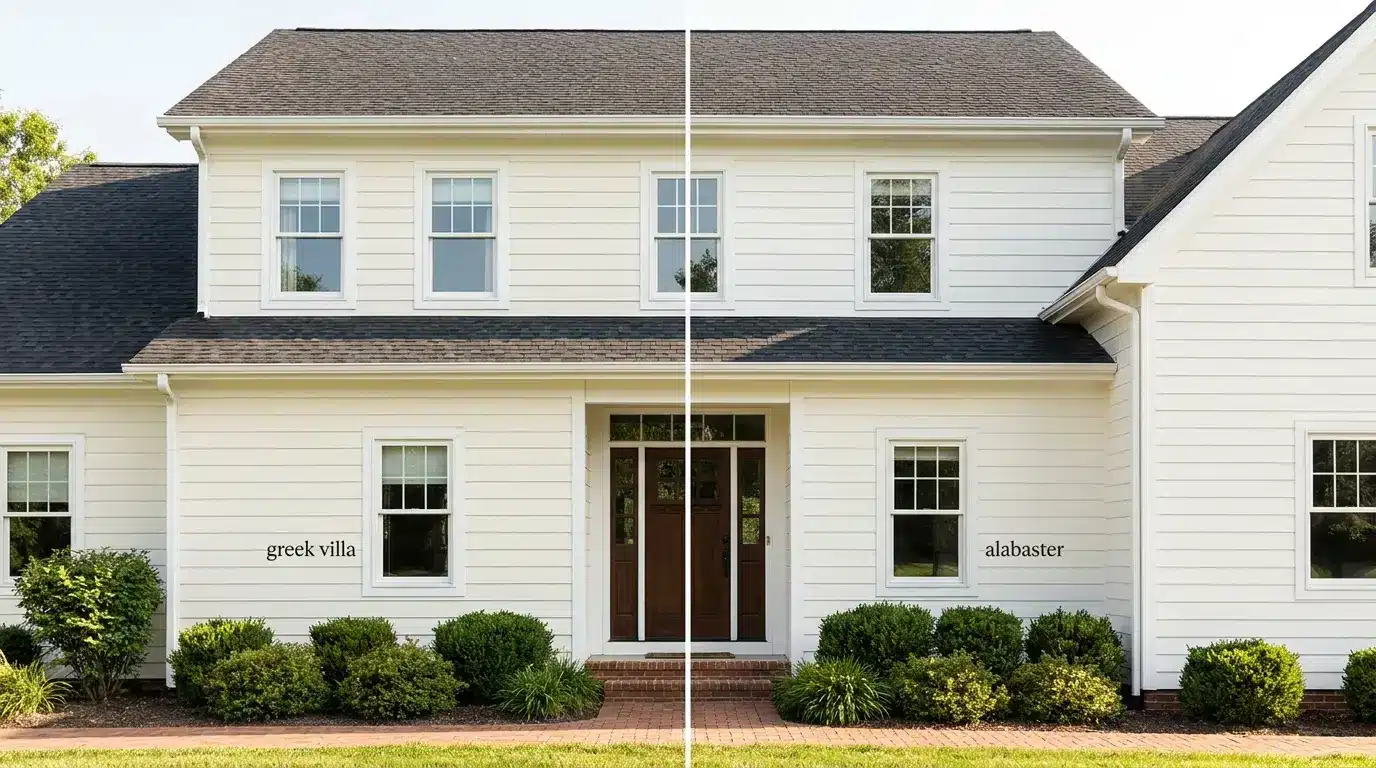
Exterior daylight is stronger and more variable than interior light. Both colors will look lighter on an exterior than they do inside, and undertones will be more visible on a large facade.
Greek Villa on an exterior reads as a warm, lightly creamy white. It pairs well with black window frames, tan or warm stone, brick, and wood accents.
Alabaster gives a softer, slightly more muted exterior white that suits homes with warm roofing, traditional trim, or cream-toned stonework. If you are working with cool siding colors or a very bright white roofline, test Alabaster carefully before using it as the main body color.
Coordinating Colors for Greek Villa

Greek Villa’s yellow-beige warmth pairs best with colors that support rather than fight that warmth. These are coordinates that consistently work well in real rooms:
- Accessible Beige SW 7036 for an adjacent room or lower wall where more color depth is needed
- Natural Linen SW 9109 for a warm transition between rooms without adding saturation
- Black Magic SW 6991 for trim, doors, or accents where strong contrast is needed
- Antique White SW 6119 for ceiling use when the walls are Greek Villa and you want the warmest possible whole-room feel
Avoid pairing Greek Villa with very cool or gray-based whites on trim and ceilings. The contrast will make the wall color read yellower than it actually is.
Coordinating Colors for Alabaster

Alabaster’s gray-stabilized warmth makes it one of the most flexible whole-house whites available. It coordinates well with a wide range of neutrals. The Alabaster coordinating colors the full palette with room-by-room examples.
- Agreeable Gray SW 7029 for adjacent spaces or lower walls, the most common Alabaster pairing
- Repose Gray SW 7015 for a slightly cooler adjacent gray that still works with Alabaster’s undertone
- Intellectual Gray SW 7045 for accent walls or furniture in rooms where Alabaster is the primary wall color
- Eider White SW 7014 for a slightly cooler ceiling option when Alabaster is on the walls
Alabaster also works well beside its close relatives. Among the cooler warm whites, Shoji White vs Alabaster how a grayer warm white sits beside it in real rooms.
When NOT to Use Greek Villa
Greek Villa is not the right choice in every “warm white” situation. Skip it when:
- The room has warm floors, warm bulbs, and warm wood furniture together. All that warmth will pull Greek Villa toward a yellow-cream that feels dated rather than cozy.
- You are painting beside a stark or cool white on ceilings. The contrast will make Greek Villa look yellower than it should.
- The room is south-facing with strong afternoon sun. Greek Villa will feel noticeably creamy in that light, which can make the room feel smaller and warmer than intended.
- The design direction is modern or minimal. Greek Villa’s visible warmth reads more traditional or Mediterranean. It works against clean-lined, cool-neutral interiors.
When NOT to Use Alabaster
Alabaster is close to a universal neutral, but there are conditions where it underperforms:
- The room has very cool floors (gray tile, blue-gray stone) and cool-toned furniture. Alabaster’s warmth will look muddy against that coolness rather than warm and intentional.
- You need true brightness. A shaded room with poor natural light needs more lift than Alabaster provides. Greek Villa or an even higher-LRV white would serve better.
- The trim and adjacent rooms use a bright or pure white. Alabaster will read as beige or cream beside those whites rather than as a warm white in its own right.
Greek Villa vs Dover White and Dover White
Dover White SW 6385 is the third option that comes up most often alongside these two. Here is how all three compare:
| Point | Greek Villa SW 7551 | Alabaster SW 7008 | Dover White SW 6385 |
|---|---|---|---|
| Overall look | Bright warm white, slightly creamy | Soft warm white, stable across light | Creamy white with a clear yellow lean |
| Undertones | Yellow-beige | Yellow-beige with gray base | Yellow, more saturated |
| Light behavior | Shifts noticeably in warm light | Holds steady across most conditions | Turns distinctly yellow in warm light |
| Best for | Rooms needing brightness and lift | Whole-house use, cozy rooms, cabinets | Rooms with golden wood and traditional decor |
| Main risk | Looks creamy in warm or bright light | Looks flat beside cool or bright whites | Looks yellow beside cool finishes |
Dover White is the one to choose when you genuinely want a creamier white and the room supports it. Greek Villa and Alabaster are safer if you want warmth without a strong yellow cast.
How to Test Greek Villa and Alabaster the Right Way
These are the questions I hear most from people who already have the chip on the wall and are still not sure. The testing process is the answer to almost all of them.
- Use large boards, not small chips. A chip is too small to show how the color reads across four walls with your light hitting it at an angle.
- Stand them upright. A sample lying flat on a table catches light differently than a vertical wall. Always prop the board upright.
- Check at three times of day. Morning, afternoon, and evening with your room lamps on. For Greek Villa especially, the evening check is the one that surprises people.
- Move the board to different walls. The north wall of a room and the south wall can read as different colors with the same paint. Check both.
- Test the sheen you plan to use. Matte and eggshell absorb light. Satin reflects it. The same color in two sheens can feel different in the same room.
| Pro Tip: If you are torn between the two after testing, look at your trim. If your trim is a brighter or cooler white, Alabaster may look beige beside it. Greek Villa will hold up better in that situation. If your trim is warm or cream-toned, either color works. |
Frequently Asked Questions
Does Greek Villa work better with warm or cool furniture pieces?
Greek Villa usually works better with warm or natural furniture pieces. Think pale oak, rattan, linen, tan leather, beige upholstery, or black accents. Cool gray furniture can still work, but it may make Greek Villa’s creamy side more noticeable. Test it near your largest furniture pieces before painting.
Can Alabaster make a small room feel too closed in?
Alabaster can make a small room feel calm, but it may not always make it feel larger. If the room has weak light or dark flooring, it can feel a little soft instead of open. Use good lighting, lighter fabrics, and simple decor if you want Alabaster to feel less heavy.
What ceiling color works best with Greek Villa walls?
Greek Villa walls usually look best with a ceiling white that is warm, not icy or blue-based. A very bright ceiling white can make Greek Villa look creamier by contrast. For a softer look, use Greek Villa on both walls and ceiling, then change the sheen for trim.
What ceiling color works best with Alabaster walls?
Alabaster walls pair well with a soft white ceiling that does not feel too sharp. A cooler ceiling can make Alabaster look beige or slightly flat. If you want a seamless look, Alabaster can also go on the ceiling, especially in bedrooms, hallways, and calm living spaces.
Is Greek Villa a good choice for open-concept spaces?
Greek Villa can work in open-concept spaces if the flooring, trim, and lighting stay fairly consistent. It may shift more between bright and shaded zones, so large sample boards are important. If one area gets strong warm light, check that it does not turn too creamy there.
Is Alabaster too creamy for a modern home interior?
Alabaster is not too creamy for a modern home if the rest of the design has warm, simple finishes. It works well with wood, black accents, soft grays, and natural textures. It may feel less modern beside bright white trim, cool gray floors, or very sleek blue-toned materials.
Should Greek Villa or Alabaster be used in rental homes?
Alabaster is often the easier rental choice because it feels soft, neutral, and steady across different rooms. Greek Villa can also work if the rental needs brightness, but it may show more warmth under certain bulbs. For rentals, pick the shade that works with the existing floors and trim.
Final Take
Greek Villa and Alabaster may look close at first, but they create different results once they are on your walls. Greek Villa gives you more brightness and lift, so it works well in rooms that feel shaded or small.
Alabaster feels softer and steadier, which makes it a strong choice for cozy rooms, cabinets, and whole-house use.
I would not choose either color from a chip alone because lighting and fixed finishes can change everything.
Test both beside your trim, floors, counters, and lamps before making the final call. If you have used either shade, share what it looked like in your home.