

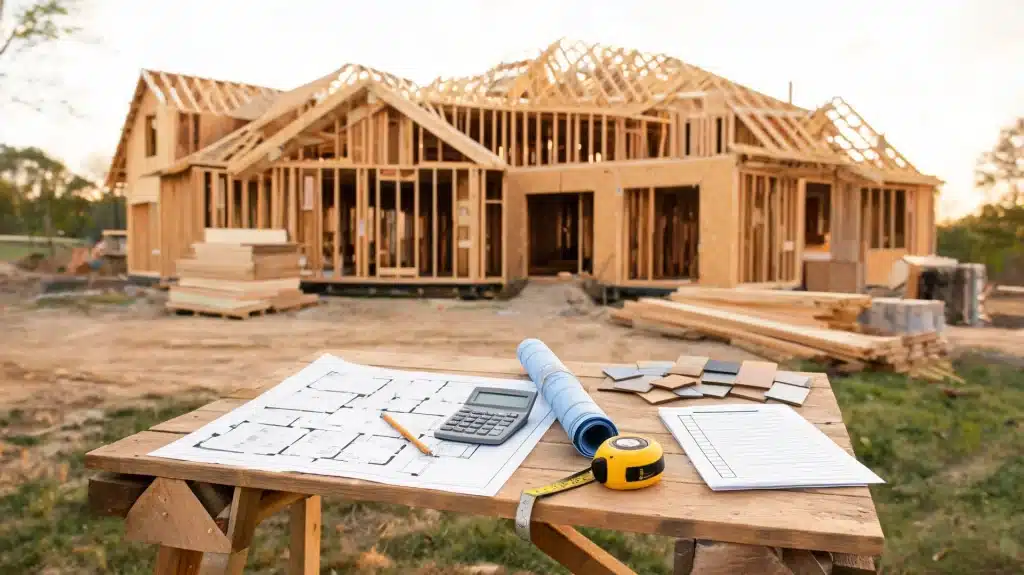


Building a 4 bedroom house in the US typically runs between $280,000 and $600,000 in construction costs, not including land.
That range is wide because a compact 4-bedroom ranch on a flat lot and a custom 4-bedroom home with a basement, wraparound porch, and premium windows are genuinely not the same project, even if the bedroom count is identical.
| Cost Note: Figures in this article are estimates based on national averages from NAHB and US Census Bureau data. Actual costs vary significantly by region, contractor, materials, and project scope. Always get at least three local quotes before committing to any build above $1,000. |
Most 4-bedroom homes fall between 1,800 and 3,000 square feet, but size alone doesn’t determine price.
The lot condition, finish level, foundation type, and labor market where you build shape the number just as much as the bedroom count. Here’s what that means in real dollar terms.
| Build Type | Typical Size | Estimated Construction Cost | What It Usually Means |
| Basic build | 1,800–2,200 sq ft | $270,000–$400,000 | Stock plan, simple shape, standard finishes |
| Mid-range build | 2,200–2,800 sq ft | $380,000–$560,000 | Common family layout, mid-grade finishes |
| Custom build | 2,800+ sq ft | $500,000–$900,000+ | Custom plans, premium finishes, complex site |
| High-end build | 3,000+ sq ft | $700,000–$1,500,000+ | Full custom design, luxury finishes, high-cost market |
These are construction-only estimates. Land, site prep, permits, utility connections, and landscaping come on top of whatever the builder quotes you.
What the National Data Says About 4 Bedroom Build Costs
The Census Bureau reported that the median size of a new single-family home sold in 2024 was 2,210 square feet, with a median sales price of $420,300. That sales price includes land, lot prep, and builder margin. It is not a construction-only figure.
NAHB’s 2024 Cost of Construction Survey put the average construction cost at $428,215 for a 2,647-square-foot home, with construction making up 64.4% of the average sales price.
For a 4-bedroom home in the mid-range (roughly 2,400 square feet with standard finishes), that data puts you broadly in the $380,000 to $480,000 construction range before land or site work.
Neither number is a quote. Both are useful anchors before you start talking to builders.
Why the Cost Range on a 4 Bedroom House is So Wide
The biggest swing factors are location, lot condition, foundation type, finish level, and builder model. None of them are small variables.
Location and labor market. Construction costs ranged from $154 per square foot in Mississippi to $230 per square foot in Hawaii in 2024, a 49% gap driven entirely by labor rates, material delivery costs, and local code requirements. The same floor plan priced in the Midwest and re-priced on the West Coast can differ by 40% to 60%. To understand what drives that variation, the construction cost per square foot breaks down the state-by-state factors in detail.
Lot condition and site prep. A flat lot with good soil and nearby utilities costs far less to build on than a wooded slope with clay soil and a long utility run. On a difficult lot, site prep alone (clearing, grading, drainage, driveway base) can add $20,000 to $80,000 before a single board is framed.
Foundation type. A slab costs less than a crawl space, and a crawl space costs less than a full basement. That choice alone can shift the budget by $30,000 to $100,000. Soil type, frost depth, and drainage usually determine which foundation is correct for your lot, not personal preference. If you’re still deciding, house foundation types cover the full cost comparison across all 13 options.
Finish level. Cabinets, countertops, flooring, plumbing fixtures, and lighting are where most budgets shift from planned to over budget. The same structural shell with builder-grade finishes versus semi-custom finishes can differ by $60,000 to $100,000 on a 2,400-square-foot home.
Builder model. Production builders repeat plans, systems, and materials. That repetition lowers per-square-foot cost. A fully custom builder designs for your specific lot and program, which adds both design time and construction complexity.
Full Cost Breakdown: What Every Line Item Actually Covers
A 4-bedroom home budget is a chain. Land condition sets site prep costs. Site prep determines the foundation. The foundation and layout shape framing. Framing affects how systems route.
And finish choices decide how expensive the final stage becomes. Here’s how that chain breaks down by category for a mid-range 2,400-square-foot build.
| Line Item | Low End | High End | What Drives the Variation |
| Land (if purchasing) | Varies | Varies | Location, acreage, zoning |
| Site prep | $10,000 | $80,000+ | Slope, soil, trees, utility distance |
| Design and permits | $5,000 | $40,000 | Stock vs. custom plans, municipality fees |
| Foundation | $15,000 | $100,000+ | Slab vs. crawl space vs. full basement |
| Framing | $40,000 | $95,000 | Plan complexity, roofline, wall height |
| Exterior shell | $50,000 | $100,000+ | Siding material, window count, roofing type |
| Plumbing, electrical, HVAC | $60,000 | $100,000+ | Bathroom count, climate zone, home size |
| Interior finishes | $75,000 | $180,000+ | Cabinet line, countertop material, flooring type |
| Appliances and fixtures | $15,000 | $60,000 | Appliance tier, fixture brands |
| Builder overhead and profit | 10% | 20% of the construction total | Builder type, market demand |
| Contingency | 10% | 15% of project total | Surprises, change orders, delays |
These ranges cover a mid-range build at standard finish levels. Custom finishes, difficult sites, high-cost markets, or premium systems push each category toward and past its upper end.
1. Land and Site Prep
Land purchase and closing costs are almost never included in a builder’s quote. Site prep (clearing, grading, excavation, and driveway base) is also usually quoted separately.
A builder’s base price typically starts after the lot is already ready to build on. On a challenging lot, everything before framing can add $40,000 to $80,000 to a project that looked straightforward on paper.
2. Design, Permits, and Fees
Stock plans cost $500 to $5,000. Custom architecture runs $3,000 to $30,000 or more, depending on complexity and the architect’s fee structure.
Permit and impact fees vary enormously by municipality: $2,000 in a rural county can become $15,000 to $30,000 in a higher-density jurisdiction. Budget this line item early, before you fall in love with a lot.
3. Foundation
Slab foundations are the lowest-cost option, typically $15,000 to $30,000 for a 2,400-square-foot home.
A crawl space adds access and moisture management complexity, usually $25,000 to $50,000.
A full basement can add $50,000 to $100,000 or more to the base cost, depending on size, soil conditions, and whether it’s finished.
Frost depth requirements in cold climates can also raise foundation costs independent of type.
4. Framing and Exterior Shell
Lumber, trusses, sheathing, roofing, siding, windows, and exterior doors make up this stage.
Simple rectangular plans with clean rooflines cost less to frame than complex shapes with dormers, multiple gable ends, or tall walls.
According to NAHB’s 2024 data, framing and exterior finishes together represent around 30% of average construction costs.
Brick house construction runs higher than vinyl or fiber cement siding, sometimes by $20,000 to $40,000 on a 4-bedroom footprint.
5. Plumbing, Electrical, and HVAC
More bathrooms mean more pipe runs, more vent stacks, and more fixture connections.
A 4-bedroom home with three full bathrooms runs meaningfully more in rough-in plumbing than the same footprint with two. Climate zone also determines HVAC equipment sizing.
A home in Minnesota needs substantially more heating capacity than one in Georgia.
NAHB’s 2024 survey found that system rough-ins accounted for nearly one-fifth of average construction costs, over $82,000 per home.
Understanding what’s included in rough-in plumbing helps you compare contractor quotes accurately and catch line items that get billed separately.
6. Interior Finishes
Interior finishes accounted for the largest single share of construction costs in NAHB’s 2024 survey: 24.1%.
This is where the most discretionary money goes. Cabinets, countertops, flooring, trim, paint, lighting, and hardware all sit here.
Three full bathrooms and an upgraded kitchen in a 4-bedroom home can carry $80,000 to $150,000 in those rooms alone.
Cabinet choice and countertop material are the two decisions that most commonly cause builder allowances to run short. Always review your allowance figures before signing.
7. Builder Overhead, Profit, and Contingency
Builder margin typically runs 10% to 20% of the construction cost. Beyond that, hold a 10% to 15% contingency in reserve.
Site surprises, material delays, code-required changes, and mid-build decisions all pull from this cushion.
Projects that skip the contingency line don’t avoid surprises. They just fund them with stress and rushed decisions.
How to Estimate Your Build: The Square Footage Formula
Once you know your local cost per square foot, the formula is direct: multiply your planned square footage by that rate, then stack on every cost your builder’s quote won’t include.
| Base formula: Square footage × local cost per square foot = construction estimate. Then add: land, site prep, driveway, utility connections, design fees, permits, builder overhead, upgrades above allowances, and a 10–15% contingency. |
The two most common mistakes: using a national per-square-foot average instead of a local one, and treating the builder’s quote as the total project cost.
The builder’s quote is the structure. The project cost is everything else on top of it.
| Home Size | What’s on Top of Construction | Total Project Budget Direction |
| 1,800 sq ft | Land, site, permits, utilities, finishes | Lower end, simple plan, easy lot |
| 2,400 sq ft | Same categories, more of each | Mid-range, standard finishes |
| 2,800 sq ft | Same categories, higher quantity | Higher range, more rooms, and systems |
Two to three local builder bids, with the full scope listed, will always produce a more useful number than any national average. The per-square-foot figure is a starting point for conversations, not a final budget.
Where 4 Bedroom Build Budgets Go Wrong
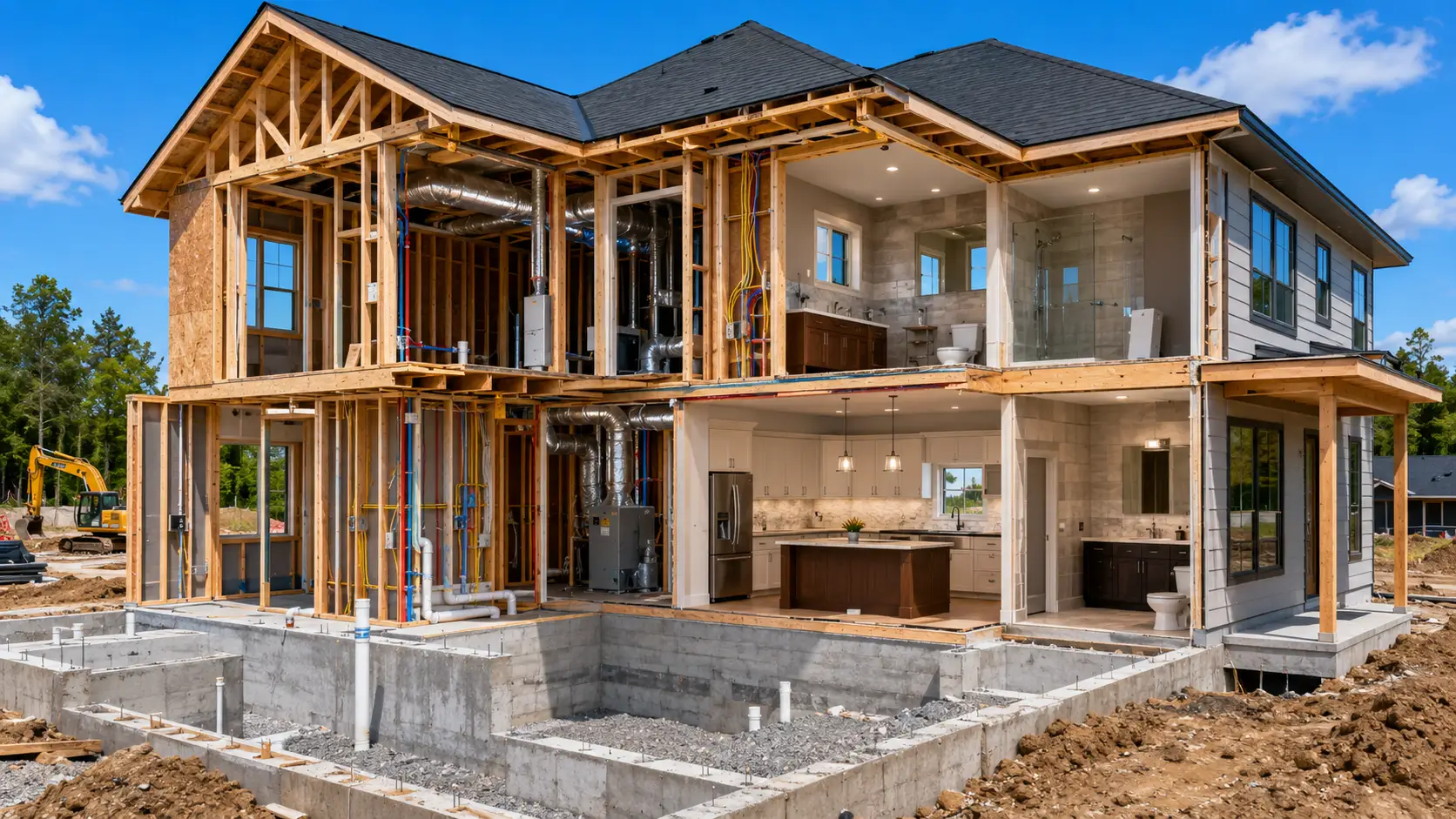
This is the section most people skip when reading about construction costs, and it’s the one that matters most to your actual budget. These aren’t rare edge cases. They’re patterns that come up on builds of every size.
Site work surprises. Sloped lots, clay soil, tree clearing, and long utility runs regularly add $15,000 to $60,000 to the project. Almost none of it shows up in the initial builder quote, because the builder hasn’t done a full site survey yet. Ask for a site prep estimate as a separate line item before signing anything.
Finishes running over allowances. Builder allowances for cabinets, countertops, and flooring are frequently set below what a buyer actually selects. The shortfall gets billed as a change order after the contract is signed. A $5,000 cabinet allowance on a kitchen that actually costs $18,000 is a $13,000 surprise you can avoid by verifying that allowances match your real finish preferences.
Confusing the builder’s quote with the total project cost. Land, utility hookups, landscaping, driveway paving, window treatments, and move-in costs are not in most contractor bids. A $420,000 builder quote for a 4-bedroom house is not a $420,000 project. The average cost to build a house guide walks through how to layer a complete project budget beyond the builder’s base price.
Change orders after framing starts. Every plan modification after the frame is up adds labor and material costs and pushes the schedule. Decisions made after framing cost three to five times more than the same decisions made before breaking ground. Lock in finish choices, room layouts, and structural details before construction begins.
Location gaps larger than expected. A Texas builder commented directly on NAHB’s Eye on Housing data in 2025: “no one in Texas is building true custom homes for $138 per square foot.” National averages mask real regional and project-type gaps. What a production builder in Mississippi charges per square foot is not what a custom builder in Texas or New York charges.
What’s Negotiable and What Isn’t
Knowing which line items have flexibility (and which don’t) helps you make smarter decisions before and during the build.
Not negotiable (or very hard to change after you’ve started): foundation type once the lot is assessed, structural framing once engineered plans are drawn, permit fees and impact fees set by the municipality, and soil or site conditions that require specific engineering solutions.
Where you have real control: finish tier (cabinets, countertops, flooring, fixtures), plan complexity (a simpler roofline and rectangular footprint genuinely cost less), square footage (building only what you need is the most reliable cost reducer), and timing (some markets are more competitive in certain seasons).
Where to push back on bids: builder overhead margin (10–15% is standard; 20%+ is worth questioning on a large contract), allowance levels (always verify they reflect your actual finish preferences), and landscaping scope (this is frequently overbid and easy to phase).
What to Ask Your Contractor Before Signing
These five questions catch most of the common problems before they become expensive ones:
- What exactly does your base quote include, and what is explicitly excluded? Get the scope in writing before comparing bids.
- What are all of my allowances, and what happens when I go over them? Ask for the change order process in writing.
- Have you reviewed the site survey results? Are there any conditions that could affect cost? Don’t sign until the lot has been assessed.
- What does the payment draw schedule look like, and what triggers each draw? Understand when money leaves your account and why.
- What is the contingency process if we hit something unexpected during construction? Know how decisions and approvals work mid-build.
Planning a 4-bedroom build from scratch involves more decisions than most people expect before breaking ground. Building a house on your own land walks through the full pre-construction sequence from site verification to permit approval.
Smart Ways to Reduce the Cost of Building a 4 Bedroom House
The most reliable savings come from plan simplicity, early decisions, and finish control, not from negotiating on line items you don’t fully understand yet.
- Use a stock or semi-custom plan. Reduces design fees and avoids costly layout revisions before the project starts.
- Keep the shape simple. Rectangular footprints, fewer corners, and clean rooflines cost less to frame. A complex roofline with multiple gable ends can add $15,000 to $30,000 to framing costs alone.
- Lock in finish choices before construction starts. Decisions made after framing cost more, take longer, and create scheduling conflicts. Every unresolved selection on day one is a potential change order by week eight.
- Spend on what you can’t change easily later. Structure, foundation, windows, HVAC equipment, insulation, and air sealing quality matter more long-term than countertop material or cabinet hardware.
- Use standard sizes. Standard windows, doors, cabinets, and fixtures are faster to source and install. Custom sizing adds lead time and labor.
- Build only the square footage you’ll use. Extra bonus rooms, oversized garages, and spaces without a clear purpose raise both construction cost and long-term operating costs.
- Review every allowance line before signing. A low allowance for cabinets or flooring doesn’t make the bid cheaper. It moves the cost to a change order you’ll pay later.
- Keep the lot as simple as possible. Wooded lots, steep grades, and distant utilities add cost before framing starts. If you have a choice of lots, the easier one usually saves $20,000 to $60,000 before you’ve made a single finish decision.
| Ongoing costs to factor in: A 4-bedroom home carries real monthly costs after move-in: electricity, gas, water, insurance, property taxes, maintenance, and landscaping all scale with home size. Insulation quality, window performance, and air sealing decisions made during construction directly affect energy costs for the life of the home. The payback on a better building envelope is measured in years, not decades. Spending more upfront on those systems typically costs less over ten years than recovering the energy savings you gave up by going with minimum standards. |
For a full picture of how construction time affects your budget, how long it takes to build a house covers each phase and the common delays that add cost to every stage.
Frequently Asked Questions
These are the questions I hear most often from people who’ve looked at a first bid and realized the number doesn’t tell the full story.
How much does it cost to build a 4 bedroom house in the US?
Most 4-bedroom builds run between $280,000 and $600,000 in construction costs, depending on size, location, finish level, and foundation type. That figure does not include land, site prep, or permits. Total project cost, including everything, often runs 25% to 40% higher than the construction-only quote.
What is the average cost to build a 4 bedroom house per square foot?
National averages ran $154 to $230 per square foot in 2024, depending on the state. Adding builder overhead and profit typically puts the effective rate at $175 to $275+ per square foot. High-cost markets like California or the Northeast sit well above that range.
How much would it cost to build a 4 bedroom 2 bath house?
A 4-bedroom, 2-bathroom home in the 1,800 to 2,200 square foot range typically runs $270,000 to $400,000 in construction. Two bathrooms rather than three keep plumbing costs lower. Expect rough-in plumbing to run $25,000 to $45,000 less than a comparable three-bathroom build.
How much does a 4 bedroom house cost to build vs. buy?
In many markets, buying an existing home costs less than building new when you account for the full project cost. Building new gives you control over finishes, layout, and systems, but total cost, including land, site prep, and permits, often exceeds the purchase price of a comparable existing home in the same area.
What part of a 4 bedroom build costs the most?
Interior finishes consistently account for the largest single cost category: 24.1% of average construction costs, according to NAHB’s 2024 survey. Kitchens and bathrooms concentrate the most expensive work in the smallest footprints. Major systems (plumbing, electrical, HVAC) typically account for nearly one-fifth of the construction cost.
How much does a brick 4 bedroom house cost to build?
Brick construction adds $15,000 to $40,000 over vinyl or fiber cement siding on a typical 4-bedroom footprint, depending on the percentage of brick coverage and local labor rates. Full-brick construction costs more than brick veneer. In some southern markets with strong brick traditions, the labor premium is smaller than in areas where brick is less common.
Does the number of stories affect the cost to build a 4 bedroom house?
A two-story home typically costs less per square foot to build than a single-story of the same square footage because it has a smaller foundation and roof footprint. However, it adds structural complexity: framing stairs, floor systems between levels, and load path engineering. The savings per square foot usually run $5 to $15 depending on the market.
How much do 4 bedroom house plans cost?
Stock plans range from $500 to $5,000. Semi-custom plans with site-specific modifications run $3,000 to $12,000. Full custom architecture typically costs $15,000 to $50,000 or more for a 4-bedroom home, billed either as a flat fee or a percentage of the project cost (typically 5% to 15%).
Final Words
The cost to build a 4 bedroom house lands between $280,000 and $600,000+ in construction, but the number that matters to your project isn’t the national average.
It’s what a local builder quotes for your specific lot, plan, and finish preferences.
The biggest budget risk on a 4-bedroom build isn’t the foundation or the framing. It’s the gap between the allowances in the builder’s contract and what you actually choose in the showroom.
Verify every allowance line against your actual preferences before you sign, and get at least 3 local bids that include the full scope. That comparison will tell you more than any national figure can.
Cost estimates based on the NAHB Cost of Construction Survey 2024 and the US Census Bureau 2024 national averages. Verify current pricing with local contractors and suppliers before budgeting.