

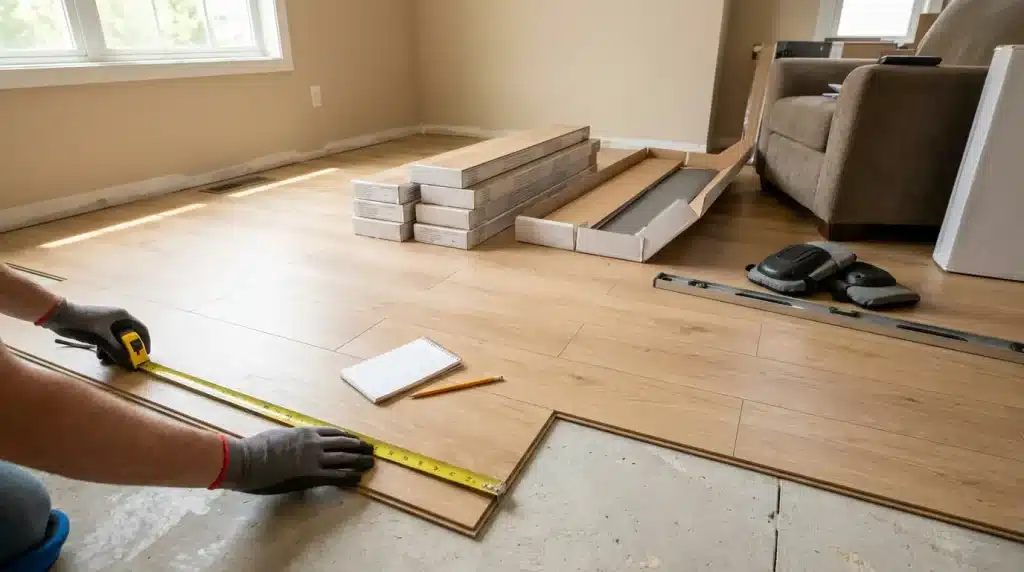


Laminate flooring installation costs between $4 and $14 per square foot installed, which puts a typical 500 sq. ft. room somewhere between $2,000 and $7,000.
That range is real, but it is wide for a reason: laminate flooring labor cost per square foot, subfloor condition, plank quality, and whether you have stairs all pull the number in different directions.
If you go in with just a per-square-foot figure in your head, you will be caught off guard by what the quote actually includes.
This guide breaks down where that money actually goes, what the labor charge covers, which cost lines are negotiable, and how to read a quote before you sign anything.
| Cost Note: Figures in this article are estimates based on national averages. Actual costs vary significantly by region, contractor, materials, and project scope. Always get at least three quotes before committing to any project above $1,000. |
How Much Does It Cost to Install Laminate Flooring?
Most homeowners pay between $4 and $14 per square foot for laminate flooring, all in. That figure covers materials and labor together.
The low end applies to basic planks in a simple, rectangular room with a clean subfloor. The high end reflects premium planks, subfloor repairs, stair installations, and higher labor markets.
Labor alone typically runs $3 to $8 per square foot on top of material costs, which range from $1 to $6 per square foot depending on plank quality and thickness.
| Line Item | Low End | High End | What Drives Variation |
| Laminate planks (materials) | $1 per sq. ft. | $6 per sq. ft. | Thickness, water resistance, attached underlayment |
| Labor and supplies | $3 per sq. ft. | $8 per sq. ft. | Room complexity, region, installer experience |
| Total installed cost | $4 per sq. ft. | $14 per sq. ft. | Materials + labor combined |
| 500 sq. ft. project | $2,000 | $7,000 | Common open-plan room or living area |
| 1,000 sq. ft. project | $4,000 | $14,000 | Multi-room or whole floor install |
The mid-range project covers better planks, a room with a couple of doorways, and normal prep, landing around $7 to $10 per square foot.
A high-cost project involves damaged subfloors, stairs, or premium laminate and pushes toward $11 to $14 per square foot.
Cost to Install Laminate Flooring by Room Size
Your square footage gives you the quickest rough estimate. Multiply your room’s length by its width, add 10% for waste and cuts, then apply the installed cost range.
Formula: length x width = sq. ft., then multiply by your cost range
| Room Type | Square Feet | Low Estimate | Mid Estimate | High Estimate |
| Small bedroom | 100 | $400 | $900 | $1,400 |
| Standard bedroom | 150 | $600 | $1,350 | $2,100 |
| Living room | 300 | $1,200 | $2,700 | $4,200 |
| Large open room | 500 | $2,000 | $4,500 | $7,000 |
| Whole floor | 1,000 | $4,000 | $9,000 | $14,000 |
Room type shifts the number too. Bedrooms tend to land at the lower end because they are simple rectangles with one or two doorways.
Hallways, kitchens, and stairways push toward the higher end because of the cutting complexity involved.
For basement installs, budget for moisture protection as well, since that cost shows up in both materials and prep.
Laminate Flooring Labor Cost Per Square Foot: What the Charge Covers
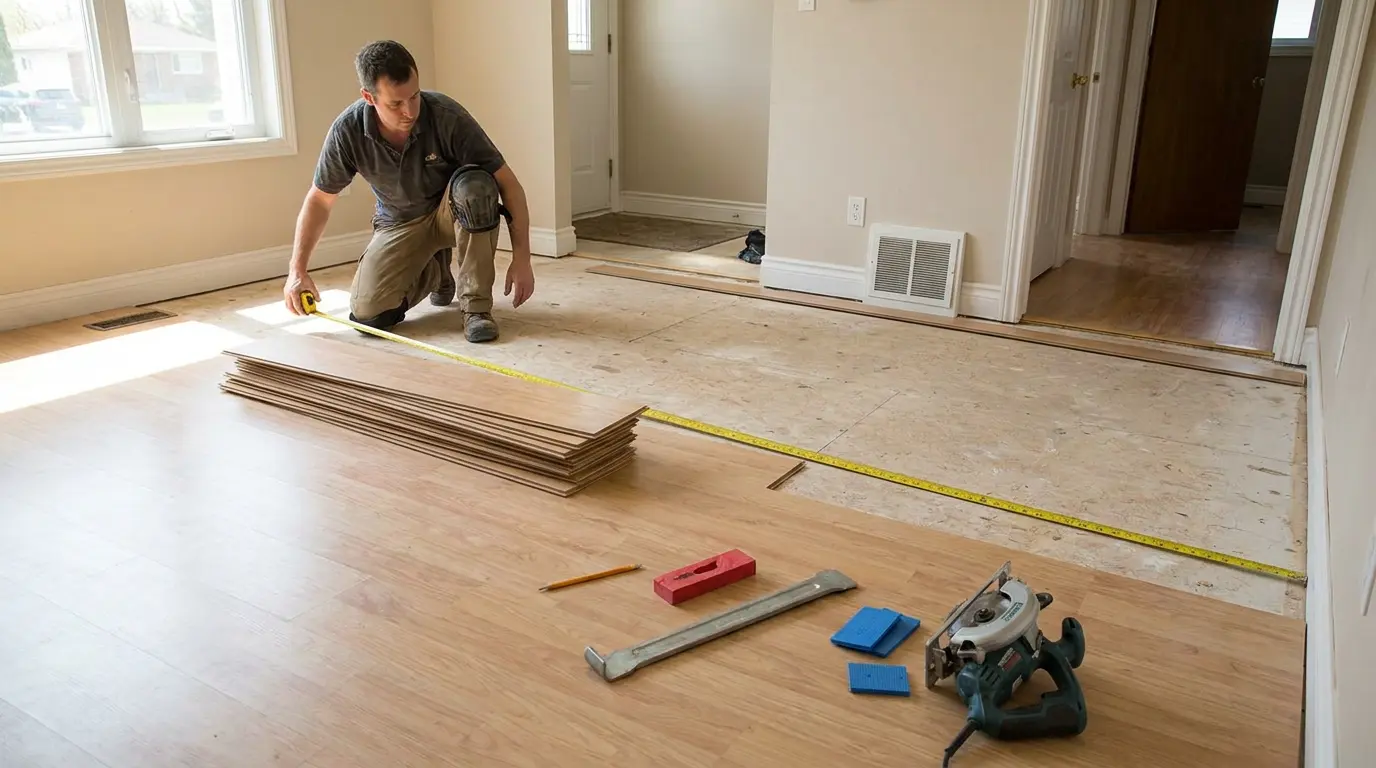
A lot of homeowners look at the labor line and assume it is mostly physical installation. It is not.
The labor charge covers several things before a single plank goes down and a few things after the last one is in place.
Most installers include room measurements and layout planning, determining the direction to run the planks, cutting planks to fit walls and door frames, fitting around vents and cabinets, installing transition strips at room boundaries, and basic cleanup of debris and scraps.
Some include baseboard removal and reinstallation; others charge for that separately. Ask before assuming.
Laminate flooring labor cost per square foot varies by region. Higher labor markets in major coastal metros tend to sit toward the $6 to $8 range.
Smaller markets and rural areas often land between $3 and $5. The same room, same plank, different zip code can produce a $1,500 difference in labor alone.
| Pro Tip: Ask every installer to break out the quote line by line: labor, materials, underlayment, removal, trim, and disposal, listed separately. Quotes that show only a single total number are harder to compare and easier to lowball. |
Where Budgets Go Wrong: The Cost Lines Most Homeowners Miss
The plank cost is almost never what surprises people. The surprise usually comes from one of these five areas.
Old Flooring Removal
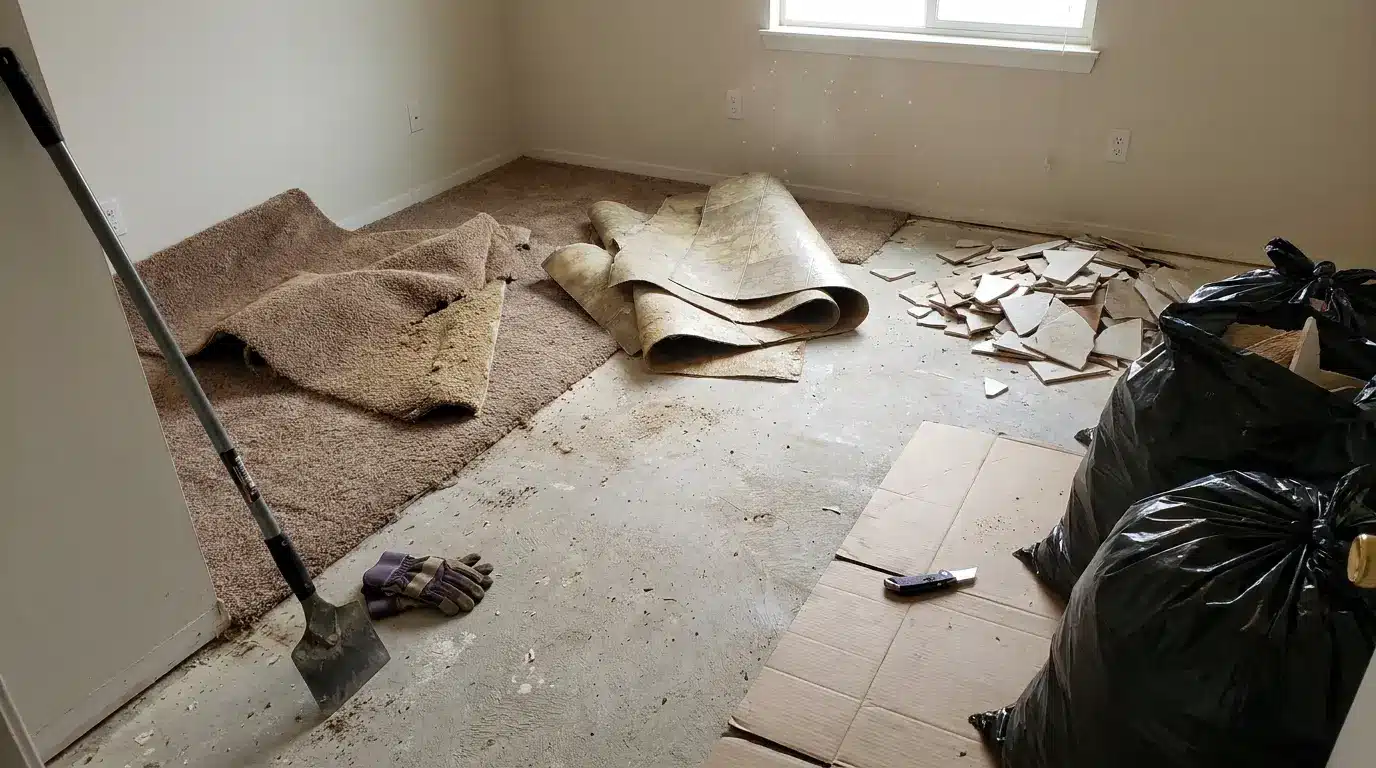
Carpet removal is the easiest and cheapest, but the padding and tack strips still take time. Tile removal is more labor-intensive and often costs more because breaking up tile and cleaning the adhesive residue is slow work.
Glued-down vinyl or old laminate may require scraping, which adds to both time and cost. Budget $1 to $3 per square foot for removal, depending on the existing floor type.
Subfloor Repair
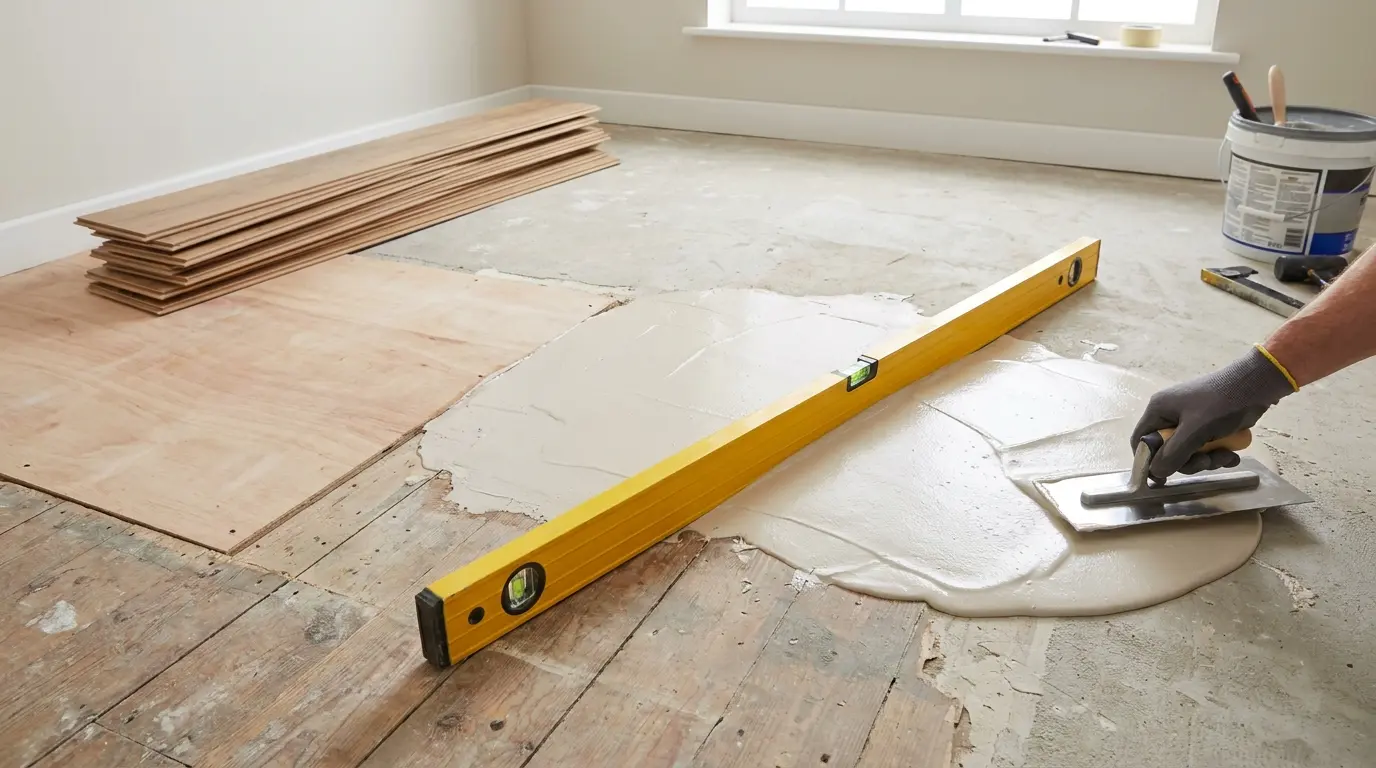
Laminate needs a flat, stable, dry surface. If the subfloor has dips deeper than 3/16 inch over 10 feet, squeaks, soft spots, or moisture damage, those need to be addressed before installation, not after.
Skipping subfloor prep to save money is the single most common reason laminate floors develop gaps, movement, and noise within the first year.
Repairs range from minor leveling compound ($100 to $300) to replacing sections of the subfloor ($500 to $1,500 or more).
Underlayment and Moisture Barrier
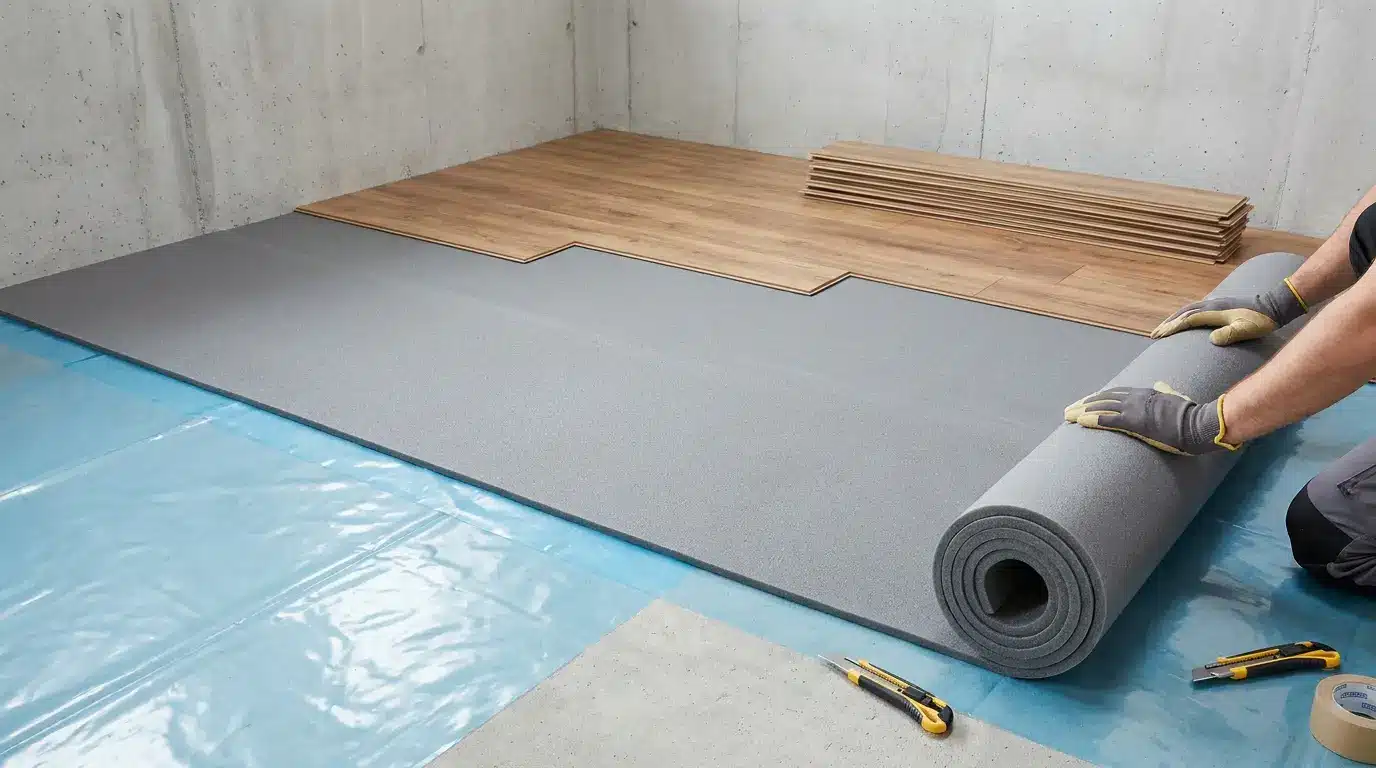
Some laminate planks come with underlayment attached. Others require a separate layer, which adds $0.30 to $0.80 per square foot in materials.
In basements or rooms over concrete, a moisture barrier is not optional. It is the line item that determines whether your floor lasts 10 years or 3.
Check what the plank manufacturer requires before assuming attached underlayment is sufficient for your specific subfloor.
Trim, Transitions, and Stair Nosing
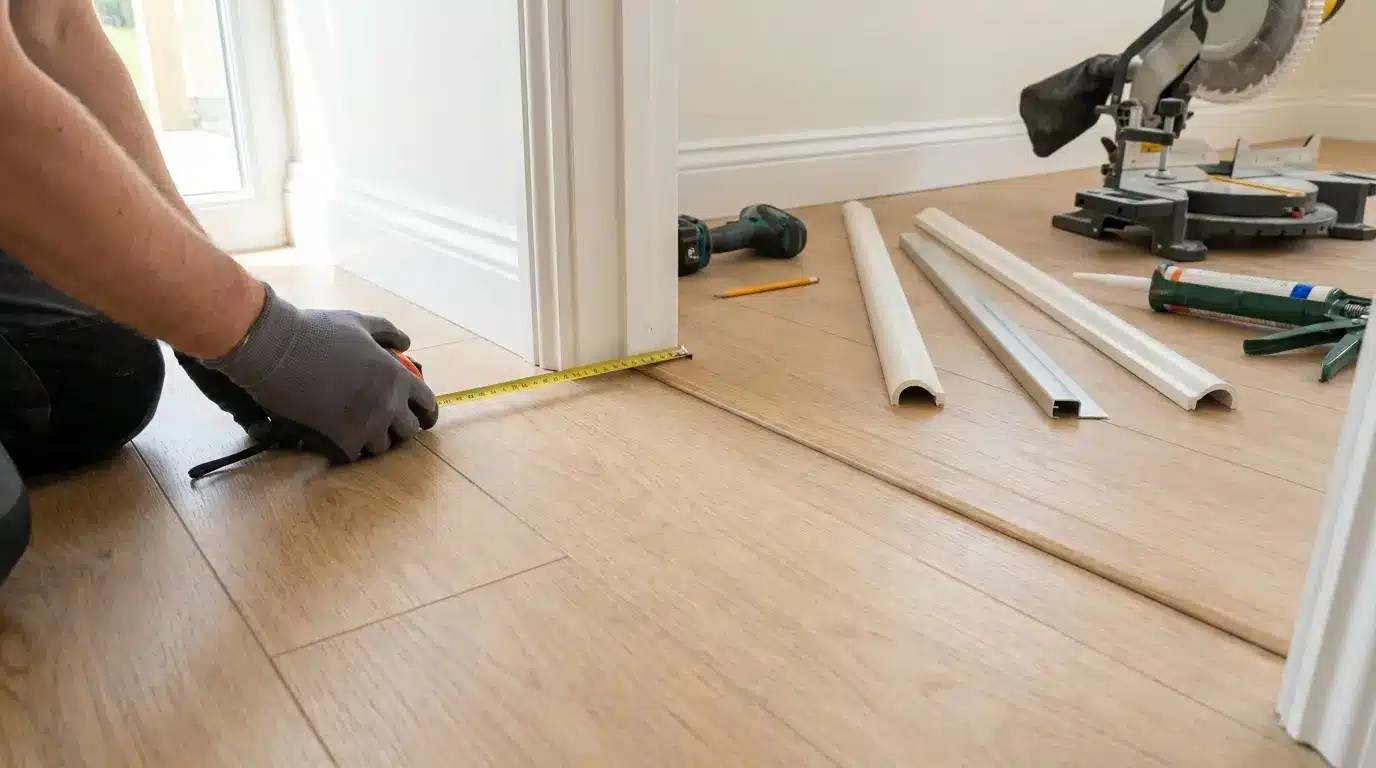
Transition strips where laminate meets tile, carpet, or another room are often not included in a base quote.
Neither is door undercutting (so planks slide cleanly under the frame) nor stair nosing.
Stairs are a separate labor category entirely, since each step requires precise measuring and fitting, and most installers price them per step rather than per square foot. Expect $30 to $60 per step.
Furniture Moving and Disposal
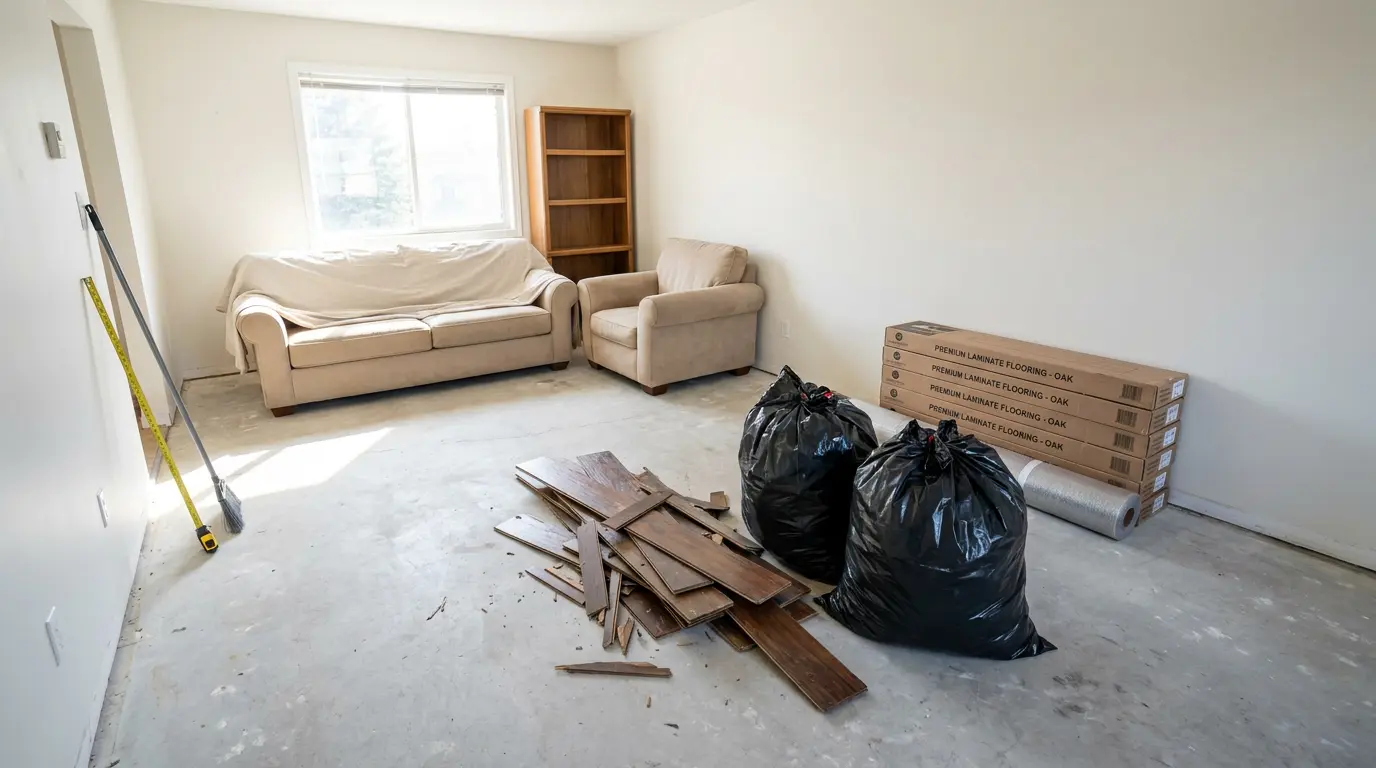
Large furniture, including beds, sofas, and full bookcases, takes real time to move. Some contractors include light furniture moving; others do not.
Waste disposal of old flooring, underlayment, and packaging is frequently a separate line. Get clarity on both before the crew arrives.
DIY vs. Professional Installation: Which Makes Financial Sense?
DIY laminate installation saves the labor cost, which, on a 300 sq. ft. room at $5 per square foot, means $1,500 back in your pocket. Whether that savings is real depends on the room and the condition of your subfloor.
DIY makes sense-
DIY makes sense when the room is square, the subfloor is flat and clean, the old flooring is already removed, and the space has minimal doorways and no stairs. Bedrooms and offices are the most DIY-friendly.
You will need a miter saw or circular saw, spacers, a tapping block, a pull bar, a tape measure, and a square. The job itself is learnable.
The risk is in the prep: an uneven subfloor that a pro would flag before starting will cost more to fix after the planks are already down.
Professional installation makes sense-
Professional installation makes sense for rooms with multiple doorways, hallways, kitchens, basements, and anything involving stairs.
A professional also provides a warranty on labor, which matters if something shifts in year one. For a basement install where the moisture risk is real, hiring out is the lower-risk financial decision even if it costs more upfront.
For a comparison of flooring options that work below grade, the guide to basement finishing costs covers when laminate and luxury vinyl plank make the most sense in that environment.
How Laminate Compares to Other Flooring Types
Laminate earns its place in the market by delivering a wood-look finish at roughly half the installed cost of hardwood. Whether it is the right choice depends on the room and how you plan to use the space.
| Flooring Type | Installed Cost Range | Best For | Avoid In |
| Laminate | $4 to $14 per sq. ft. | Dry rooms, wood-look finish | Wet rooms, high-moisture areas |
| Luxury vinyl plank | $3 to $10 per sq. ft. | Basements, kitchens, bathrooms | High-heat direct sunlight exposure |
| Carpet | $3 to $8 per sq. ft. | Bedrooms, low-traffic areas | High-traffic zones, households with allergies |
| Tile | $7 to $20 per sq. ft. | Bathrooms, laundry rooms | Cold climates where tile feels uncomfortable |
| Hardwood | $8 to $25 per sq. ft. | Long-term investment, refinishable floors | High-moisture areas, over concrete |
Laminate is not refinishable. When the wear layer is gone, the floor needs to be replaced. If you want a floor you can sand and refinish in 15 years, hardwood is the call.
If you want a wood-look floor in a dry room without the hardwood price, laminate delivers that well.
For anywhere moisture is a concern, luxury vinyl plank handles it better and costs slightly less to install. The guide to vinyl plank flooring layout covers what to consider if you are deciding between the two.
What to Ask Your Contractor Before Signing Anything
The contractor who seems cheapest on a single-number quote may not be the cheapest once every line item is visible. Ask these questions before you agree to anything.
- Is subfloor inspection and leveling included, or is that quoted separately if issues are found? Some contractors discover subfloor problems on day one and present a change order. Knowing the policy upfront prevents a $600 surprise.
- Does the quote include old floor removal and disposal, or only new floor installation? These are frequently two separate line items with different costs.
- Is underlayment included in the material price, or is it a separate charge? If the plank does not have attached underlayment, this is a real cost line.
- Are transition strips, door undercutting, and stair nosing included? Trim work is one of the most commonly excluded items.
- What is the warranty on labor, and what does it cover? A one-year labor warranty on a laminate install is standard. Anything shorter is worth noting.
If a contractor is reluctant to break the quote into line items, that is useful information on its own. Most experienced installers have seen enough scope disputes to prefer itemized quotes. The ones who resist usually have a reason.
If you are also renovating the kitchen or another room at the same time, it is worth reading the kitchen remodel cost guide to understand how flooring interacts with the broader scope and which line items overlap.
How to Build Your Laminate Flooring Budget Before Getting Quotes
You do not need a contractor quote to build a working budget. Here is how to do it yourself before anyone walks through the door.
Measure your room in square feet, add 10% for cuts and waste, then apply the cost range. A 250 sq. ft. room with 10% waste is 275 sq. ft. of material.
| Price Level | Calculation | Estimated Total |
| Low (basic planks, clean subfloor) | 275 x $4 | $1,100 |
| Mid (better planks, standard prep) | 275 x $9 | $2,475 |
| High (premium planks, repairs needed) | 275 x $14 | $3,850 |
On top of that base estimate, add possible fees for old floor removal ($150 to $600), separate underlayment ($80 to $220), subfloor repairs ($100 to $1,500), trim and transitions ($100 to $400), furniture moving ($50 to $200), and disposal ($75 to $200).
Build those contingencies into your budget before the first quote arrives, so you are evaluating actual scope rather than reacting to sticker shock.
For larger renovation projects where laminate is just one line item, the basement remodel cost guide and the average cost to build a house article both cover how flooring fits within a larger scope and where it is most likely to shift mid-project.
Frequently Asked Questions
These are the questions that come up most often once someone has gotten a first quote and wants to verify whether what they are seeing is normal.
What is the average labor cost to install laminate flooring?
Labor typically runs $3 to $8 per square foot. The exact rate depends on your region, room complexity, and whether prep work like old floor removal or subfloor leveling is included.
How much does it cost to install laminate flooring in one room?
A standard bedroom (150 sq. ft.) runs $600 to $2,100 installed. A living room (300 sq. ft.) runs $1,200 to $4,200. Add 10% for material waste and ask separately about trim and disposal.
Is it cheaper to install laminate or vinyl plank flooring?
Laminate and luxury vinyl plank are similarly priced at $4 to $14 per square foot installed. Vinyl plank handles moisture better, so for kitchens and basements it is typically the better financial decision even if the material cost is slightly higher.
Can laminate flooring go over existing flooring?
It can go over flat, stable, dry surfaces like vinyl or tile if the base is sound and does not raise floor height to a problem level. It should not go over carpet, soft vinyl, uneven tile, or any surface with moisture damage.
How long does laminate flooring installation take?
Most single-room installations take one day. Multi-room or whole-floor projects typically run two to three days, depending on prep, number of doorways, stairs, and whether old floor removal is included.
Do you need permits for laminate flooring installation?
No permit is needed for standard laminate installation in most jurisdictions. Permits may apply if structural subfloor repairs are required, if you are in a condo with HOA rules, or if the project is part of a larger renovation that already requires permits.
Does laminate flooring installation cost more for stairs?
Yes. Stairs are typically priced per step rather than per square foot because each step requires individual measuring, cutting, and nosing installation. Expect $30 to $60 per step, separate from the flat floor installation quote.
Final Words
The $4 to $14 per square foot range for laminate flooring installation is accurate.
But the number that lands in your quote will be driven by factors the range does not show: your subfloor condition, how many doorways and transitions exist, and whether removal, underlayment, and trim are included.
The homeowner who goes in knowing those variables is the one who can evaluate a quote rather than just accept it.
Before you call the first installer, measure your room, note the condition of your current floor, and build your budget with contingency lines for the five cost categories most quotes leave out.
Then ask for three itemized quotes, not three totals, and you will have what you need to make a clean decision on how much it costs to install laminate flooring in your specific space.
Cost estimates based on the 2025 national averages from HomeGuide, HomeAdvisor, and This Old House. Verify current pricing with local contractors and suppliers before budgeting.