
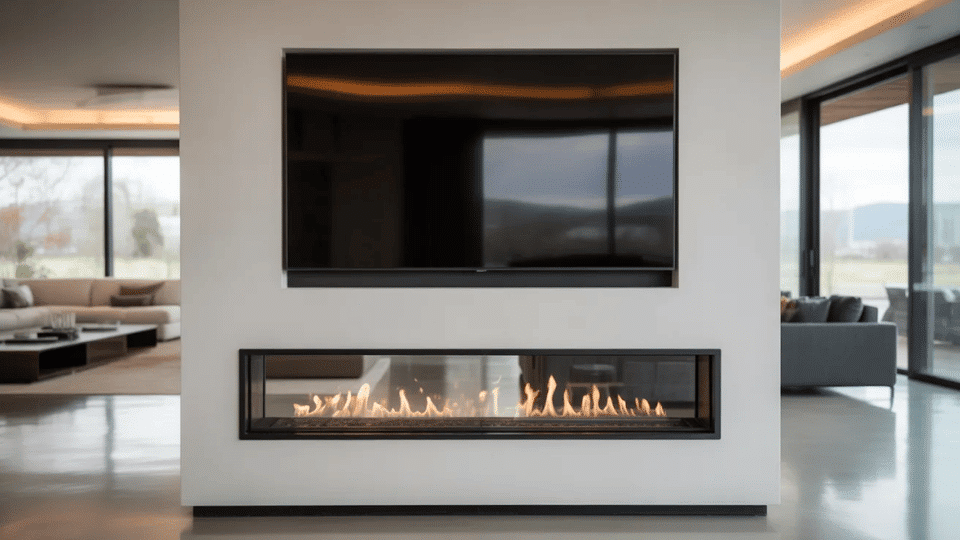


The fireplace does not move. That is the actual problem. Every other element in the room adapts; the firebox is fixed, and wherever it sits determines where the TV can go.
When both of those things are competing for the same wall, the answer most people land on is to stack them. Whether that works depends entirely on the room, not the idea itself.
| Ideal Viewing Distance | 10 to 15 feet from the screen to the seating |
| Comfortable TV Center Height | 42 to 48 inches from the floor (seated eye level) |
| Typical Above-Fireplace Height | 60 to 72 inches (center of screen) |
| Minimum Clearance Needed | 12 inches between the top of the surround and the bottom of the TV |
| Best Fireplace Type for This Setup | Electric or sealed direct-vent gas |
| Worst Fireplace Type for This Setup | Open wood-burning or open-face gas |
| Maximum Ambient Temperature (TV safe) | 95 to 104 degrees Fahrenheit at the mount location |
| Safety Note: Mounting a TV above a fireplace typically requires anchoring into masonry, brick, or a reinforced wall section. This kind of structural mounting requires locating studs or using masonry anchors correctly. Incorrect anchoring can result in the TV falling. If you are not confident working with masonry or load-bearing anchors, hire a licensed installer before proceeding. |
What This Setup Actually Involves
Mounting a TV above a fireplace means placing the screen on the same wall as the firebox, above the mantel or surround. It changes almost every measurement the room depends on.
The firebox adds visual weight at the base, throws heat upward in a column, and forces the lowest edge of the TV higher than any standard wall mount recommendation would suggest. The combination is what makes this different from hanging a TV on a blank wall.
The setup has become common as living rooms get smaller and open-plan layouts push multiple functions into shared space. But common does not mean universally suitable. The fireplace is a permanent architectural element. The TV has to work around it.
Why People Choose This Layout
The fireplace and the television both want the most prominent wall in the room. Stacking them removes that conflict and gives the room a single visual anchor. When that still produces an unsettled layout, the decisions look very different — a problem the fireplace layout guide covers with nine real rooms and what fixed each one.
- Modern living rooms often have one dominant wall with limited options on either side
- A combined focal point lets the rest of the room orient around one axis
- In open-plan spaces, it defines the living zone without consuming a second wall
- The result reads as intentional rather than improvised
When the only alternative is a TV floating on a side wall with no visual grounding, the above-fireplace placement wins on design logic. The question is whether it holds up in practice.
The Trade-Off: Comfort vs. Aesthetics
Combining the two elements resolves visual tension but introduces a different problem: physical tension in the neck of anyone watching for more than 20 minutes.
| Factor | Comfort Priority | Aesthetics Priority |
|---|---|---|
| Screen position | Eye-level on a dedicated wall | Above the mantel, elevated by default |
| Viewing angle | Neutral, no neck strain | Upward tilt required from most seats |
| Seating setup | Any height works | Low-profile or reclined works best |
| Best suited for | Daily extended viewing | Occasional or background viewing |
| Room feel | Functional, viewing-focused | Clean, unified focal point |
Neither column is wrong. The right answer depends on how the room is used day to day, not just how it looks in a photo.
The Two Costs You Cannot Ignore
Viewing Experience: What Actually Changes When the Screen Goes Up
The picture quality does not change. What changes is the angle your neck holds for the entire session.
Seated eye level for most adults sits at 42 to 48 inches from the floor — the target for any good TV placement guide. A screen above a standard fireplace centers at 60 to 72 inches, depending on mantel height. That is a gap of 12 to 30 inches above where your eyes want to land. Over a two-hour film, that tilt accumulates.
Distance softens it. Beyond 12 feet, the elevation angle drops enough that the strain becomes minor for most people. Choosing low-profile furniture reduces neck tension further — a sectional at 15 to 17 inches seat height makes a 20-inch height gap far more manageable than an upright chair at standard height. Large rooms with relaxed seating absorb the difference well.
Close proximity makes it worse. Upright dining chairs or standard sofas within 8 feet create a steep, sustained upward angle. Small rooms have no distance to offset the elevation. If your seating is within 8 feet of the wall and you use standard-height furniture, this setup will be uncomfortable for regular viewing.
| Rule of thumb: Divide your room depth by the height gap. If you are 8 feet away and the screen is 20 inches above eye level, the viewing angle is roughly 12 to 14 degrees. Ergonomic research suggests anything above 15 degrees produces measurable neck strain over sessions longer than 30 minutes. Measure your room before committing. |
Heat Impact: What the Fireplace Does to the TV Over Time
Heat moves upward. The TV sits directly in that column every time the fireplace runs.
Convective heat rises from the firebox and concentrates in the zone directly above the mantel. Most consumer electronics are rated for ambient operating temperatures of 32 to 95 degrees Fahrenheit. Some extend to 104 degrees. Once the ambient temperature at the mount location exceeds that range consistently, degradation begins. It rarely produces immediate visible failure. It shortens component lifespan over one to three heating seasons.
Fireplace type determines how serious the risk is:
- Electric fireplaces: Lowest risk. No combustion, minimal heat rise above the unit.
- Sealed direct-vent gas fireplaces: Acceptable risk if clearance is 12 inches or more. The sealed combustion chamber reduces heat output above the unit significantly.
- Open-face gas fireplaces: Higher risk. Heat and particulates move freely upward with no barrier.
- Open wood-burning fireplaces: Highest risk. Soot, creosote, and sustained high-output radiant heat all reach the TV. This combination causes cosmetic and functional damage over time.
The threshold for real damage is not just temperature: it is the combination of no mantel buffer, frequent high-output use, and less than 12 inches of clearance between the top of the surround and the bottom of the TV. When all three conditions exist together, damage within a single heating season is likely.
Height and Clearance: The Numbers That Determine Whether This Works
Every room has a different mantel height. These figures give you the actual targets to measure against before mounting anything.
| Mantel Height | TV Bottom Edge | TV Center (55-inch screen) | Verdict |
|---|---|---|---|
| 48 inches | 60 inches | 60 inches | Workable with low seating |
| 54 inches | 66 inches | 66 inches | Pull-down mount recommended |
| 60 inches | 72 inches | 72 inches | Problematic without a tilting mount |
| 60+ inches | 72+ inches | 72+ inches | Consider an alternative layout |
TV width matters too. A screen wider than the fireplace surround creates visual imbalance and emphasizes the height. As a rule, choose a TV no wider than the outer edge of the fireplace surround.
Three Setups That Actually Work
These are not aesthetic options to pick from. Each addresses a specific room condition. Read them in terms of what your room has, not what you prefer visually.
Setup 1: The Low Mantel Layout
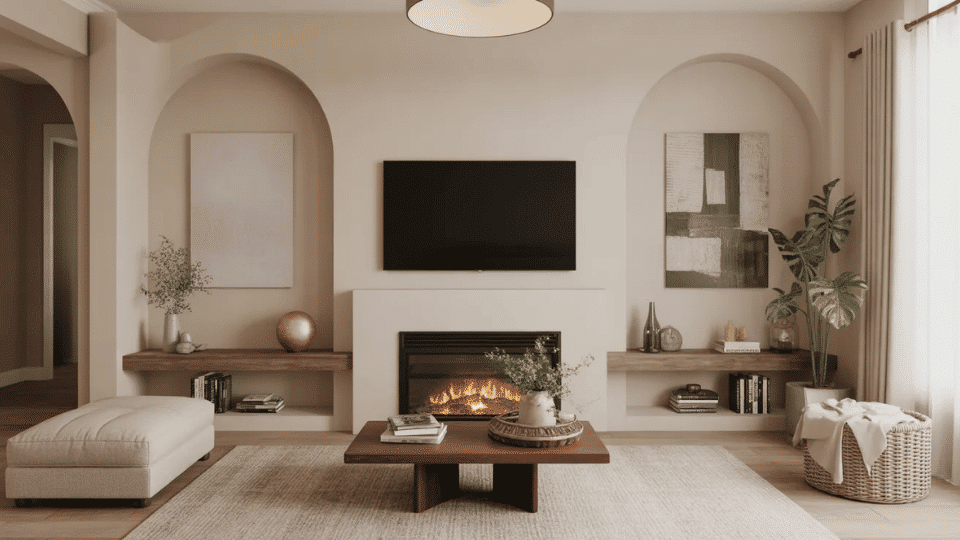
This works when the mantel sits at 48 inches or below, and the room has at least 10 feet of seating distance. The TV center lands at or near 60 inches, close enough to comfortable viewing height that a fixed flat mount is sufficient. No correction required.
- The screen center falls within a comfortable range without tilting the hardware
- At least 12 inches of clearance between the surround and the TV’s bottom
- TV width matches the fireplace surround width for visual balance
- Low-profile sofa or reclined seating completes the setup
This is the cleanest version of the setup. If your mantel height allows it, a fixed mount and correct TV sizing are the only decisions left.
Setup 2: The Pull-Down Mount for a High Fireplace
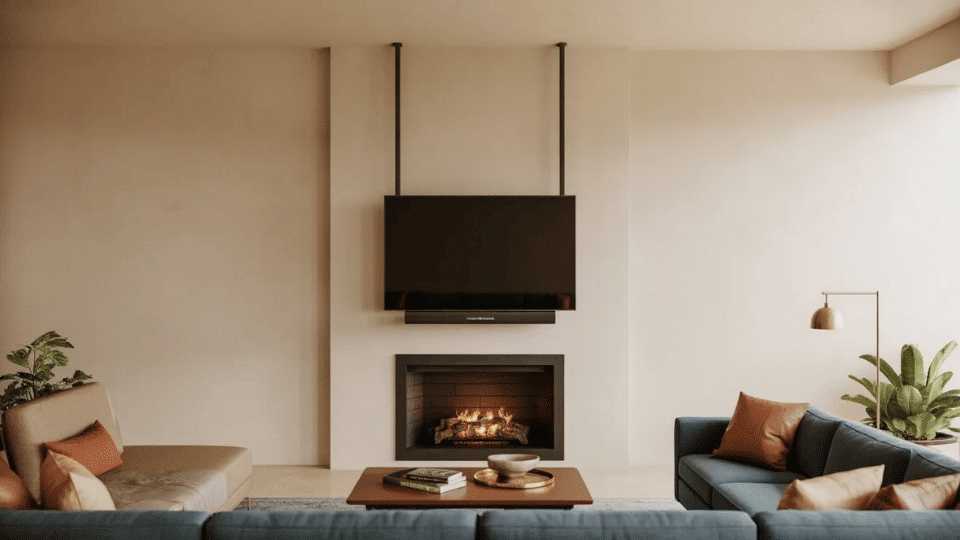
When the mantel sits at 54 to 60 inches, and there is no structural way to lower it, a pull-down mount solves the height problem mechanically. The TV parks above the surround when not in use and drops to eye level when viewing starts.
- The parked position looks clean and does not disrupt the visual line of the fireplace
- A good pull-down mount brings the screen to 42 to 48 inches center height during use
- A slight downward tilt in the lowered position improves the viewing angle further
- The mount hardware blends into the wall at rest
Pull-down mounts cost $200 to $600, depending on TV weight capacity and travel distance. That is the price of making a placement that is too high, actually comfortable. If the mantel is over 54 inches and a pull-down is not in the budget, the room needs an alternative layout.
Setup 3: The Built-In Wall
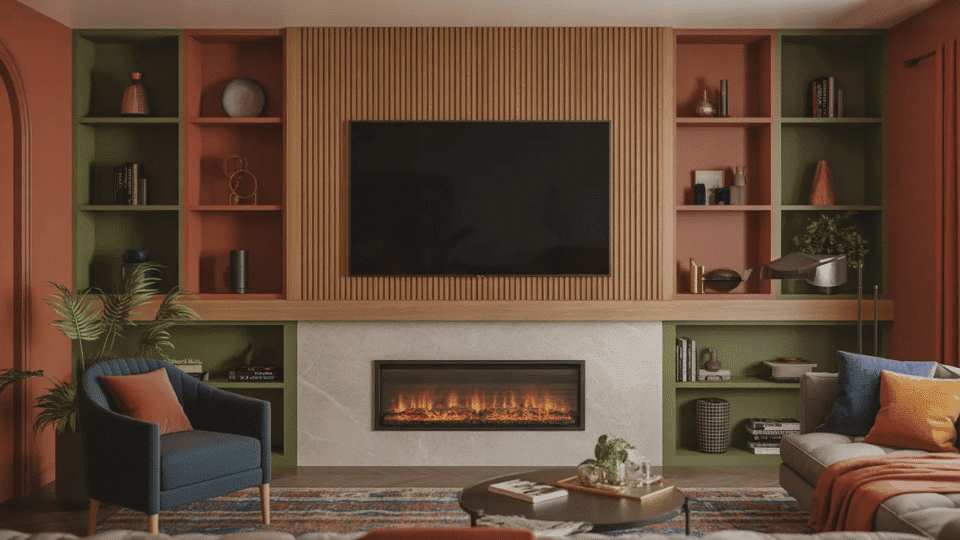
This approach works when the homeowner treats the entire wall as a single design decision rather than two separate elements that happen to share space.
The fireplace wall is designed as a unified surface. The TV is recessed or flush-mounted above the opening. Wiring runs through the wall or in a concealed channel. A matte or dark background finish reduces contrast, so the screen recedes when turned off.
- The TV is centered above the fireplace for visual symmetry
- Recessing the TV can reduce the effective height by 2 to 4 inches, depending on the wall depth
- All wiring is hidden, which removes the one detail that otherwise signals an improvised setup
- The wall reads as one unit rather than a screen sitting on top of a fireplace
This is the highest-effort version of the setup and the one most likely to require a contractor for wall work and electrical routing.
What People Who Have Done This Report Back
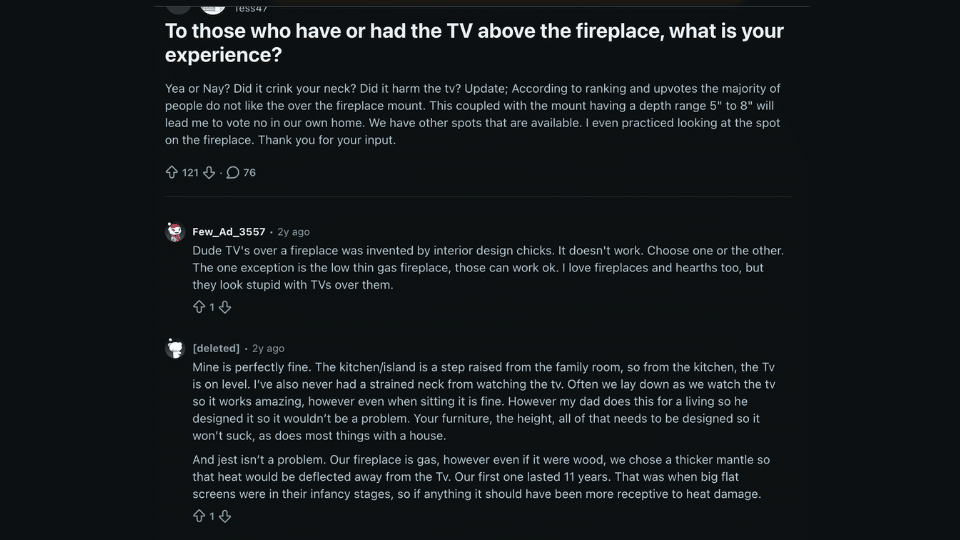
A Reddit thread titled “To those who have or had the TV above the fireplace, what is your experience?” generated over 70 responses, and the split was informative. Most users regretted it.
Neck strain came up in most negative responses, and at least one person reported visible burn lines on their screen from heat exposure. But a vocal minority defended it: those with gas fireplaces, deeper sofas, and rooms over 12 feet reported almost no issues after years of use.
A tilting mount changed the experience entirely for some. Those who made no adjustments and had standard upright sofas close to the wall were consistently the most dissatisfied.
The pattern across 70 responses is consistent: poor planning produces regret; deliberate decisions about height, clearance, and mount type produce satisfaction. The setup does not fail on its own. It fails when the room conditions are ignored.
Alternatives When the Room Does Not Qualify
If the mantel sits above 60 inches, the seating is within 8 feet, the fireplace is open wood-burning, or the room cannot accommodate a pull-down mount, the setup is not worth forcing. These alternatives preserve the design logic without the ergonomic or thermal costs.
- Side-wall placement: Moving the TV to the wall opposite the fireplace maintains viewability, brings the screen to eye level, and creates a balanced room with two intentional focal points rather than one compromised one.
- Built-in cabinetry beside the fireplace: A flanking built-in unit holds the TV at the correct height, hides cables, adds storage, and keeps the fireplace as the visual anchor it was designed to be. This is the option that usually photographs better than the above-fireplace version anyway.
- Separate zones in open-plan spaces: Seating can face the fireplace on one axis and the TV on another, creating two distinct functional areas within the same room. This works well in open-plan living rooms with 250 square feet or more of shared space — enough floor area to define both zones with furniture rather than walls.
Frequently Asked Questions
What is the ideal height for a TV above a fireplace?
The center of the screen should sit between 42 and 48 inches from the floor, as the mantel allows. Most above-fireplace setups land at 60 to 72 inches center height, which is 12 to 30 inches higher than ergonomically comfortable for daily viewing. If the gap is more than 20 inches above seated eye level, a pull-down mount or an alternative placement will produce better results.
How much clearance do you need between a TV and a fireplace?
At a minimum, 12 inches between the top of the fireplace surround and the bottom edge of the TV. For open-face gas or wood-burning fireplaces, 18 to 24 inches is safer. Less than 12 inches with regular high-output use puts the TV within the sustained heat zone and shortens its lifespan.
How hot is too hot for a TV above a fireplace?
Most consumer televisions are rated for ambient operating temperatures of 32 to 95 degrees Fahrenheit. Some models extend to 104 degrees. The risk is not a single heat event; it is sustained exposure above 95 degrees over a heating season. Use a basic infrared thermometer at the mount location while the fireplace runs at normal output to check the actual temperature before installing the TV.
What size TV should go above a fireplace?
Choose a TV no wider than the outer edge of the fireplace surround. A screen wider than the surround reads as visually heavy and draws attention to the height of the setup rather than the balance of the wall. For a standard 40 to 50 inch wide surround, a 55 to 65 inch TV is usually proportional.
Is mounting a TV above a fireplace bad for the TV?
It depends entirely on the fireplace type and clearance. Electric fireplaces pose minimal risk. Sealed direct-vent gas fireplaces with adequate clearance are generally safe. Open-face gas and wood-burning fireplaces generate sustained heat and particulates that degrade electronics over time. The risk is real but avoidable with the right combination of fireplace type, clearance, and use frequency.
Can you mount a TV above a gas fireplace?
Yes, with conditions. A sealed direct-vent gas fireplace with 12 inches or more of clearance between the surround and the TV bottom is considered acceptable by most mount manufacturers and fireplace installers. An open-face gas fireplace is a different situation: heat output is less contained, and the risk to electronics increases with frequency of use.
What type of mount works best above a fireplace?
For mantels at 48 inches or below, a fixed flat mount is sufficient. For mantels at 54 to 60 inches, a full-motion or pull-down mount corrects the height during viewing. Pull-down mounts that bring the screen to eye level are the most effective solution for rooms where lowering the mantel is not an option.
Final Thoughts
Three things determine whether this setup works: height, heat, and how the room is actually used. Get all three right and the layout is space-efficient, visually clean, and worth the planning it takes. Get one wrong, and you will notice it every time you sit down to watch something.
The mantel height sets the ceiling on what is possible. If it puts the TV center above 60 inches with no room for a pull-down mount, the room is not suited for this layout, regardless of how good it looks in a photo. The fireplace type sets the floor on how much heat management is required. Open wood-burning and open-face gas fireplaces raise the bar significantly. Viewing distance and seating height determine whether the elevation gap is tolerable or not. Below 8 feet with upright furniture, it is not.
When all three conditions line up, mounting a TV above a fireplace is a legitimate long-term decision. When they do not, the alternatives in this article will serve the room better. Tried this setup yourself? Drop your experience in the comments.