

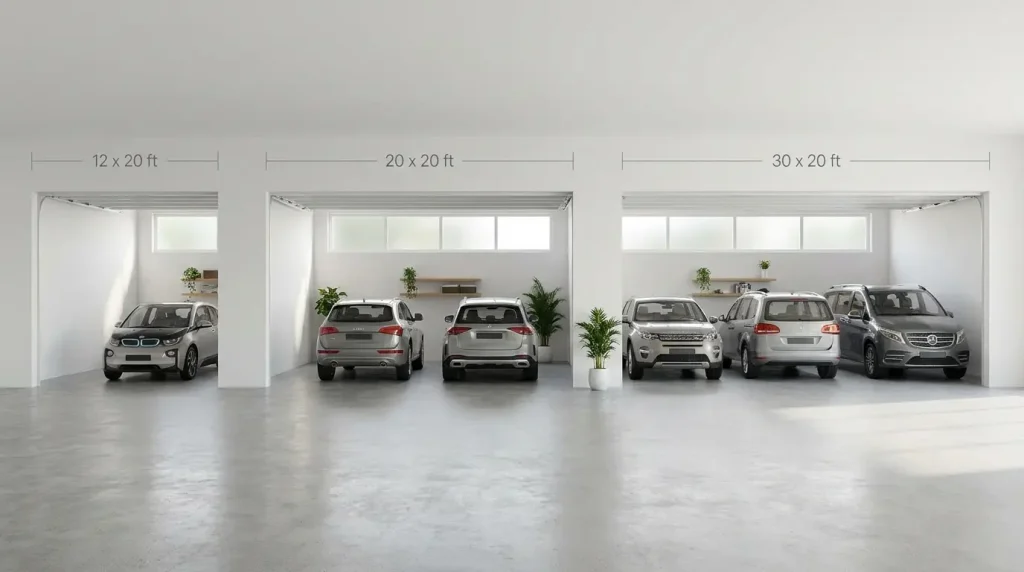


A standard garage size is not a fixed number; it is a range that shifts based on how many vehicles you are parking, how large those vehicles are, and whether the space needs to do more than hold a car.
For most homes, a single-car garage runs 12 to 16 feet wide, a double-car garage runs 20 to 24 feet wide, and a triple-car garage starts at 30 feet wide. But those are the minimum figures, and minimum sizes rarely feel comfortable once you are actually using the space daily.
What most homeowners do not realize until they are already in is that garage size affects more than parking. It affects how far the budget stretches, whether a permit is required for the footprint, and what the long-term cost of getting it wrong looks like.
This breakdown covers single-, double-, triple-, and four-car garages, including width, depth, door sizing, clearance, storage planning, and the decisions that tend to go wrong before the concrete is poured.
| Cost Note: Figures in this article are estimates based on national averages. Actual costs vary significantly by region, contractor, materials, and project scope. Always get at least three quotes before committing to any project above $1,000. |
Standard Garage Size at a Glance
Before getting into the details of each type, here is the basic footprint comparison most homeowners use as a starting point. These are planning numbers, not final answers for every lot or household.
| Garage Type | Minimum Size | Comfortable Size | Best For |
|---|---|---|---|
| Single-car | 12 x 20 ft | 14 x 22 ft to 16 x 24 ft | Compact cars, sedans, and light storage |
| Double-car | 20 x 20 ft | 22 x 22 ft to 24 x 24 ft | Two cars, SUVs, daily parking |
| Triple-car | 30 x 20 ft | 32 x 24 ft to 36 x 24 ft | Three cars or two cars with extra room |
| Four-car | 40 x 20 ft | 44 x 24 ft or larger | Large homes, extra vehicles, hobby use |
Note: minimum sizes fit vehicles, while comfortable sizes fit real life. If you park daily, carry groceries through the garage, or keep tools nearby, the larger range will usually feel better than the tight option shown.
What Does Standard Garage Size Mean?
A standard garage size is the common size range used for a garage based on how many vehicles it holds. That means the number is not fixed. A single-car garage, double-car garage, and triple-car garage each have a common starting size, but the right size depends on the way you use the space.
A garage built only for parking can be smaller than one that also holds bikes, bins, tools, or a workbench. I always think of garage size in two layers. The first layer is the vehicle footprint. The second layer is the space around that vehicle.
You need room to open doors, walk without turning sideways, and reach anything stored near the walls. This is where many garage plans go wrong.
They show a car fitting inside, but they do not show a person carrying shopping bags, a child opening a door, or someone trying to reach a shelf behind the bumper. A useful garage should handle those daily moments without making you fight the room.
Factors That Affect Garage Size
A garage size should come from your real needs, not from a number copied from a plan. I have seen small garages work well because they were planned carefully, and larger ones feel messy because no one thought through the layout. Here are the main things to check before you settle on the final size:
- Number of vehicles: Start with how many vehicles need regular space. A single-car garage works for one main vehicle, while a double-car garage needs enough width for two vehicles and space between them. A triple-car garage also needs better door placement and driveway flow.
- Extra moving items: Count anything that takes up vehicle-like space. A mower, motorcycle, trailer, scooter, golf cart, or small utility vehicle can quietly take over a bay if you do not plan for it early.
- Vehicle size: A compact car may fit in a tighter garage, but a pickup truck often requires more clearance. A tall SUV may need a higher door, while a wide vehicle may need more side room.
- Real measurements: Do not size a garage by vehicle type alone. Measure the actual vehicle, including mirrors, roof racks, hitches, wide doors, and anything added after purchase.
- Storage needs: Shelves, cabinets, bikes, tools, freezers, and bins reduce usable parking space. Plan storage before choosing the final dimensions, or the garage may feel pinched even when the car technically fits.
- Garage layout: Side-by-side parking needs more width, while tandem parking needs more depth. A double door provides a single broad opening, while separate doors create clearer parking lanes.
- Attached or detached setup: Attached garages may be shaped by the home’s floor plan. Detached garages often offer more freedom, but they still require driveway access, utility planning, and local approval.
Future size note: One thing I would not shrink is future room. Your garage may work today, but a larger vehicle, EV charger, teen driver, or workbench can change that fast. If your lot and budget allow it, add a little width or depth now. It is often cheaper than fixing it later.
1 (One) Car Garage Dimensions
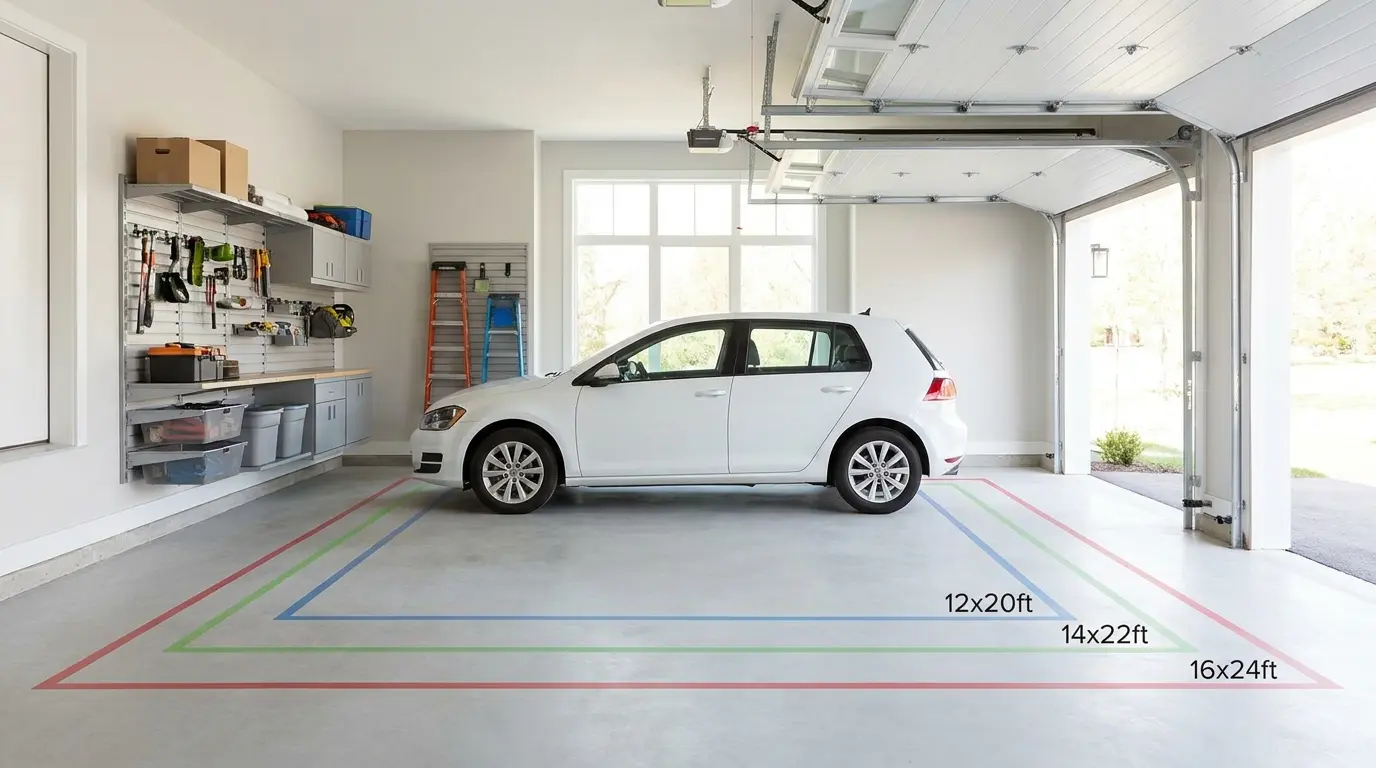
A single-car garage can be more than a basic parking space. Some homeowners only need room for one compact car, while others want space for an SUV, mower, bike, tools, or a small workbench. The right size depends on how often you use the garage and how much room you want around the vehicle.
Here is a simple way to think about single-car garage sizes:
- 12 x 20 ft for basic parking: This is a common minimum size for a single-car garage. It works best for compact cars and small sedans when the garage is mainly used for parking. I would choose this size only when the lot is limited or storage is planned elsewhere.
- 14 x 22 ft to 16 x 24 ft for daily comfort: This range gives you more room to open the car door, walk near the bumper, and use the garage without feeling boxed in. If you park here every day, this size usually feels much better than the minimum.
- 16 x 24 ft or larger for extra use: This size works well for an SUV, pickup, motorcycle, mower, or small workbench. It is a smart choice when you want one parking bay with added flexibility, but you do not need a full double-car garage.
If I were planning a single-car garage for regular use, I would avoid the tightest size unless space was the main limit. A few extra feet can make the garage feel easier every single day.
2 (Two) Car Garage Dimensions
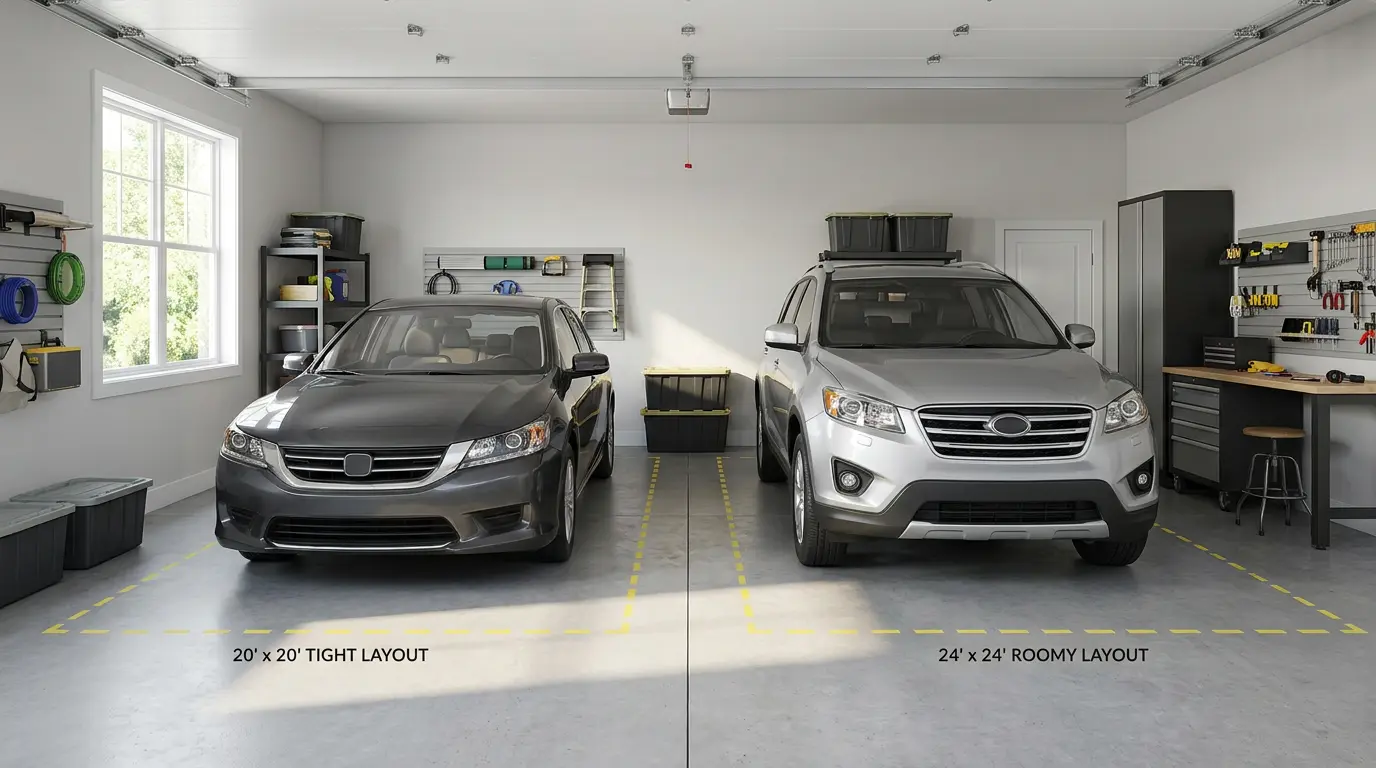
A double-car garage is where standard garage size decisions get the most expensive to reverse. The most common sizing mistake here is choosing the 20 x 20 ft minimum for two vehicles and discovering that neither driver can open their door without brushing the wall or the other car.
Two parked vehicles create pressure from three directions: the two side walls and the space between the vehicles.
- 20 x 20 ft is the technical minimum that proves two compact vehicles fit. It is not a comfortable daily-use layout, and it leaves almost no margin for storage. If this is the starting point due to budget or lot constraints, plan storage elsewhere from day one.
- 22 x 22 ft to 24 x 24 ft is where most households should land. A 24 x 24 ft layout gives 576 square feet, enough for two full doors to open, a walking lane between the vehicles, and wall storage that does not intrude on parking clearance. This is the size that tends to feel right after six months of daily use.
- 24 x 30 ft or larger is the right choice when either vehicle is a full-size truck or large SUV, when both cars are used every day, or when the garage needs to serve as a workshop or additional storage area. The added depth absorbs longer vehicles and the storage that builds up behind them.
Match the size to the actual scenario: two compact cars fit in 20 x 20 ft, two sedans fit better in 22 x 22 ft, two SUVs need 24 x 24 ft, and a truck with storage behind it typically needs 24 x 30 ft or more.
On a project that involves adding a garage to an existing home, the footprint choice affects not just comfort but permit scope and foundation requirements.
3 (Three) Car Garage Dimensions
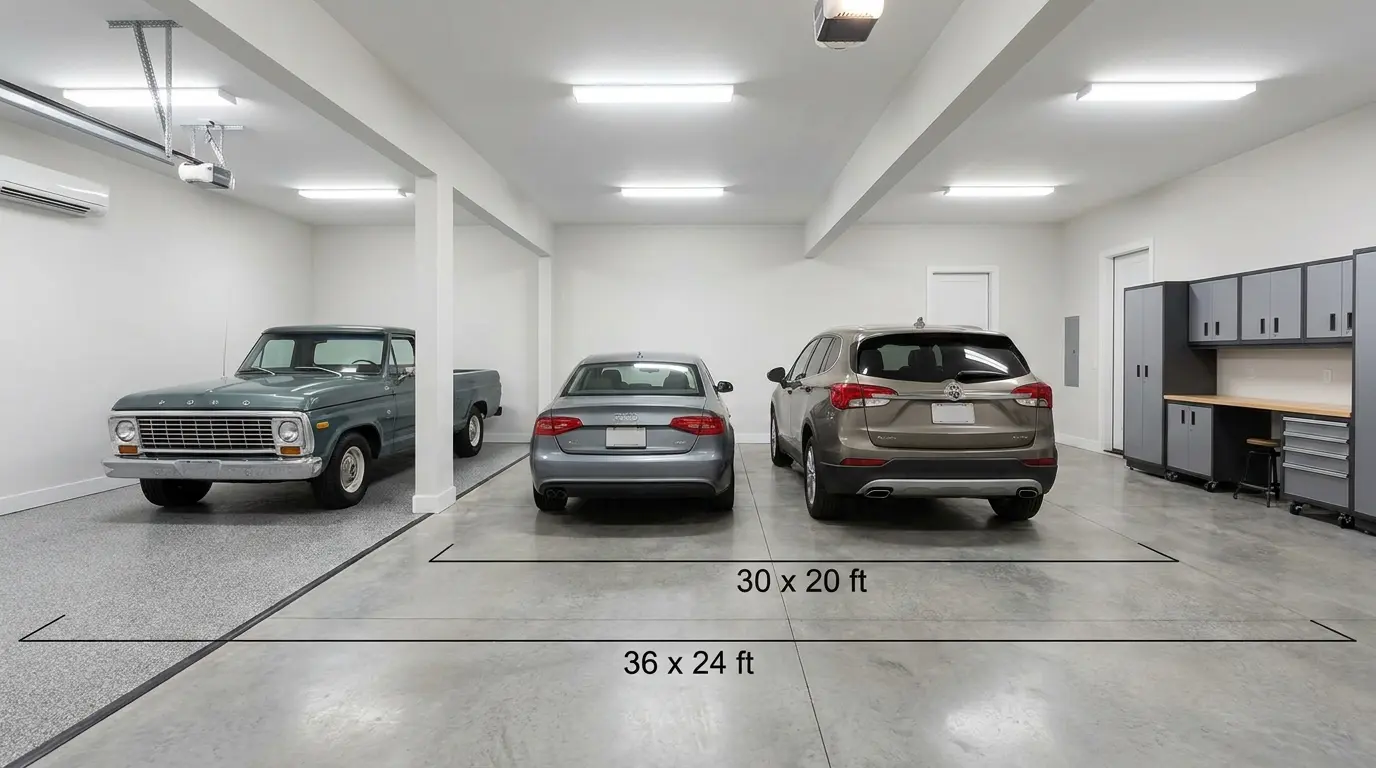
A triple-car garage is not just a double-car garage with one more bay attached. It has to support more vehicle movement, wider access, and a layout that does not slow everyone down. The right size depends on whether all three vehicles are used daily or one bay is only used sometimes.
Here is a simple way to think about triple-car garage sizes:
- 30 x 20 ft for a basic triple-car garage: This is a common minimum size. It can work when the vehicles are smaller, and the garage is mainly used for parking. I would treat this as a tight starting point, not the most comfortable choice for a busy household.
- 32 x 24 ft to 36 x 24 ft for daily use: This range gives three vehicles more room to sit side by side without making the space feel crowded. It is a better fit when more than one person uses the garage every day, especially during busy mornings.
- Wider layouts for easier access: A triple-car garage can use three side-by-side bays or a wider layout with one bay set apart. This helps when one vehicle is larger or when drivers leave at different times.
- Tandem layouts for occasional vehicles: A tandem bay can work when the third vehicle is not used daily. It is better for a hobby car, motorcycle, mower, or seasonal vehicle than for a car that needs quick access every morning.
Three vehicles create more movement than two, more doors opening at once, more people walking around bumpers, more chances for the layout to feel undersized.
When planning the foundation, it is worth knowing how the foundation type under a larger structure affects cost and long-term performance.
4 (Four) Car Garage Dimensions
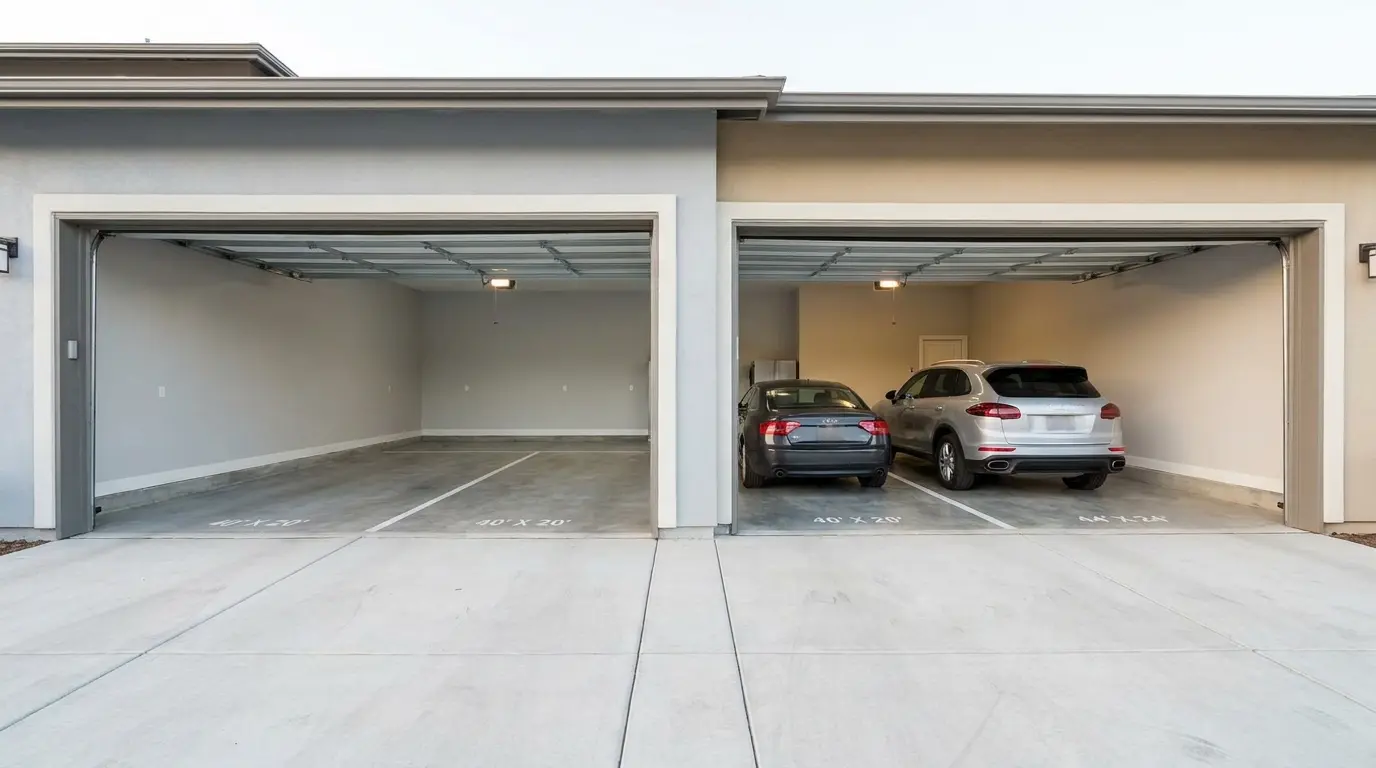
A four-car garage needs more thought because the footprint gets wide, deep, or both. At this size, the goal is not only to fit four vehicles. The garage also needs a layout that makes sense from the driveway, supports daily movement, and avoids wasted corners.
Here is a simple way to think about four-car garage sizes:
- 40 x 20 ft for basic four-car parking: This is a common minimum four-car garage size. It can hold four smaller vehicles, but it may feel tight if the cars are wide, tall, or used often. I would see this as a space-saving option, not the easiest daily layout.
- 44 x 24 ft or larger for better comfort: This size gives full-size vehicles more room and makes it easier to move around the parked cars. It also works better when more than two vehicles are used often.
- Side-by-side layouts for daily drivers: Four side-by-side bays are easier when every vehicle needs regular access. This layout takes more width, but it keeps cars from blocking each other.
- Tandem layouts for less-used vehicles: A tandem four-car layout can save width by placing two vehicles behind two others. It works best when the back vehicles are not used every day.
- Mixed layouts for larger properties: Some four-car garages use two daily bays and two secondary bays. This setup works well when the garage holds a mix of daily drivers, hobby vehicles, and occasional-use vehicles.
At this scale, access matters as much as square footage. A four-car garage with a poor driveway angle or awkward bay order will feel frustrating at 44 feet wide just as it would at 40 feet. Plan the traffic flow before finalizing the dimensions.
If the garage will include a coated or sealed floor, it helps to understand what epoxy flooring costs at this footprint before the project budget is set.
How to Measure Your Vehicle for Garage Fit
Before you settle on a garage size, measure the vehicle you actually drive. Do not rely only on labels like SUV, sedan, or pickup. Two vehicles in the same category can need different space once mirrors, roof racks, hitches, and door swings are included: heres how to measure it:
| What to Measure | How to Check It | Why It Matters |
|---|---|---|
| Full length | Measure from the front bumper to the farthest rear point, including a hitch or spare tire. | Helps you choose enough garage depth. |
| True width | Measure with mirrors included, not just the body width. | Helps avoid tight side spacing, especially in double-car garages. |
| Full height | Include roof rails, cargo boxes, racks, or lifted suspension. | Helps confirm the vehicle can clear the door and overhead space. |
| Door swing | Open the driver’s door the way you normally would and note the space needed. | Shows whether you can step out comfortably. |
| Floor outline | Mark the vehicle and walking area with tape, chalk, or cardboard. | Gives you a real feel for the layout before finalizing dimensions. |
A garage should be sized around your largest vehicle, not your smallest one. Once the biggest vehicle fits with room to move, the rest of the layout becomes much easier to plan.
Garage Width, Depth, and Height: What Each Measurement Controls
Garage dimensions are written as width by depth, but height is the third variable most buyers overlook until a taller vehicle or overhead storage need appears. Here is what each measurement actually controls in daily use.
- Width controls side-by-side parking: In a double- or triple-car garage, width is the most critical dimension. It determines whether two cars can sit side by side without door contact, and whether the space between vehicles allows a person to walk comfortably rather than squeeze through.
- Depth controls longer vehicles and rear storage: A 20-foot depth is common in basic garage plans, but longer trucks and SUVs, combined with any rear-wall storage, often require 22 to 24 feet. Standard door widths follow a similar logic, the opening size has to match the vehicle it is serving. The same principle applies when looking at door widths throughout the home, where clearance requirements drive the final spec.
- Height controls clearance for taller vehicles and overhead storage: Most garage ceilings run 8 to 10 feet, but the door opening is often lower than the ceiling. Check both. A van, lifted truck, or roof-box vehicle needs confirmed clearance at the door frame, not just the room height.
- Shape matters as much as total square footage: A garage that is poorly proportioned, very wide but too shallow, or tall but narrow, will feel awkward regardless of the total square footage. Proportional dimensions that match actual vehicle and storage needs outperform raw size on paper.
What Garage Door Size Do You Need?
Garage doors can affect how easy the garage feels to use. A garage may have enough depth and width, but the wrong door size can still make parking feel tight. Use this table as a quick guide:
| Door Option | Common Size | Best For | Key Note |
|---|---|---|---|
| Single garage door | 8 to 10 ft wide, 7 to 8 ft tall | Single-car garages | Wider is better for SUVs and wide mirrors. |
| Double garage door | 16 ft wide, 7 to 8 ft tall | Double-car garages | Gives one wide entry for two vehicles. |
| Oversized double door | 18 ft wide, 7 to 8 ft tall | SUVs and trucks | Adds an easier entry room. |
| Two single doors | 8 to 10 ft wide each | Separate parking bays | The center post can feel tight. |
Choose the door around your actual vehicle, not only the garage size. If you drive a wider SUV or truck, I would give the opening more room.
How Much Clearance Should a Garage Have?
Clearance is the space that makes a garage usable after the vehicle is parked. I think of it as the room that helps you open doors, walk around the car, and move from the garage into the house without feeling boxed in.
Side clearance matters first because doors need space to open without hitting a wall, shelf, or another vehicle. In a double-car garage, the space between the two cars is just as important as the space near the outer walls.
Front and rear clearance also matter because you need room to walk around the bumper and close the garage door safely. If your vehicle is long, this space becomes even more important.
I also plan the walking path before adding storage. If you can carry groceries, tools, or laundry through the garage without turning sideways, the layout is doing its job.
Storage and Extra Use Planning
Storage should not be treated as leftover space. Most garages collect items over time, and those items can slowly take over parking areas. A good plan gives storage its own place before the garage starts feeling crowded. Here are the main storage and extra-use zones to plan early:
- Wall storage for narrow items: Hooks, slim racks, and shallow shelves work well for keeping tools, bikes, or small gear off the floor. Deep cabinets need more caution because they can reduce side clearance and block car doors.
- Back-wall storage for bulky items: Freezers, bins, toolboxes, and cabinets usually require extra depth behind the parked vehicle. If you want this kind of storage, a deeper garage often works better than a basic-size layout.
- Overhead storage for seasonal items: Ceiling racks can help with holiday boxes, camping gear, or items you do not use often. Just make sure they do not interfere with the garage door track, vehicle height, or overhead lighting.
- Workbench space for projects: A workbench needs a planned zone, not whatever space remains after parking. If you use tools often, place the bench where it does not block car doors or the walking path.
- Gym or hobby space for regular use: Weights, bikes, hobby tools, or craft supplies need clear floor space. If the garage will support these uses, add extra width or depth early instead of squeezing them in later.
My advice is to plan the garage as if storage needs will grow over time, because they usually do. If every wall is already tight on day one, the space will feel crowded much sooner than you expect.
Attached vs. Detached Garage: How Location Affects Size Options
| Type | How It Constrains Size | Best For | What to Check First |
|---|---|---|---|
| Attached garage | Limited by the home’s floor plan and entry point placement | Direct indoor access, minimal walking distance in weather | Fire separation rules, door placement, setback requirements, permits |
| Detached garage | More freedom in width, depth, and footprint placement | Flexible layouts, workshop or hobby use, separate access | Driveway access, utility connections, distance from house, local zoning approval |
An attached garage is shaped by what the house allows. A detached garage gives more freedom, but it introduces its own planning requirements, utilities, driveway length, and zoning setbacks, which can each narrow what is realistically buildable.
The timeline for a full construction project involving a new garage structure also ties directly into broader scheduling realities, which is worth understanding before committing to a start date.
Knowing how long home construction typically takes helps set realistic expectations around permit approvals and framing schedules.
How to Choose the Right Garage Size
Once you know the common garage dimensions, choose the size by matching the garage to your daily routine. Start with the garage type you need, such as single-car, double-car, triple-car, or four-car, then check whether the vehicles will be used every day or stored only sometimes.
A daily-use garage should feel easy to enter, park in, and leave without constant adjusting. Next, consider the largest vehicle that will use the space, because that vehicle will set the actual limit for the garage. After that, look at how the garage connects to the driveway, house entry, and lot shape.
Before you commit, check local rules, permits, setbacks, and height limits. A good garage size should work on paper and feel simple in real life.
Common Garage Size Mistakes to Avoid
Most garage mistakes happen when the plan only proves that the car can fit. It does not always show how the space will feel when you open doors, walk through with bags, add storage, or use the garage every day. Watch out for these common mistakes before you choose the final size:
- Choosing only the minimum size: A minimum garage may save space and money, but it can feel tight if you use it daily. When the lot and budget allow it, moving one step above the minimum usually makes the garage easier to live with.
- Forgetting door swing: A parked car is not the full picture. You need space to open doors, load bags, help kids out, or reach items beside the vehicle. Always think beyond the parked footprint.
- Adding storage after the layout is set: Shelves, bins, and cabinets can quickly take away parking space. Plan storage while choosing dimensions so the garage does not become too tight later.
- Ignoring how the garage connects to the house: A garage that looks fine inside can still feel awkward if the entry path, driveway angle, or walking route is poorly planned.
- Skipping local rule checks: Permits, setbacks, height limits, drainage, electrical work, and attached garage safety rules can affect the final plan. Check these early so you do not have to fix problems later.
I always treat the garage like a working room, not just a car box. If the space supports parking, movement, storage, and access, it will feel better long after the plan is built.
Frequently Asked Questions
What is the standard size of a 2-car garage?
The recognized standard for a two-car garage is 20 x 20 ft at minimum, with 24 x 24 ft being the more comfortable everyday size for two full-size vehicles. A 24 x 24 ft layout gives 576 square feet and enough side clearance to open both car doors without contact. For trucks or SUVs, 24 x 30 ft is a better fit.
Is a 20×20 garage big enough for 2 cars?
Two compact cars can fit in a 20 x 20 ft garage, but it will feel tight. Door swing is restricted on the outer walls, and the gap between parked vehicles gives limited walking clearance. It works as a minimum; it does not work well as a daily-use layout. Most households find 22 x 22 ft or 24 x 24 ft noticeably easier.
What is the minimum single-car garage size?
The minimum single-car garage size is 12 x 20 ft, which fits one compact car or small sedan with minimal clearance. It does not allow for meaningful storage alongside the vehicle. For daily use with an SUV or regular storage needs, 14 x 22 ft or 16 x 24 ft is the practical range.
Does garage size affect home value?
Yes. A garage that is functionally undersized, one that cannot fit the vehicles a buyer owns, reduces perceived value even if the square footage on paper appears adequate.
Buyers discount garages that require tight maneuvering or offer no storage capacity. Comfortable standard garage dimensions tend to hold value better than minimum-size builds.
What size garage do I need for a full-size pickup truck?
A full-size pickup typically runs 19 to 22 feet in length and up to 80 inches wide with mirrors. For a single-truck garage, 14 x 24 ft is the practical minimum. For a double garage with a truck as one vehicle, 24 x 24 ft is the minimum, and 24 x 30 ft is more realistic for comfortable daily use with rear storage.
How wide should a 3-car garage be?
A three-car garage should be at least 30 feet wide, with 32 to 36 feet being the functional range for daily-use vehicles. Narrower layouts cause crowding in the middle bay, where door swing is most constrained. If the third vehicle is a seasonal or occasional-use vehicle, a tandem bay layout can reduce the required width.
What is a tandem garage?
A tandem garage parks one vehicle directly behind another instead of side by side. It reduces the width footprint but limits access to the rear vehicle. It works well when the rear bay holds a seasonal car, motorcycle, or stored vehicle, not a daily driver that needs to leave and return independently.
Wrapping Up
A good garage should feel easy the moment you pull in, not like a daily puzzle. The right standard garage size gives you space for the vehicle, the door swing, the walking path, and the things you reach for often.
I always tell homeowners to size the garage around the largest vehicle and the busiest day, not the cleanest floor plan. If you are comparing 2-car garage dimensions, avoid choosing the bare minimum unless space or budget makes that necessary.
A few extra feet can change how the whole area works. Measure your vehicle, mark storage zones with tape, check the door opening, and use this guide before you commit to a final garage plan today with real confidence. Read our other blogs for more such informations.