

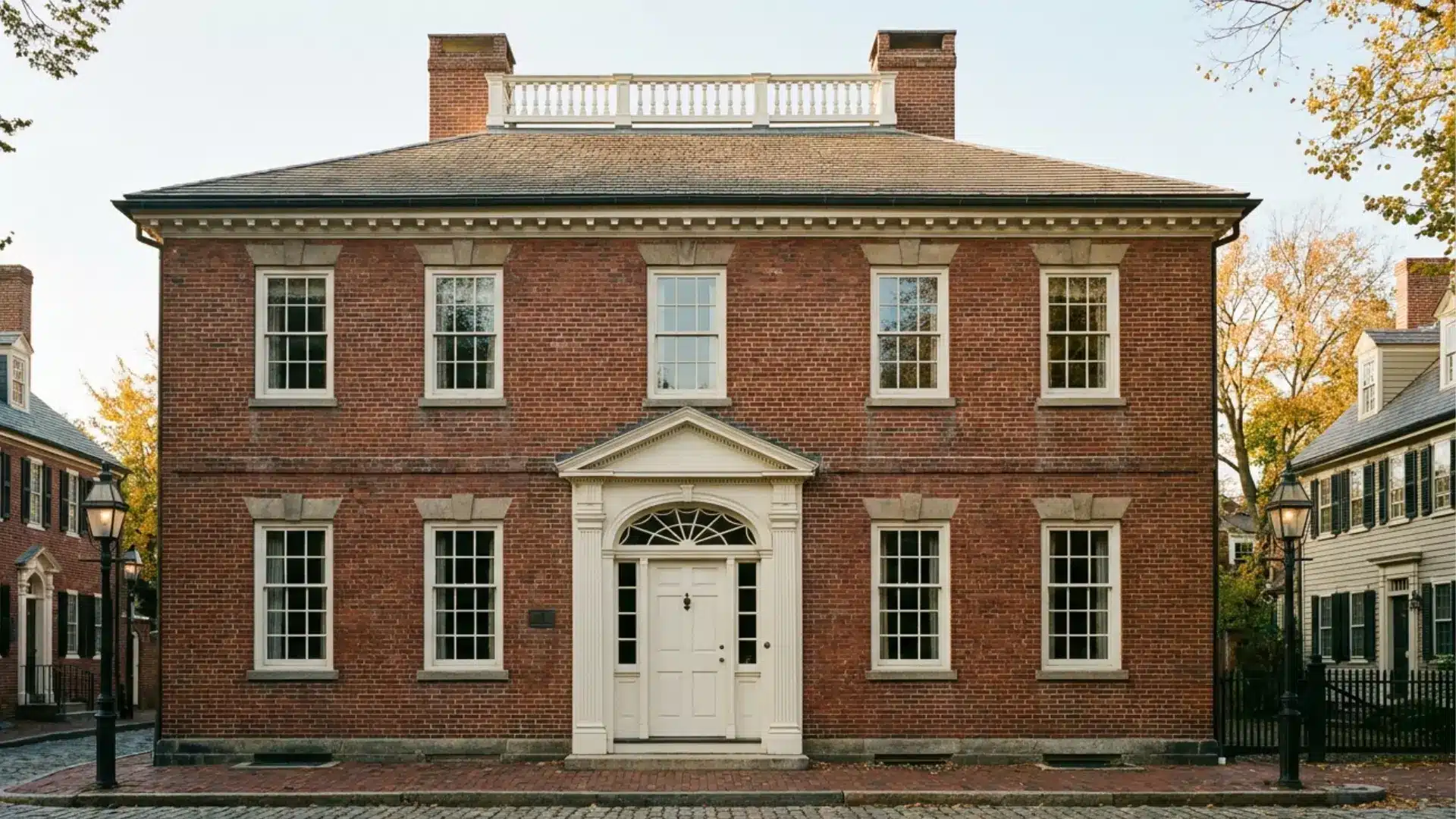


Have you ever stood in front of an old American home and felt a kind of quiet order, as if everything were exactly where it should be?
I noticed it the first time I walked through a preserved Federal-era neighborhood in Salem, Massachusetts. The homes weren’t grand or showy.
They were composed. Every window, every roofline, every doorway sitting in perfect relationship to everything else.
This guide explains the origins and design features of federal architecture, helping you easily recognize the style.
What Is a Federal Style House?
Before diving into details, it’s important to grasp what distinguishes Federal architecture as a style, not just a period.
A Federal-style house is a building from the first architectural movement to arise in the newly independent U.S., and was popular from 1780 to 1830.
Emerging from Georgian architecture, it incorporated Greek and Roman influences, resulting in a lighter, more elegant look with less ornamentation and precise proportions.
Characterized by symmetrical facades, centered entrances, low-pitched roofs, fanlights, sidelights, and restrained details, it draws heavily on the work of Scottish architect Robert Adam, earning the nickname ‘Adam Style.’ Unlike Georgian, it’s a refined evolution: thinner moldings, delicate motifs, and a lighter touch.
Historical Context and Evolution of Federal Architecture
Federal architecture didn’t appear out of nowhere. It was a direct response to a political moment. After the Revolution, a young country needed buildings that projected confidence, stability, and civic identity, without borrowing too heavily from British traditions.
Architects like Charles Bulfinch in Boston and Samuel McIntire in Salem shaped what that looked like in practice. Their work set the template that spread across New England, the Mid-Atlantic, and beyond.
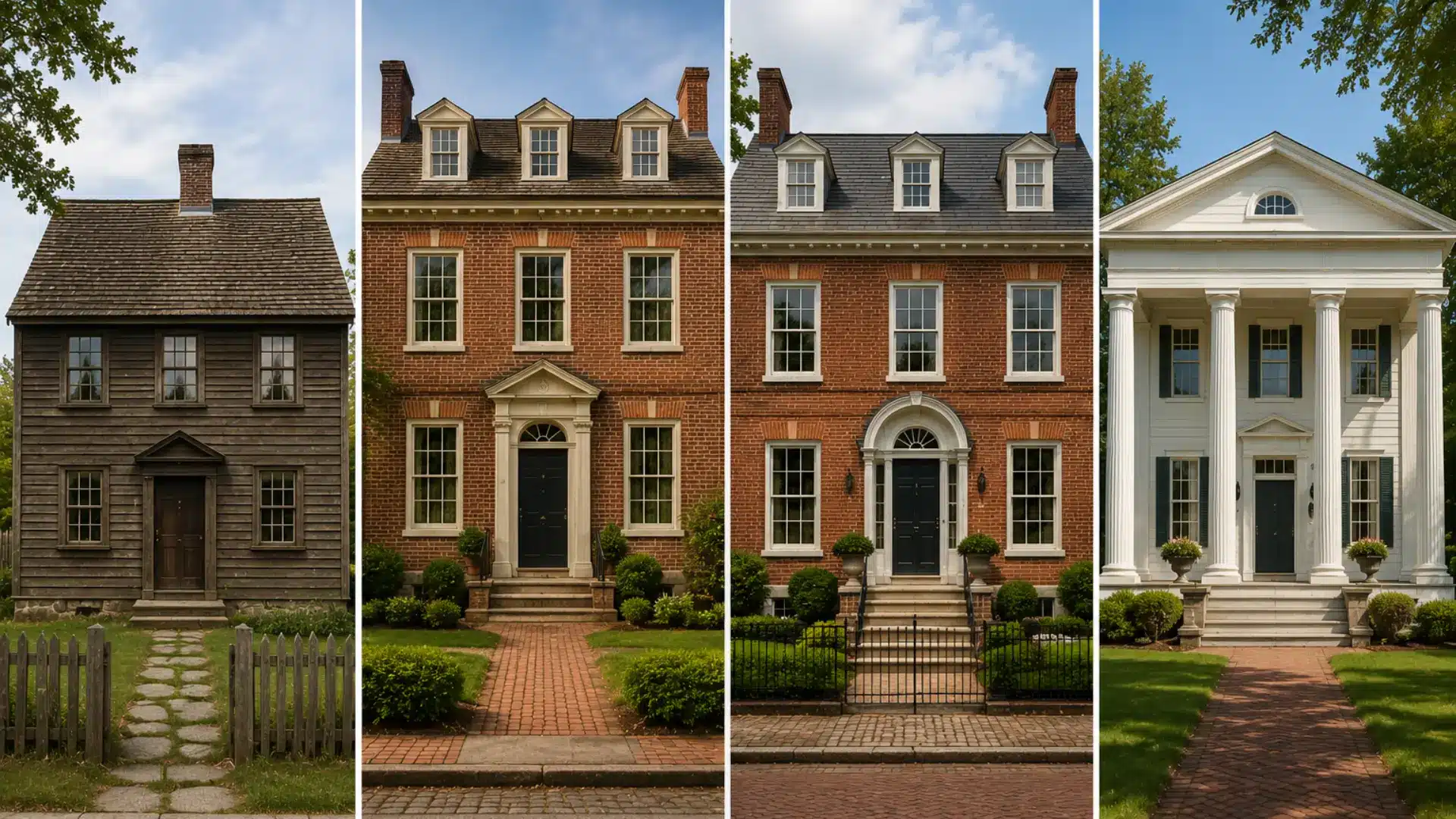
1. Colonial Architecture (1600s–1770s): Practical above all else. Homes were built to function, using whatever local materials were available. Decorative detail was minimal.
2. Georgian Architecture (1725–1800): More formal and symmetrical, with classical cornices and heavier ornamentation. A step toward grandeur, though still rooted in British influence.
3. Federal Architecture (1780–1830): A lighter, more refined version of Georgian. Neoclassical motifs replaced heavy trim. Fanlights, elliptical details, and elegant entryways became the signature.
4. Greek Revival Architecture (1830–1860): Bolder and more monumental. Columns, temple facades, and a heavier classical hand replaced Federal restraint.
Federal sits in the middle of that arc, between the practicality of Colonial design and the drama of Greek Revival. That in-between quality is exactly what gives it its character.
Characteristics of Federal Architecture
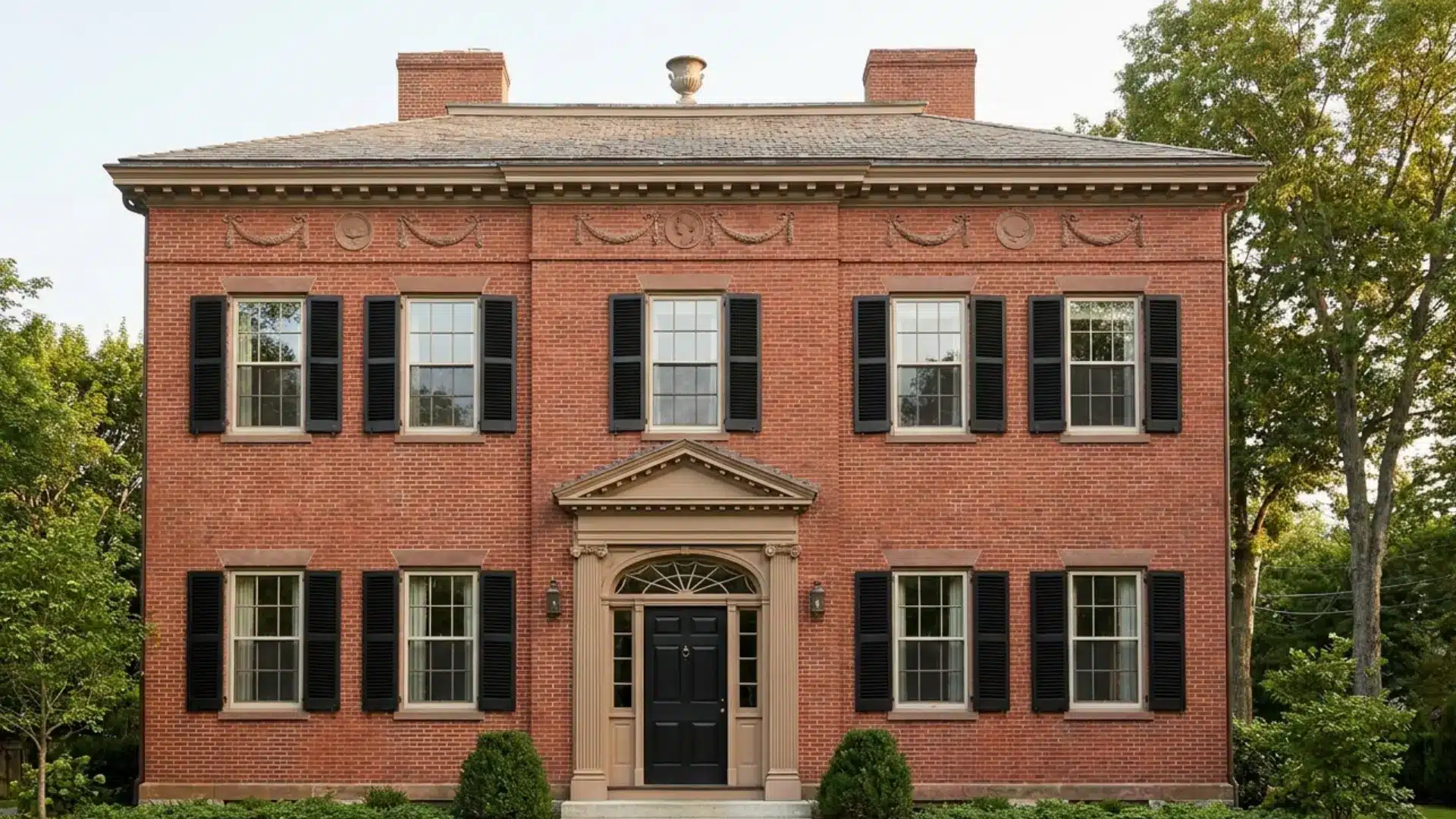
A client asked why a Federal home “feels different” from other historic styles before understanding what to look for. I said: because every element is in conversation with every other; nothing is accidental.
Here’s what to look for:
1. Symmetrical Facades
The facade is where Federal design announces itself most clearly. Windows and doors are arranged in a balanced, centered layout, typically a five-bay configuration with the entrance at the middle.
Unlike Georgian homes where symmetry feels imposed, Federal symmetry feels inherent. The proportions are worked out so precisely that the facade reads as a single composed unit.
2. Building Form and Massing
Federal homes are usually two or three stories, square or rectangular in plan, with clean, uncluttered lines. The massing is deliberate, with no unnecessary projections and no decorative excess. The form itself carries the visual weight.
3. Entryway Design
The front door is the focal point. Above it, a fanlight, semi-circular or elliptical, lets light into the entry hall. Narrow sidelights flank the door on either side, reinforcing the vertical axis and the home’s overall symmetry.
Door surrounds are classical but never heavy. The detailing is precise without being fussy. This is one of the easiest ways to distinguish a Federal home from a Georgian one: the Georgian entry tends to feel more muscular; the Federal entry feels more refined.
4. Roof Styles
Low-pitched side-gabled or hipped roofs are standard. Overhangs are minimal. The roofline remains quiet, keeping the eye on the facade. Chimneys, when present, are placed symmetrically.
If you’re already familiar with hip roof construction, you’ll recognize the form immediately on many Federal homes; it was a practical and visually clean choice for the period.
5. Window Design
Double-hung sash windows are most common, with thin muntins that create a lighter grid pattern than earlier multi-pane Georgian windows. More elaborate Federal homes may include Palladian windows or arched elliptical openings, particularly on upper floors or stair landings.
Window placement is never arbitrary. Each opening is sized and spaced to reinforce the overall compositional order.
6. Decorative Motifs
Federal ornament is neoclassical but restrained. Common motifs include swags, garlands, urns, medallions, sunbursts, eagles, and elliptical forms, references to ancient Greek and Roman design filtered through an American sensibility.
The key word is restraint. These elements appear at doorways, cornices, and interior plasterwork, not everywhere at once.
Federal Style House Features
The residential version of Federal architecture translates all of these principles into livable spaces. What’s worth noting is how consistently the same values, order, proportion, restraint, carry from the street facade all the way through to the interior.
Exterior: Materials and Facade
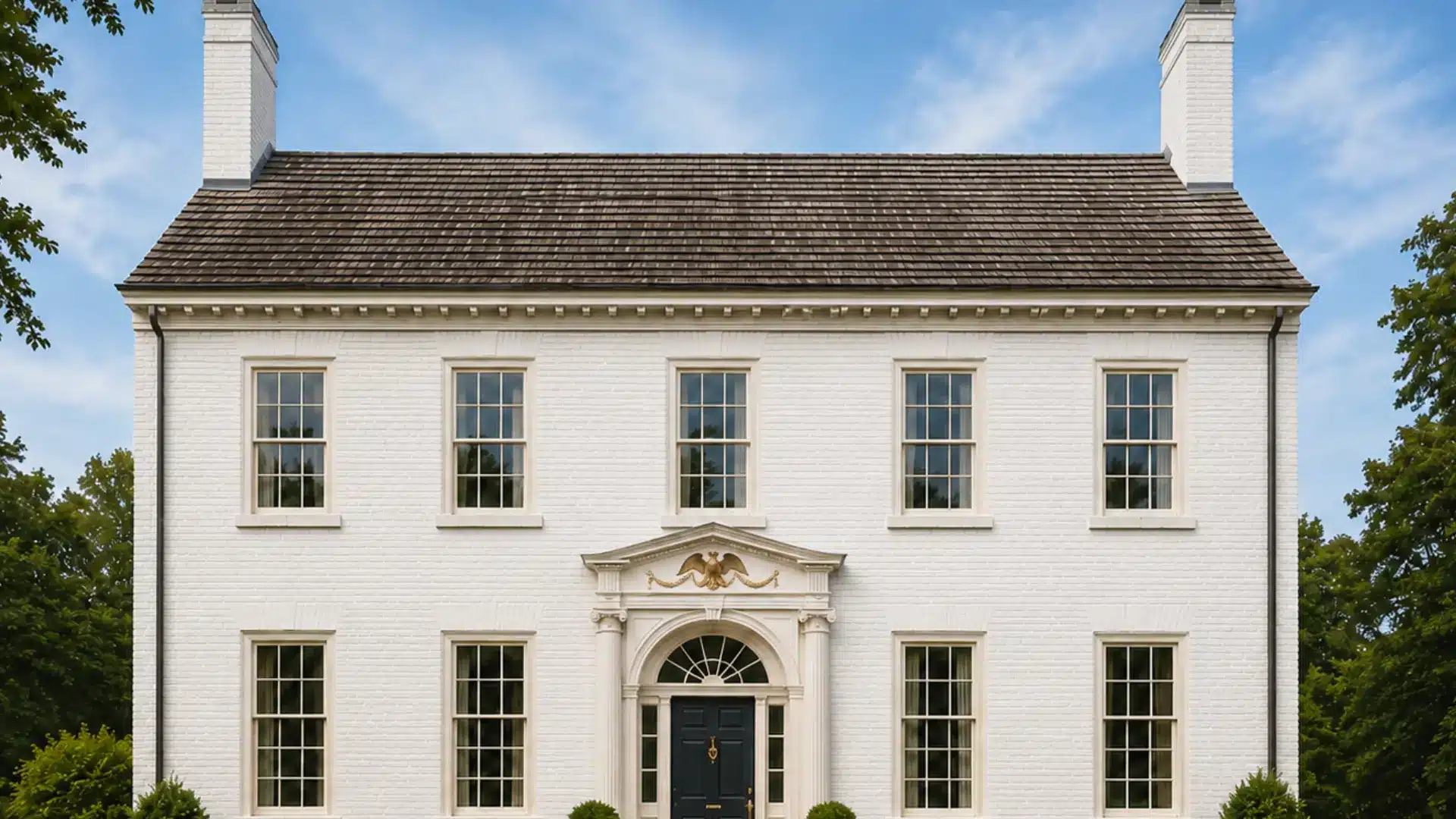
- Building Materials: Brick dominated in cities like Boston, Philadelphia, and Baltimore. Painted clapboard was more common across New England and rural areas. Stone appeared in regions where it was locally abundant.
- Facade Composition: Balanced proportions, smooth wall surfaces, centered entrance, and evenly spaced windows, all working together as a unified whole.
- Entryway Details: Fanlight above the door, sidelights on either side, and a classical door surround that draws attention without overpowering the facade.
- Roof and Chimneys: Low-pitched hipped or side-gabled roof with minimal overhang, chimneys placed to mirror each other.
- Windows and Trim: Double-hung sash windows with thin muntins; occasional Palladian or elliptical windows on grander homes; neoclassical motifs, swags, urns, eagles, used selectively on cornices and surrounds.
Interior Features of a Federal Style House
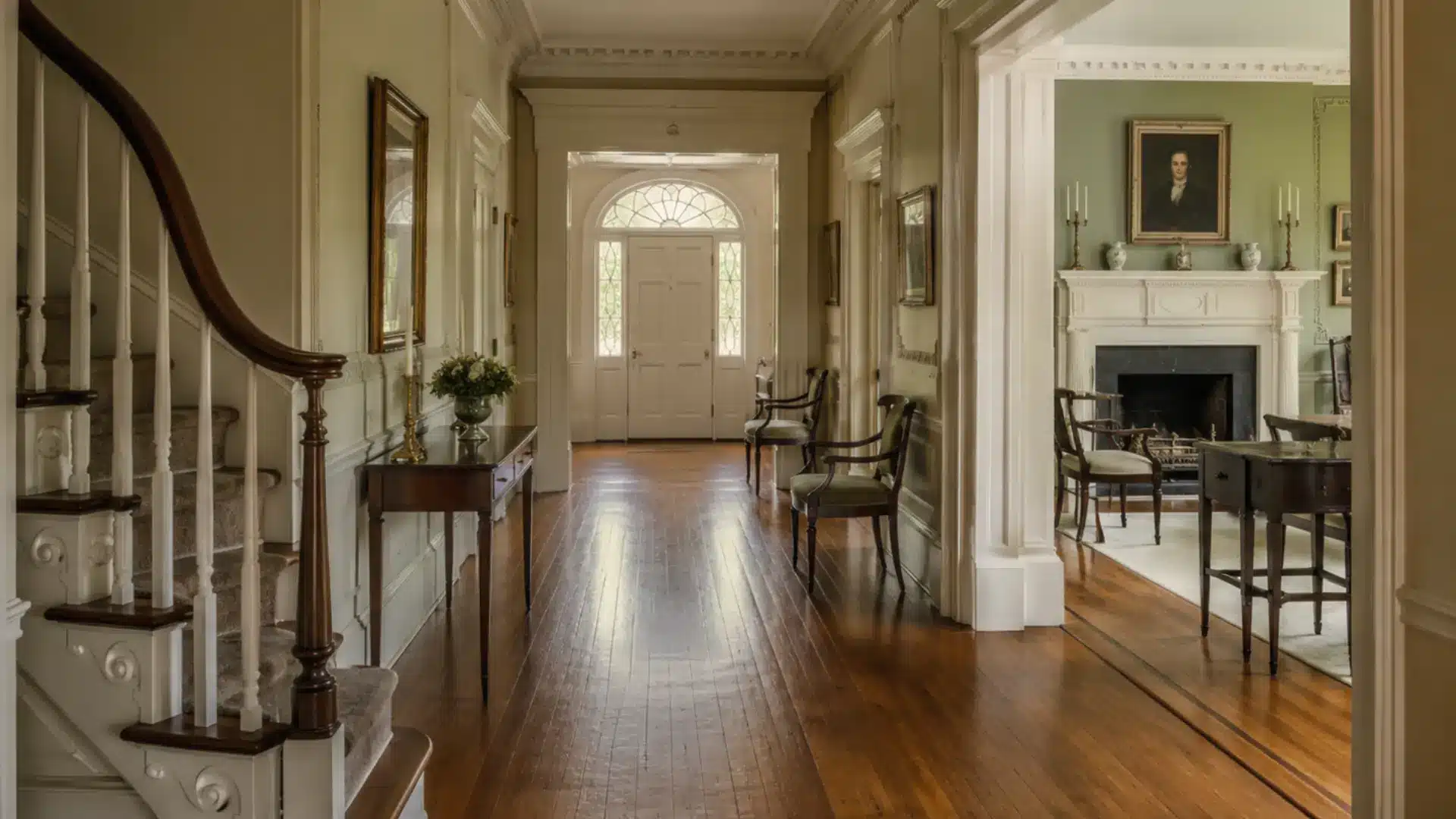
Step inside a Federal home and the exterior logic continues. Rooms are placed to either side of a central hallway, creating a clear axis through the house. Everything is planned around symmetry and formal sequence.
- Floor Plans: Central hallway with rooms arranged symmetrically on both sides, typically two rooms deep. The layout reflects both social convention and classical planning principles.
- Architectural Details: Refined staircases with delicate balusters, classical mantels framing fireplaces, plaster cornices and ceiling medallions, and door surrounds with pilasters or entablatures.
- Furniture and Decor: Federal interiors pair well with neoclassical American furniture, think Hepplewhite and Sheraton styles, that echo the same emphasis on lightness, proportion, and restrained ornament.
Tip: To identify a Federal style house, look for the combination of a symmetrical five-bay facade, centered fanlight entry with sidelights, low-pitched roof, and thin-muntin sash windows. Neoclassical motifs, urns, swags, eagles, medallions, should appear selectively, not everywhere. The overall impression should be elegant and ordered, not ornate.
Materials Used in Federal Style Houses
Material choices in Federal homes were driven by what was locally available, what the climate demanded, and what the homeowner could afford. Despite those variables, the results shared a consistent character: durable, well-crafted, and visually clean.
- Brick: The material of choice in urban centers. Dense, formal, and long-lasting, well suited to the civic ambitions of Federal-period builders. Many surviving Federal townhouses in cities like Salem and Alexandria are brick.
- Clapboard Siding: Standard across New England. Wood-framed and painted white or light colors, clapboard Federal homes have a crisp, orderly look that holds up well in the historic streetscapes of towns like Newburyport and Portsmouth.
- Stone: Used regionally where quarried stone was accessible. Stone Federal homes are less common but retain all the characteristic proportions and detailing of the style.
- Wood Trim and Millwork: High-quality hardwood for doors, window casings, staircases, and interior moldings. The craftsmanship in Federal millwork is often extraordinary, thin, precise profiles that required skilled hands to execute.
- Plaster: Interior walls and ceilings were finished in plaster, which allowed for decorative work: ceiling medallions, friezes, and cornices that gave Federal interiors their characteristic refinement.
Federal Style vs. Other Architectural Styles
Federal architecture sits at a pivot point in American design history, after the Georgian period and before Greek Revival took over. That position shapes how it compares to each neighboring style.
| Feature | Federal Style | Georgian | Colonial | Colonial Revival | Greek Revival |
|---|---|---|---|---|---|
| Time Period | 1780–1830 | 1725–1800 | 1600s–1770s | 1880–1950s | 1830–1860 |
| Appearance | Light, refined | Formal, heavy | Simple, functional | Mixed traditional | Bold, monumental |
| Symmetry | Strong | Strong | Moderate | Strong | Strong |
| Ornamentation | Delicate | Heavy | Minimal | Moderate | Bold |
| Entry Design | Fanlights, sidelights | Simple classical | Plain | Revived historic styles | Large columns, grand |
| Roof Style | Low-pitched | Medium-pitched | Steep/simple | Varied | Low-pitched |
| Windows | Sash, elliptical | Multi-pane | Small | Larger, mixed | Large, rectangular |
| Columns | Minimal | Occasional | Rare | Sometimes used | Prominent |
| Motifs | Swags, urns, eagles | Classical trim | Limited | Mixed styles | Greek temple forms |
The Federal style house occupies a specific lane: more polished than Georgian, less theatrical than Greek Revival. It’s the style that figured out how to be both civic and livable, which is probably why so many Federal homes have survived in such good condition.
Common Mistakes to Avoid When Identifying a Federal Style House
Even experienced observers misread Federal homes. Here’s where identification tends to go wrong:
- Confusing Federal with Georgian: Both are symmetrical, but Georgian homes carry heavier cornices, thicker moldings, and denser ornament. Federal homes feel lighter. If the detailing looks muscular, it’s probably Georgian.
- Relying on one feature: A fanlight alone doesn’t confirm Federal. Look for the full combination, fanlight, sidelights, low-pitched roof, five-bay facade, thin-muntin windows, before drawing a conclusion.
- Missing regional variation: A Federal brick townhouse in Baltimore looks quite different from a clapboard Federal home in coastal Maine. Same principles, very different materials and scale.
- Confusing Colonial Revival with original Federal: From the 1880s onward, Colonial Revival builders borrowed Federal details liberally. A home with Federal-looking features built in 1910 is almost certainly Colonial Revival, not Federal.
- Discounting altered homes: Replacement windows, added porches, and modernized facades are common on historic homes. Don’t dismiss a property based on surface changes, look at the underlying structure and proportions.
- Expecting grandeur: Many Federal homes were modest. Scale doesn’t determine the style, proportion and detail do.
Where Federal Style Houses Are Best Preserved
Federal residential streetscapes survive in greatest concentration along the northeastern seaboard, with a few notable clusters further south. These cities are worth knowing whether you’re visiting, researching, or evaluating a period property.
| City / Neighborhood | State | Notable Example | Why It Stands Out |
|---|---|---|---|
| Salem & Newburyport | Massachusetts | Gardner-Pingree House (1804) | Samuel McIntire’s finest residential work, intact Federal streetscapes |
| Beacon Hill | Boston, MA | Harrison Gray Otis House (1796) | Dense concentration of Federal brick rowhouses; open to the public |
| Old Town | Alexandria, VA | Lee-Fendall House (1785) | Strong Mid-Atlantic Federal vernacular; primarily brick construction |
| South End & Strawbery Banke | Portsmouth, NH | Moffatt-Ladd House (1763) | Range of Federal scales from modest clapboard to formal commissions |
| Historic District | Charleston, SC | Nathaniel Russell House (1808) | Finest Southern Federal example: elliptical freestanding staircase |
Frequently Asked Questions
How do I know if a historic home is actually Federal period or a later revival?
Check the construction date first. Original Federal homes were built between roughly 1780 and 1830. A home built after 1880 with Federal-looking details is almost certainly Colonial Revival. Local historic registries and deed records can confirm the actual build date.
Can a Federal-style house have an addition or renovation and still be considered Federal?
Yes. Preservation standards focus on retaining the character-defining features, facade composition, entryway details, window placement, and interior trim. A well-executed addition that doesn’t compromise those elements doesn’t disqualify the home from its Federal classification.
What exterior paint colors are typical for Federal-style homes?
Off-whites, soft yellows, pale grays, and muted earth tones were most common. Brick homes were often left unpainted, with white trim. Bold or saturated colors are not consistent with the period’s restrained aesthetic.
Is the Adam Style the same as Federal architecture?
Largely yes. The Adam Style refers to the influence of Scottish architect Robert Adam, whose neoclassical vocabulary, elliptical motifs, delicate ornament, and refined plasterwork were the primary inspiration for American Federal architecture. In the U.S., “Federal” is the standard term, but both describe the same design tradition.
Conclusion
A federal-style house is what happens when a young country decides that how it builds reflects what it’s saying about itself. The symmetry wasn’t just aesthetic; it was a statement about order, reason, and civic ambition.
Federal architecture managed something genuinely difficult: it created a distinctly American design language by refining, rather than copying, what came before it.
Lighter than Georgian, more human-scaled than Greek Revival, it remains one of the most livable and visually coherent styles in the American residential canon.
Whether you’re touring a historic district, evaluating a period property, or simply trying to make sense of what you’re looking at on a quiet New England street, knowing the federal house style gives you a new way to read the built environment around you.