

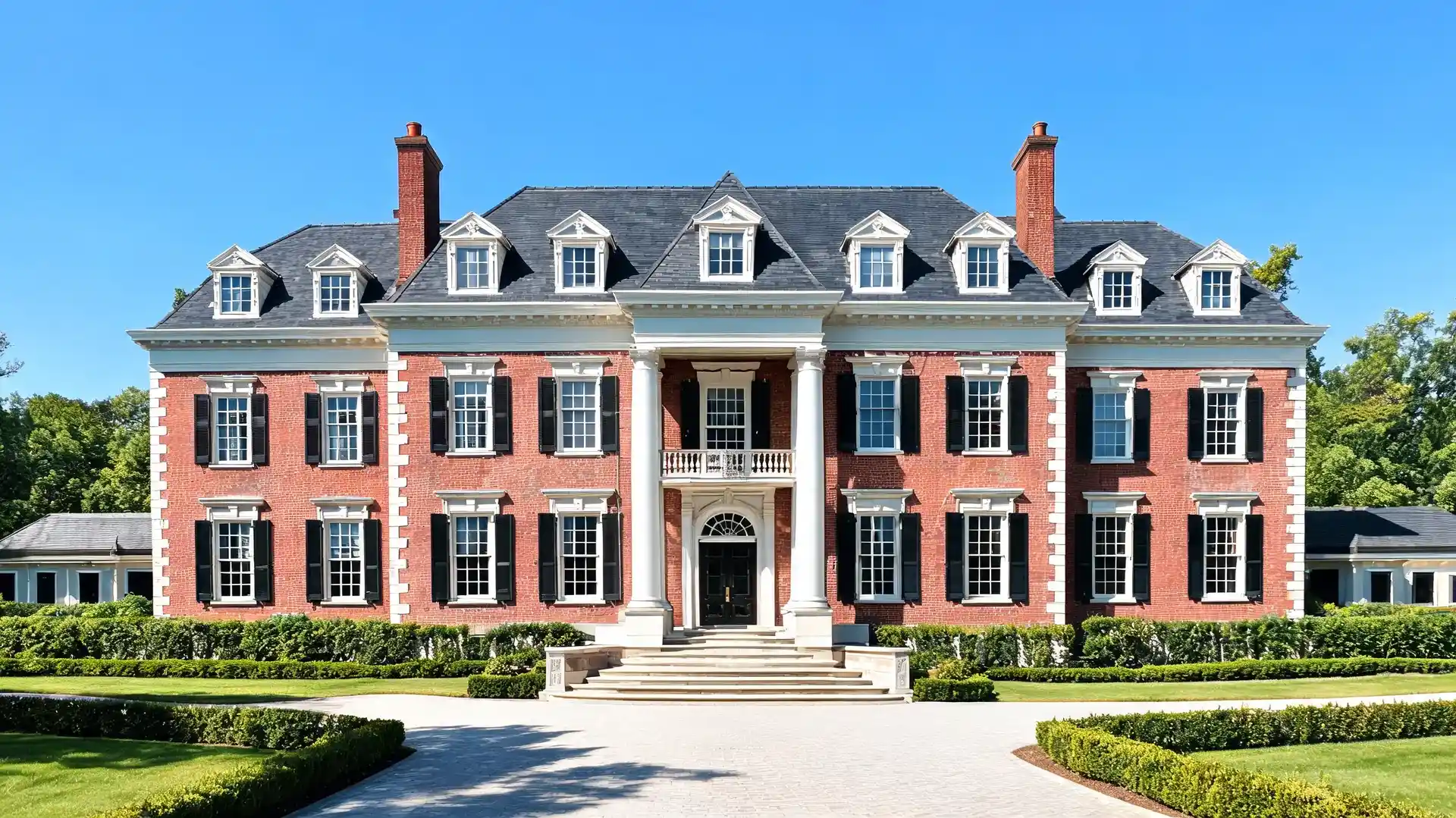


Have you ever looked at an old brick home and noticed how perfectly everything lines up? That is often the pull of Georgian architecture. This classical building style is known for symmetry, proportion, brick or stone exteriors, sash windows, and a calm, formal look.
Once you know the signs, it becomes much easier to recognize them in old houses, townhouses, terraces, civic buildings, and American colonial homes.
I’ll explain where the style came from, what makes it different, how it shaped interiors and streets, and what details to look for when you see a Georgian building today.
What Georgian Architecture Actually Is
Georgian architecture is a building style defined by one thing above everything else: every element on the facade earns its place through proportion. If a window is the wrong size, it pulls the whole front out of balance.
If the door is off-center by a foot, the entire elevation reads as wrong. That precision is not accidental. It is the core logic that ran through British construction from 1714 to 1830, and it is why Georgian buildings still hold up visually today.
The style draws directly from ancient Greek and Roman design, filtered through Italian Renaissance principles and applied to brick-and-mortar construction across Britain, Ireland, and eventually the American colonies.
Once you understand what Georgian architecture is built around, you start seeing its fingerprints everywhere: in terraced townhouses, civic halls, colonial plantation homes, and the Georgian Revival houses going up in new developments right now.
| Style Name | Georgian Architecture |
| Period | 1714 to 1830 (reigns of Kings George I through IV) |
| Origins | Classical Greek and Roman design via the Italian Renaissance (Palladian influence) |
| Defining Feature | Symmetry and proportion: centered doors, evenly spaced sash windows, balanced facades |
| Primary Materials | Brick (towns), stone (grand houses), stucco (later Regency period) |
| Found In | Britain, Ireland, the American colonies, and Georgian Revival homes today |
| What It Replaced | Baroque excess and heavy ornament; folk-style colonial dwellings in America |
The table above gives you the factual skeleton. What the table cannot show is how these principles translate into specific decisions for a real building, from the spacing of windows to the height of ceilings to the placement of chimneys. That is what the rest of this article walks through.
The History Behind Georgian Architecture
The Georgian style developed during a period of growth, trade, and urban planning in 18th-century Britain. As towns expanded, builders used classical ideas to create homes and public buildings that felt refined, practical, and easy to organize.
Key historical influences included:
- Britain’s growing wealth and demand for formal homes
- Planned streets, terraces, squares, and crescents
- Palladian design, with columns, pediments, and classical proportions
- The spread of British building traditions to Ireland and North America
- Later adaptations, including Regency, Federal, and Georgian Revival styles
These influences made Georgian architecture more than a house style. It became a clear design language based on proportion, restraint, and practical planning. That is why many Georgian buildings still feel formal, calm, and easy to recognize today.
The Five Core Principles of Georgian Architecture
Every recognizable Georgian building follows the same five design principles. These are not decorative choices. They are structural logic that determines what gets built and where.
1. Symmetry
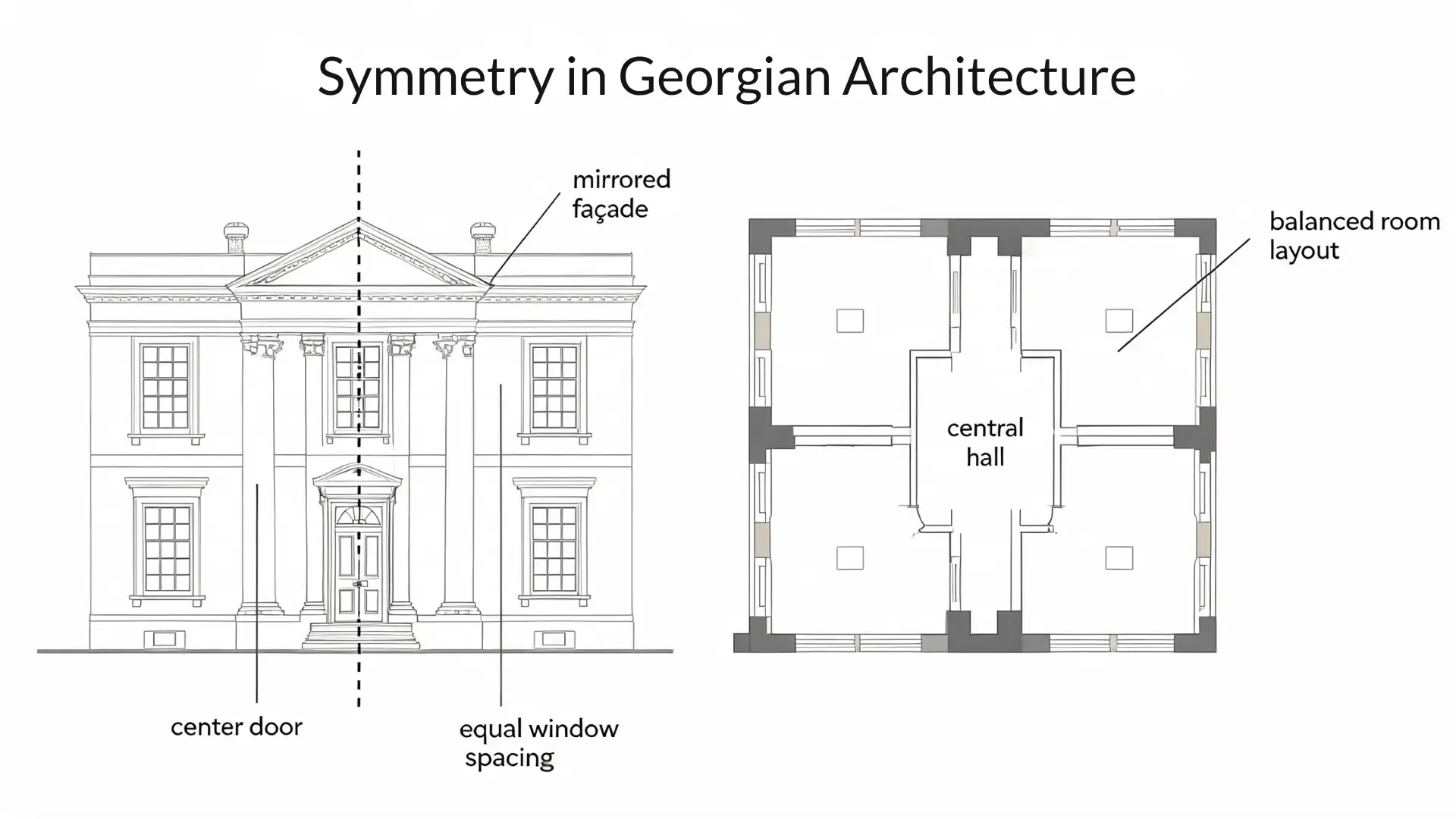
The front door sits at the center. Windows are placed in matched pairs on either side, at consistent spacing across each floor.
The roofline, chimneys, and any decorative details mirror each other left to right. This is the most immediately legible feature of Georgian architecture, and the easiest to check: stand in front of the building and draw an imaginary vertical line down the center. If both sides are true mirrors, you are almost certainly looking at a Georgian design.
Inside, the same logic continues. A central entrance hall runs front to back, with rooms arranged in balanced positions on either side. The layout is not just aesthetic. It makes the house easy to navigate and gives every main room equal relationship to the central axis.
2. Proportion
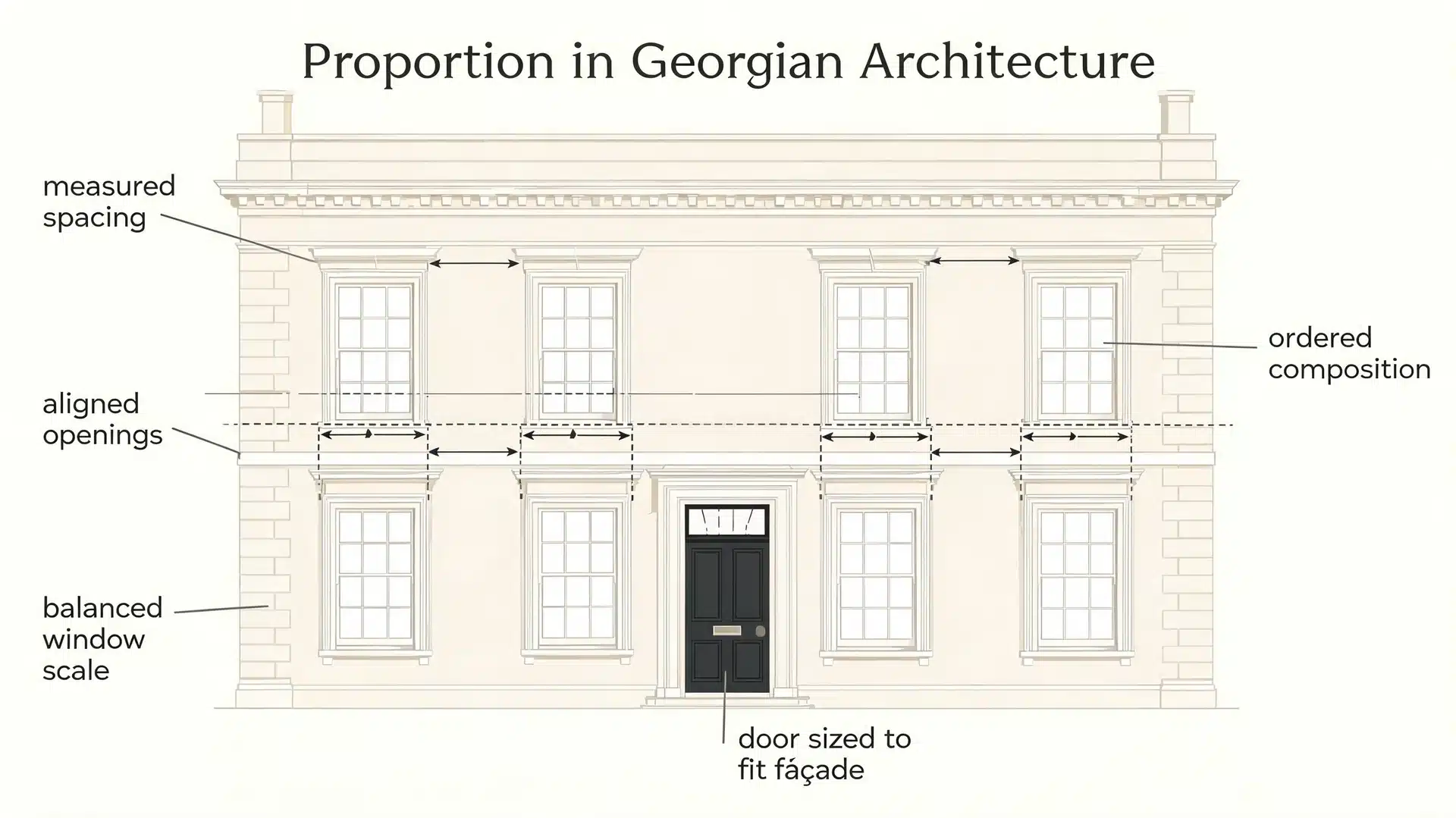
Proportion in Georgian design means that every element, window, door, room height, facade width, relates mathematically to every other element. A window is not placed based on how it looks in isolation.
It is sized and positioned based on the total height and width of the wall it sits in. A door surround is not chosen for ornament alone. Its height, its frame width, and its relationship to the windows beside it all follow deliberate rules.
This is the principle most responsible for why Georgian buildings look considered even when their detail is minimal. The math is doing the work that decoration is not.
3. Classical Influence
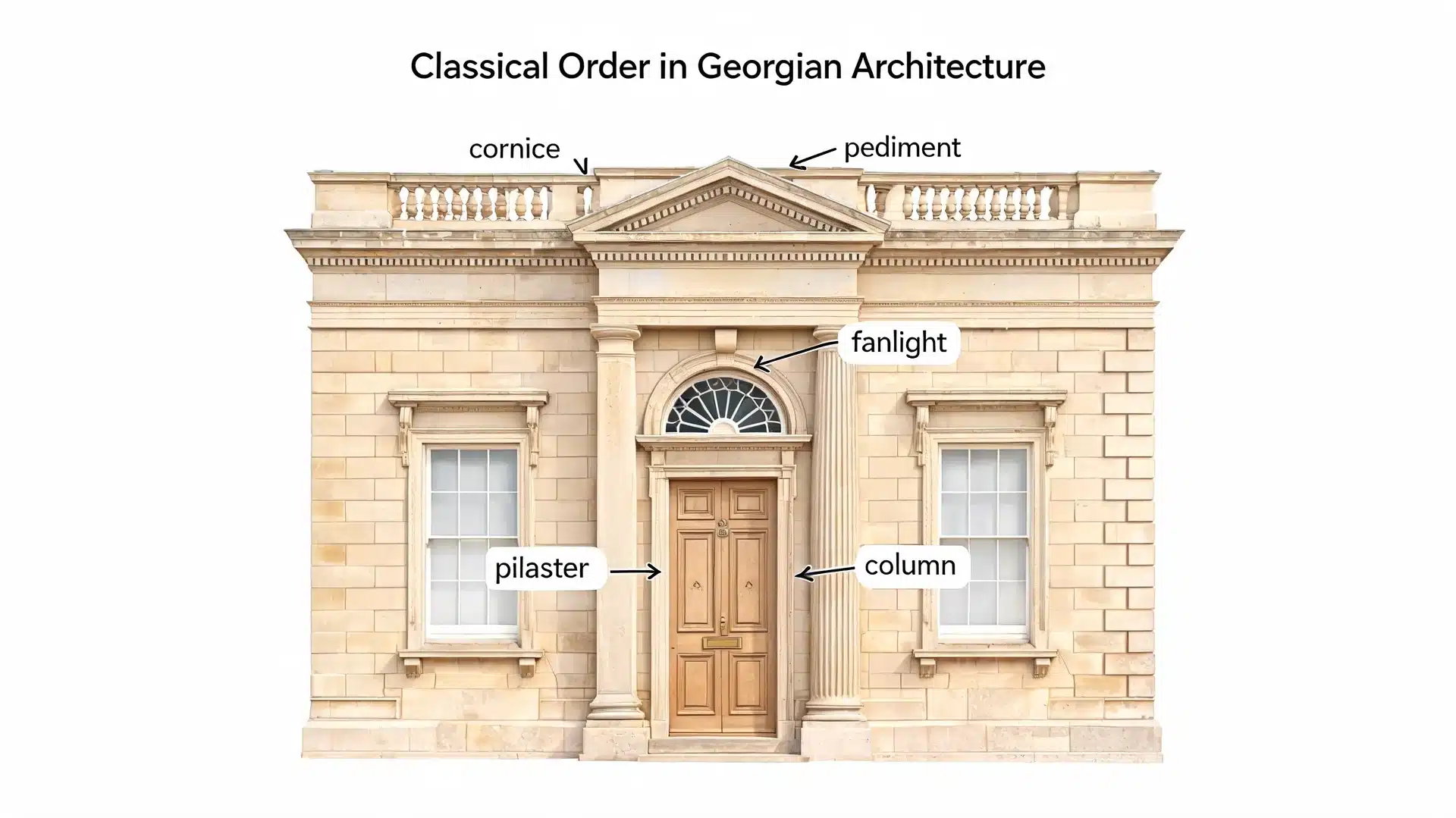
Georgian buildings borrowed specific classical vocabulary from ancient Greece and Rome: columns or pilasters flanking a doorway, a pediment (the triangular element) above an entrance, a cornice line at the roofline, a fanlight above the front door. These were not decorative flourishes chosen at random.
Each had a classical precedent and a defined position in the building’s hierarchy.
The key distinction from earlier Baroque styles is restraint. Classical elements were used precisely and sparingly. A pediment on a doorway, yes. Pediments on every window as well? That would have been considered excessive. Georgian design favored control over display.
4. Light and Space
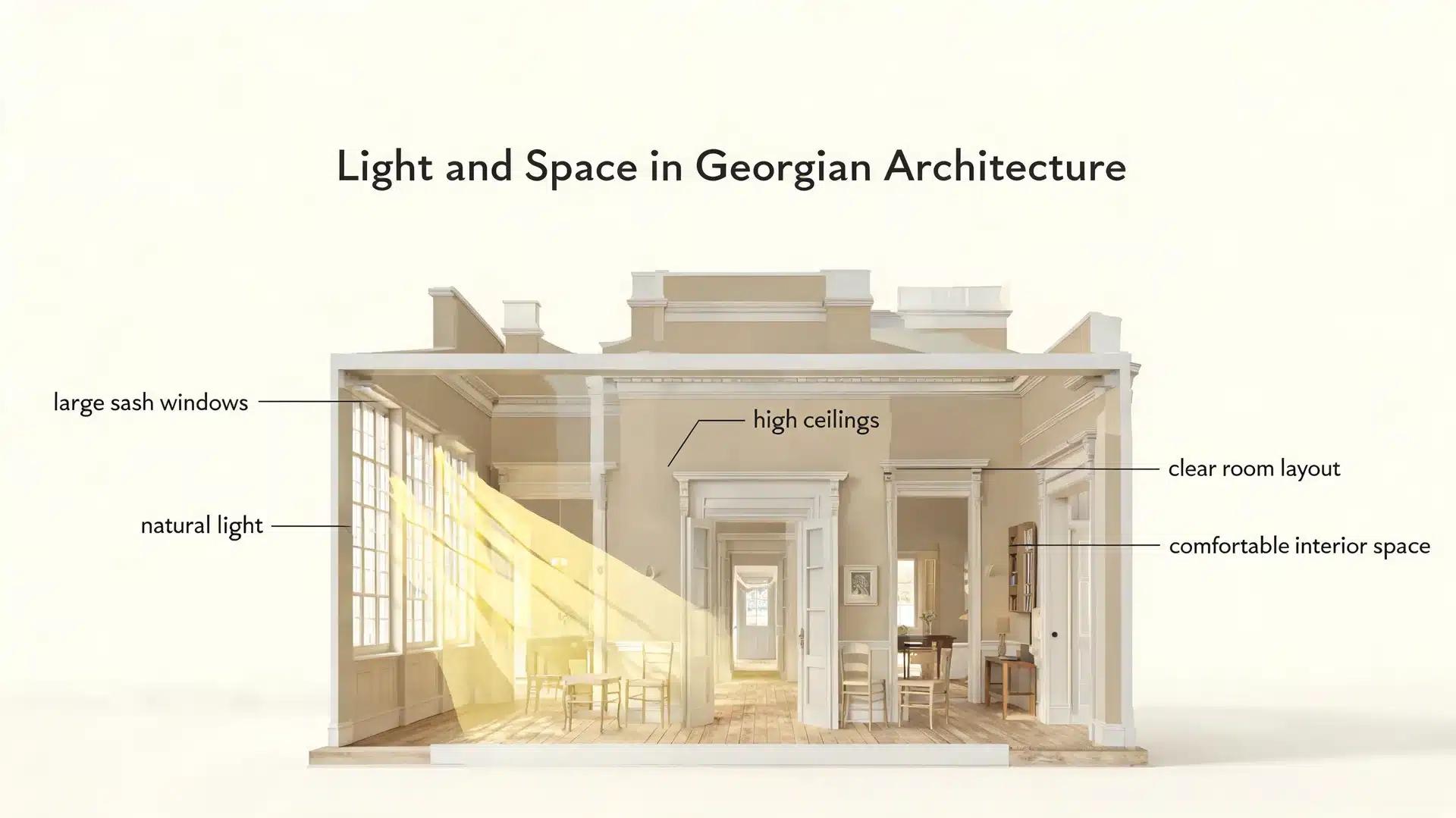
Tall sash windows, often running to near ceiling height in formal rooms, served two functions: they brought daylight deep into the interior, and they reinforced the proportional rhythm of the facade from outside.
High ceilings in principal rooms allowed those large windows without making the room feel compressed. The combination created interiors that read as spacious and well-lit by the standards of any era, not just the 18th century.
In more modest Georgian homes, the same principles applied at smaller scale. The windows were still tall relative to the room. The ceilings were still higher than strictly necessary. Light and space were not luxuries reserved for grand houses. They were built into the design logic at every level of the market.
5. Restraint
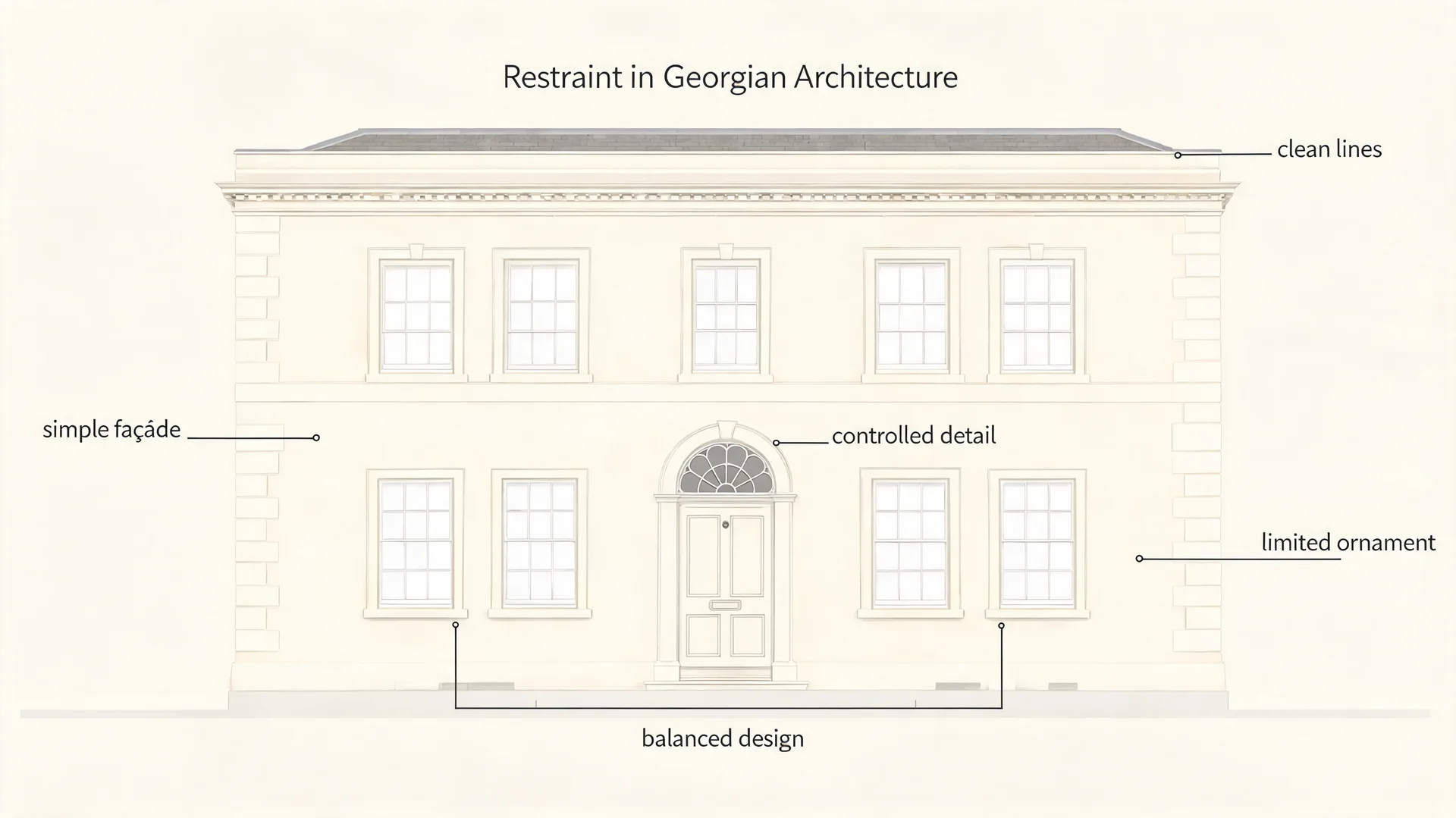
The fifth principle is what separates Georgian from Victorian. Where Victorian architecture added more molding, more color, and more carved detail, Georgian design held back.
A Georgian cornice is present because it marks the transition between wall and roof. It is not carved into elaborate foliage. A Georgian door surround has a fanlight because the fanlight brings light into the hall. It is also encrusted with decorative metalwork.
Late Georgian and Regency buildings pushed this boundary somewhat, adding ironwork balconies and stucco facades. But even in those cases, the underlying discipline of proportion kept the design from tipping into excess.
Restraint was not austerity. It was the principle that decoration should serve the structure, not compete with it.
Georgian Architecture Features: What to Look For Outside
Knowing the principles is one thing. Spotting the specific features on an actual building is another. Here is what to look for on the exterior of a Georgian building, and what each feature tells you about the design logic behind it.
Brick, Stone, and Stucco Facades
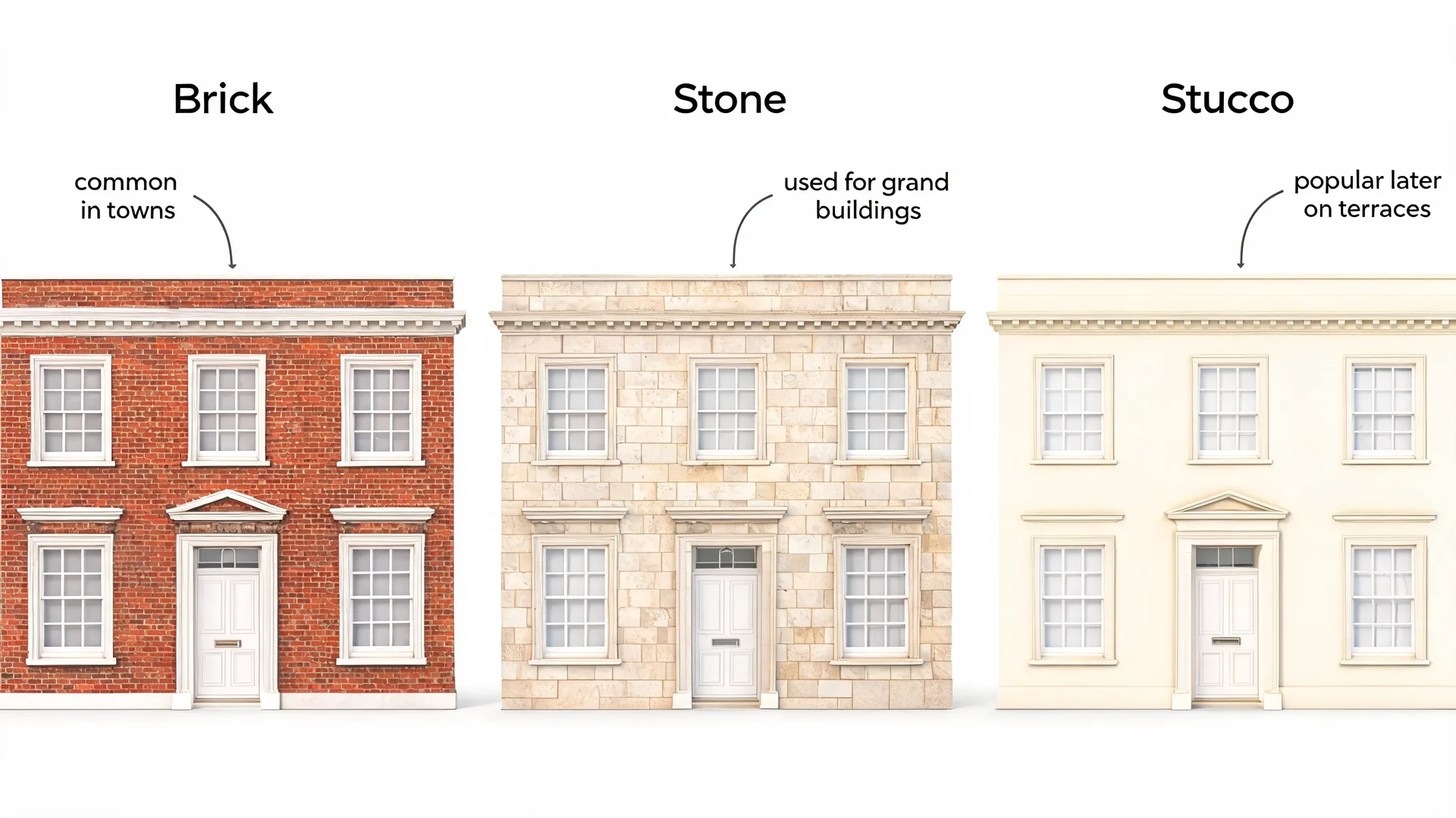
Material choice in Georgian architecture followed clear conventions based on location and budget.
Brick was the standard for urban townhouses and terrace housing because it was locally available, practical for repetitive construction, and produced even, flat facades that suited the Georgian preference for controlled surfaces. Stone appeared on grander country houses and public buildings where owners wanted a heavier, more permanent look.
Stucco became increasingly common in the later Georgian and Regency periods, particularly on high-status terraces in London and other cities. It gave buildings a smooth, pale surface that read from a distance as more expensive than plain brick. The material changed; the proportional logic underneath did not.
The Front Entrance
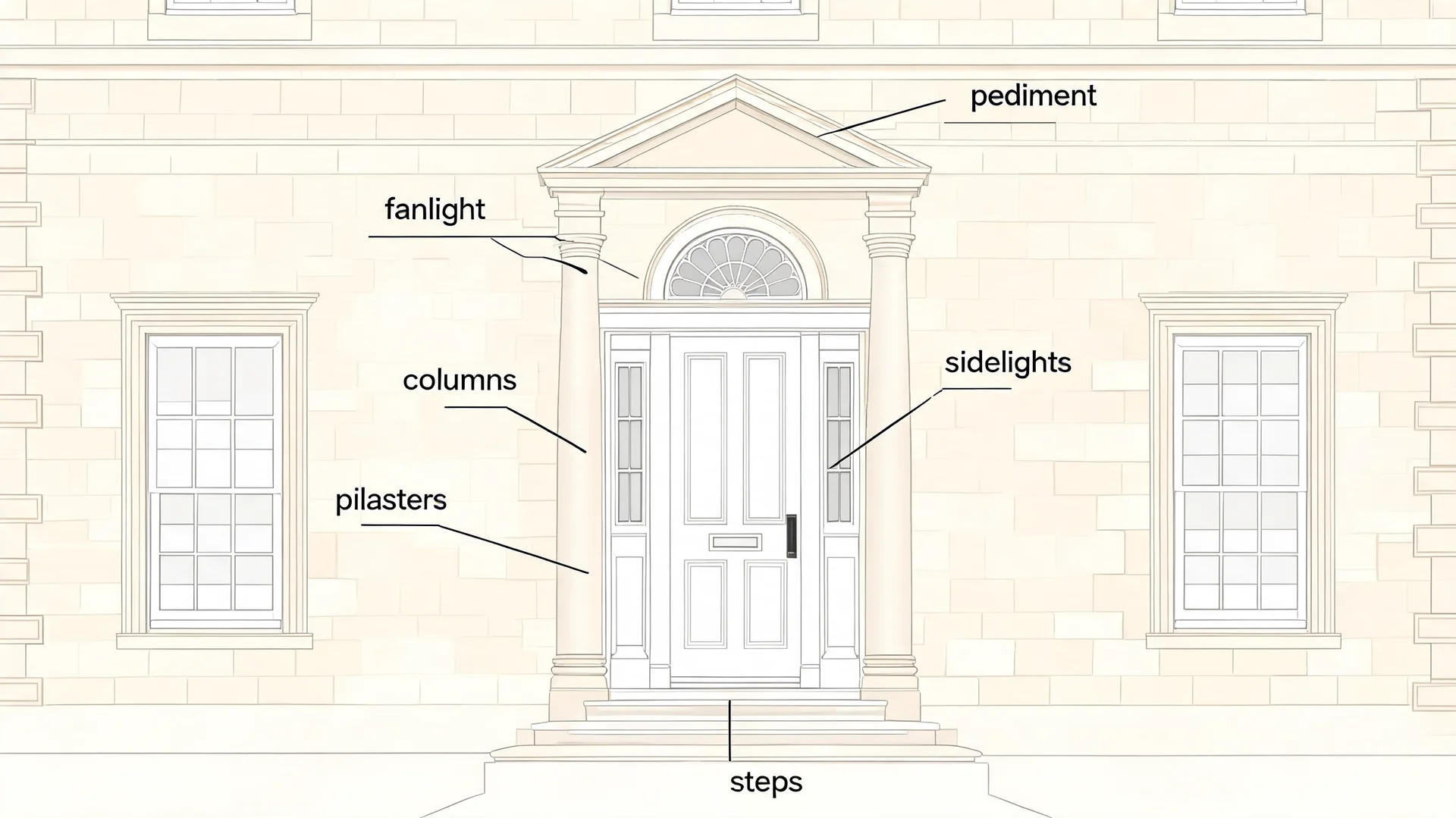
The front door in a Georgian building is always a design statement, not just an opening. It sits in the exact center of the facade.
It is framed by one or more of the following: columns or pilasters on either side, a pediment above, sidelights (narrow windows flanking the door), and a fanlight above. The fanlight is the most immediately recognizable feature: a semicircular or rectangular window set directly above the door, usually with decorative glazing bars in a fan or geometric pattern.
The purpose of the fanlight was practical as well as decorative. The entrance hall of a Georgian townhouse was often narrow and received no direct window light.
The fanlight solved that problem while simultaneously making the entrance look more formal and considered. If you spot a fanlight, you are almost certainly looking at a Georgian building or a Georgian Revival one.
Rooflines and Chimneys
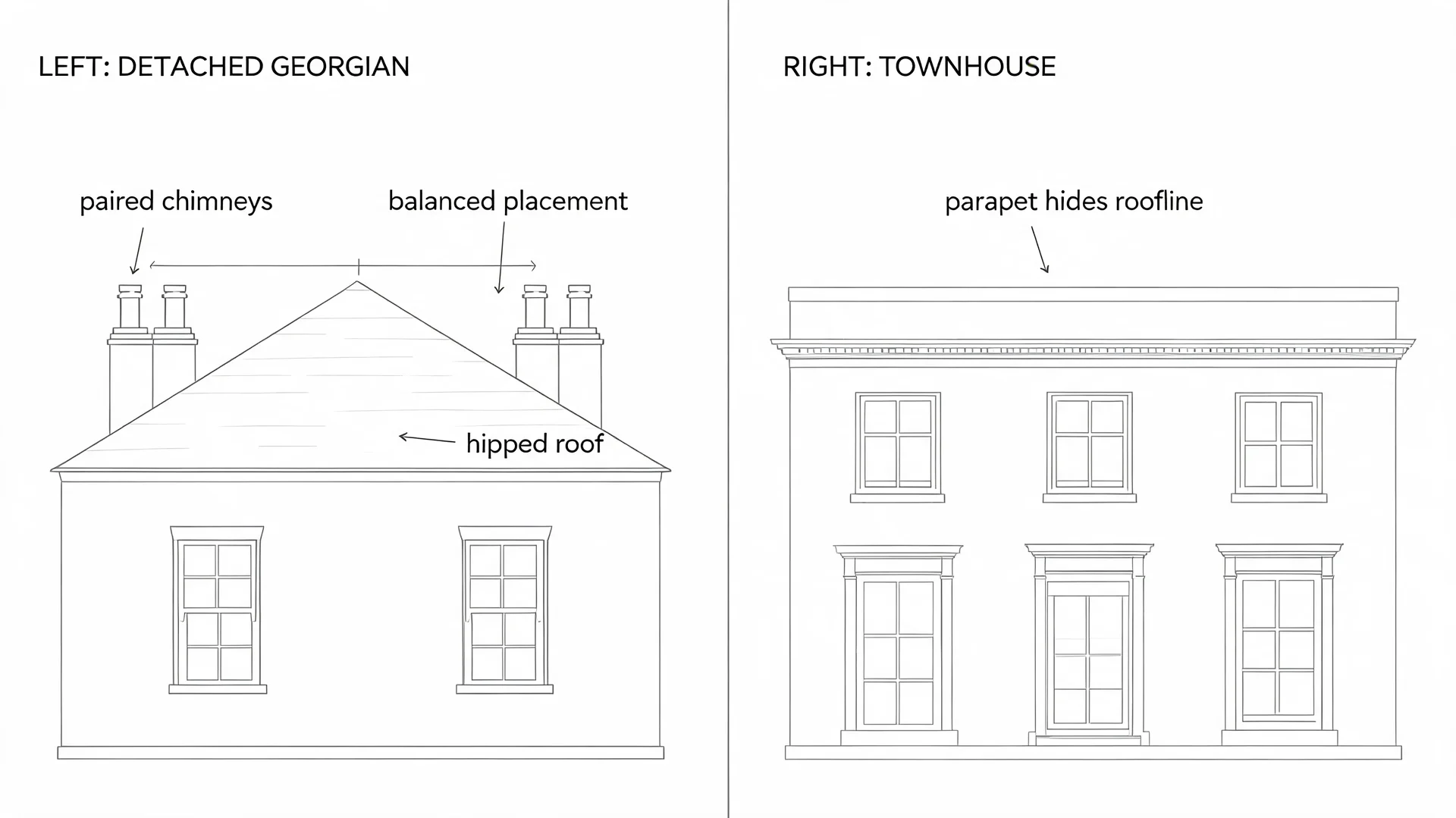
Georgian roofs are typically hipped on all four sides, sloping to a ridge rather than ending in a gable at each end. This gives the building a neat, contained profile from any angle. On terraces and townhouses, a parapet wall often hid the roof entirely from street view, making the facade read as a clean horizontal line at the top.
Chimneys were placed symmetrically. In a detached house, you will typically find them in matched pairs, positioned so they do not disturb the building’s left-right balance. Even practical infrastructure was subject to the same proportional discipline applied to windows and doors.
Georgian Interiors: What Happens Inside
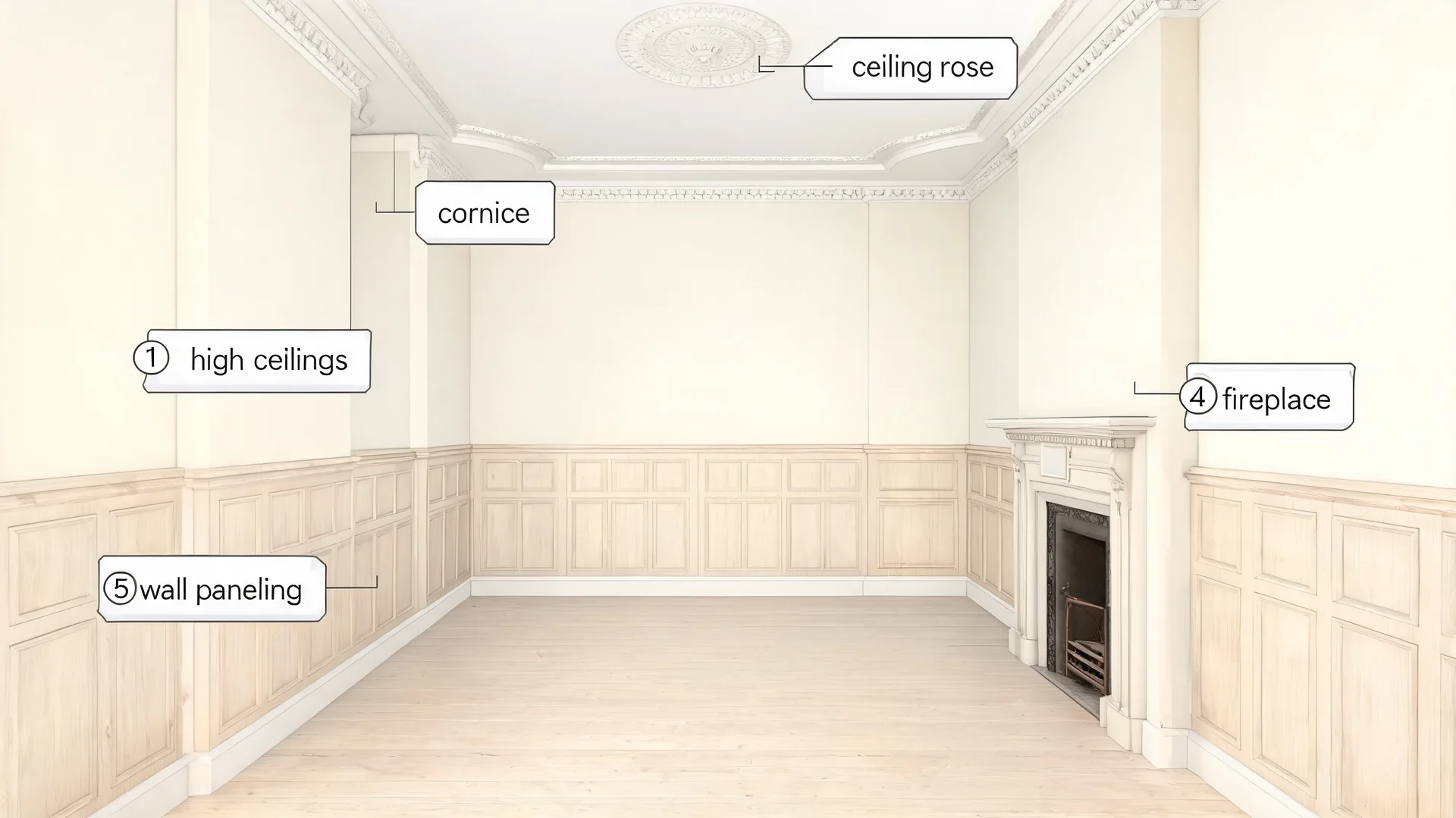
Georgian exterior logic carries into the interior. A central hall organizes the layout, with main reception rooms balanced on either side and secondary or service areas toward the back or basement, keeping principal spaces formal and uncluttered.
Rooms follow strict proportions: ceiling height matches floor area, and fireplaces align on central axes. Common features include crown molding, cornices, ceiling roses, paneled walls, and formal staircases.
Wealthier homes added elaborate plasterwork; modest townhouses kept details simple. The core principles, proportion and clear axes, translate to contemporary spaces, ensuring rooms feel balanced regardless of style or period-appropriate decoration.
The rules that underpin minimalist home decor share more with Georgian thinking than most people expect: both approaches rely on proportion and restraint rather than surface decoration to make a room work.
Georgian Townhouses and Terraces
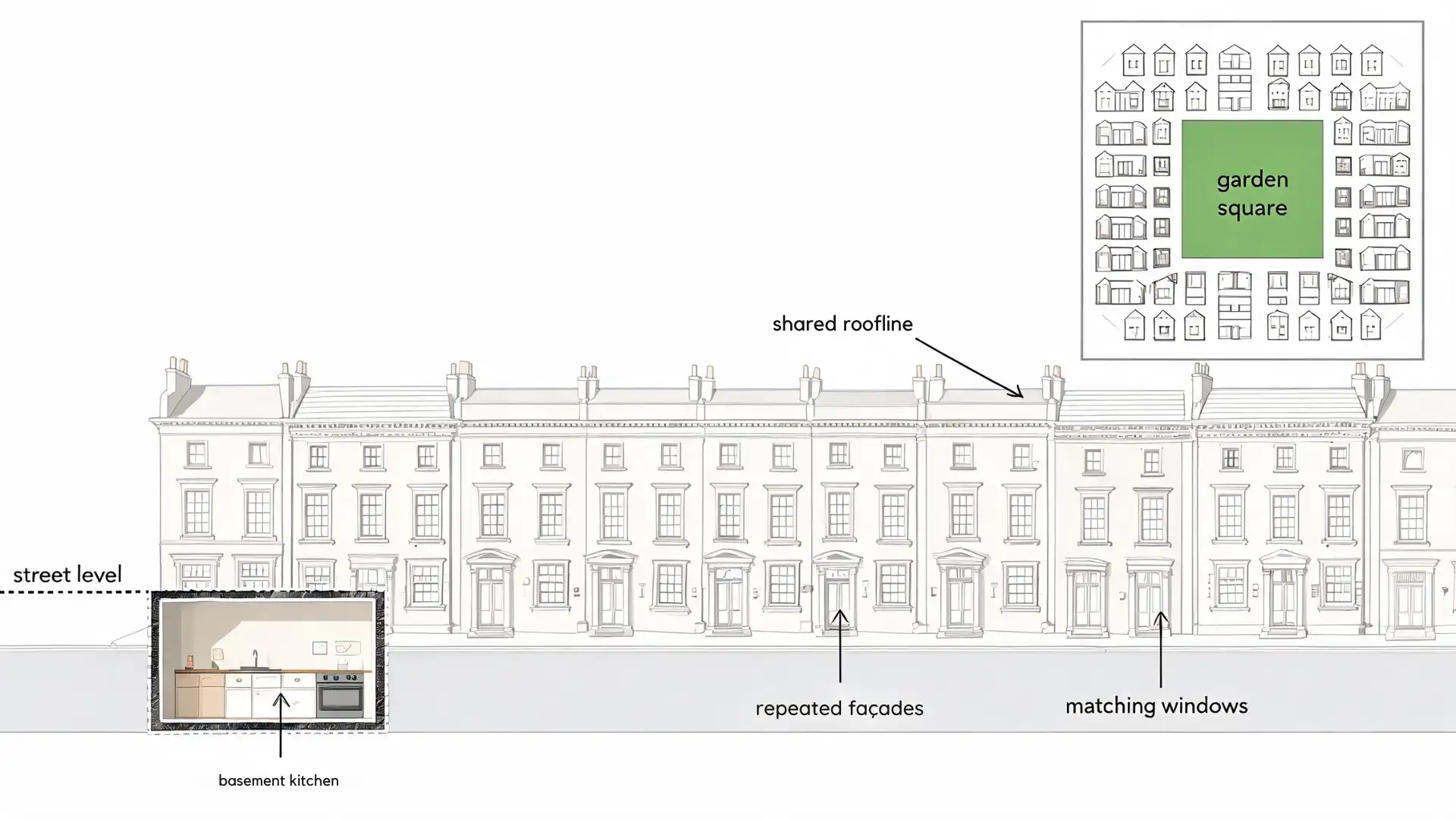
The logic of Georgian exteriors carries into the interior. A central hall from the front door organizes the plan, with main reception rooms on either side and secondary rooms or service areas toward the back or basement. This keeps principal spaces uncluttered and formally arranged.
Rooms follow proportional rules: lengths and widths feel balanced, ceiling height matches floor area, and fireplaces sit on central axes. Interiors often feature crown molding, cornices, ceiling roses above chandeliers, paneled walls in dining or entrance halls, and formal staircases near the entry.
Wealthier homes could include elaborate plasterwork, while modest townhouses used simpler detailing, maintaining the same proportional and orderly logic throughout.
In many surviving Georgian townhouses, the original basement layout is still legible even after 200 years of adaptation. The kitchen as a separate service space rather than a social room traces directly to this Georgian convention of keeping utilitarian functions off the principal floor.
Georgian Architecture in Britain, Ireland, and America
Georgian principles stayed consistent as the style crossed geographic boundaries, but materials, scale, and specific details adapted to local conditions. The table below maps the key differences.
| Region | Georgian Architecture Features |
| Britain | Townhouses, terraces, squares, country houses, and civic buildings. Planned streets with balanced facades and formal urban layouts. Brick in cities, stone in the countryside. |
| Ireland | Brick-fronted townhouses and formal squares, particularly in Dublin. Tall sash windows, simple classical details, and repeating terrace forms. Dublin’s Georgian core is one of the best-preserved examples in Europe. |
| American colonies | Brick homes, plantation houses, churches, and public buildings. Georgian principles adapted to locally available timber and different climate conditions. Later evolved into the Federal style after independence. |
| Georgian Revival (modern) | Symmetry, sash-style windows, classical entrances, and brick or stone facades applied to modern construction. Uses contemporary layouts, insulation, and materials while maintaining the proportional logic of the original style. |
The American Federal style deserves a specific note because it is often confused with Georgian. Federal kept the symmetry and classical proportion but applied lighter, thinner details: narrower door surrounds, more delicate fanlight patterns, and ornamental motifs referencing the new nation rather than British classical tradition. Georgian feels heavier and more formal. Federal is the same logic made more precise and less monumental.
How to Spot Georgian Architecture Today
You do not need architectural training to identify a Georgian building. You need to look at the front in the right sequence. Start with the door: is it centered? Move to the windows: are they arranged in even rows on both sides? Check the roofline: is it neat and symmetrical, with chimneys placed in balanced positions? If the answer to all three is yes, and the building is brick or stone with restrained classical detail, Georgian architecture is a strong candidate.
The features that most reliably confirm a Georgian identification are the fanlight above the door, the multi-paned sash windows, and the absence of heavy Victorian ornament. Georgian buildings are plain in a considered way. They are not trying to impress through decoration. They are trying to impress through order.
Georgian Revival buildings built in the 20th and 21st centuries follow the same checklist. The giveaway is usually in the window glazing bars (modern double-glazed units sit slightly differently) and in the roofline details, but the proportional logic is the same. If understanding how historical styles shape contemporary design decisions interests you, the interior design style quiz at Minimal and Modern is a useful starting point for placing your own preferences in a broader context.
| Quick identification checklist: Centered front door with fanlight above. Sash windows in even rows, taller than wide. Brick, stone, or stucco exterior. Symmetrical facade. Hipped roof or parapet roofline. Chimneys in matched pairs. High ceilings and proportional rooms inside. |
Frequently Asked Questions About Georgian Architecture
These are the questions that come up most often from people who have spotted a building they suspect is Georgian and want to understand what they are looking at.
What are the key features of Georgian architecture?
The key features are a centered front door with fanlight, evenly spaced sash windows, a symmetrical facade, brick or stone exterior, hipped or parapet roof, and proportional room layouts inside. Classical details such as columns, pilasters, and pediments appear at the entrance but are used with restraint rather than excess.
What is the difference between Georgian and Victorian architecture?
Georgian architecture is defined by restraint and symmetry: plain surfaces, proportional windows, minimal ornament. Victorian architecture added decorative complexity: carved stonework, asymmetric bay windows, polychrome brickwork, and far more surface detail. If a building looks busy, it is more likely Victorian. If it looks ordered and plain, it is more likely Georgian.
What is a Georgian fanlight?
A fanlight is the window set directly above a Georgian front door, typically semicircular in shape with radiating glazing bars. It brought daylight into the entrance hall when the door was closed and gave the entrance a more formal, considered appearance. It is one of the easiest Georgian features to spot from the street.
Why do Georgian houses have such high ceilings?
High ceilings in Georgian principal rooms were a deliberate proportional decision, not just a status signal. Taller walls allowed larger windows, which brought more daylight into formal spaces. The ceiling height also had to relate correctly to the floor area to satisfy Georgian proportional rules. A low ceiling in a large room would have read as incorrect.
What is Georgian Revival architecture?
Georgian Revival applies the proportional logic and exterior features of original Georgian buildings to modern construction. Symmetrical facades, sash-style windows, centered classical entrances, and brick or stone cladding are standard features. The underlying layouts and building systems are entirely contemporary. The revival approach has been popular in the UK and US since the late 20th century.
What colors were used in Georgian interiors?
Georgian interiors typically used muted, mid-toned colors: cream, pale blue, sage green, warm gray, ochre, and dusty pink. These worked with plasterwork, wood paneling, and period furniture without competing with the room’s proportional clarity. Deeper tones appeared in dining rooms and libraries in wealthier homes.
Did Georgian homes have basements?
Most Georgian townhouses had basements, particularly in cities. These lower levels housed kitchens, coal stores, and service rooms, keeping those functions separate from the formal living floors above. In many surviving Georgian terraces, the basement is still partially visible from the street through railings or light wells.
How does Georgian architecture influence modern home design?
Georgian influence shows up in symmetrical facades, centered front doors, sash-style windows, and proportional room layouts. The principles of balance and restraint also underpin approaches like mid-century modern design, which similarly prioritizes form and proportion over surface decoration. Both styles reward getting the fundamentals right rather than adding detail to compensate.
Final Verdict: Is Georgian Architecture Worth Understanding for Your Own Home?
Georgian architecture is not a historical curiosity. It is a set of design principles that remain some of the most reliable in residential construction: proportion first, symmetry as a structural tool, classical detail used precisely rather than liberally. If a room in your home feels off without you being able to identify why, the answer is almost always in the proportions: a ceiling that is too low for the floor area, windows that are too small for the wall they sit in, furniture at the wrong scale for the space. Georgian architecture made those decisions explicit and rule-governed. Understanding it makes it easier to see where modern rooms go wrong. Start with the room that bothers you most and measure the ceiling height against the longest wall. That ratio will tell you a lot.