

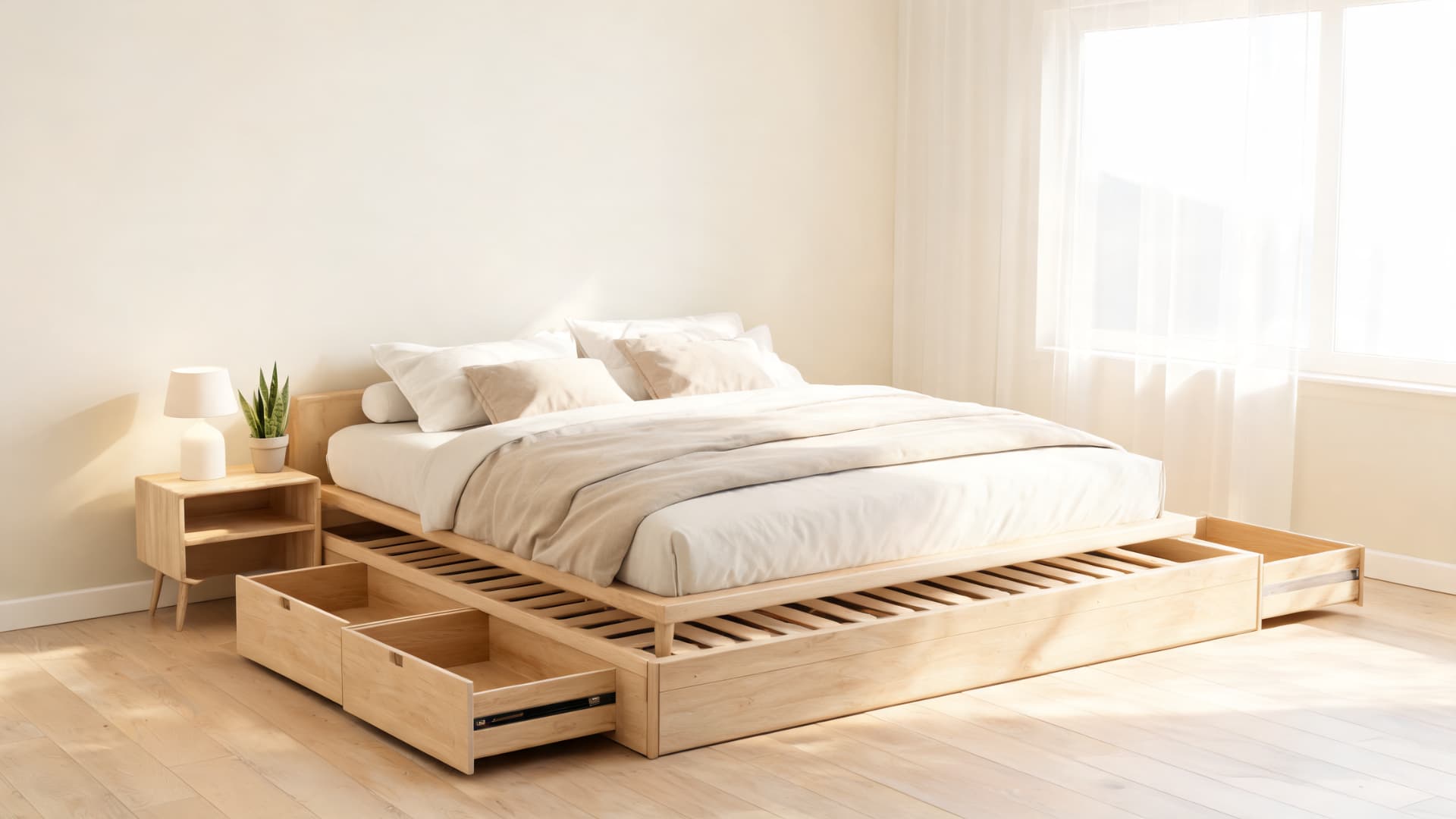


Some bed frames are easy to recognize but harder to define.
You may have seen a low, clean frame with the mattress sitting directly on top and wondered how it differs from a panel bed, box spring, or regular frame, especially when comparing different types of bed frames.
That confusion makes sense because platform beds are often described in terms of how they look rather than how they work. A platform bed is defined by its built-in support base.
I’ll explain how that structure works, why it matters for mattress support, and how the design can affect height, storage, comfort, and room layout. You’ll also see how platform beds compare with panel beds and box springs, so you can understand the benefits and decide which setup fits your needs before buying.
What Defines a Platform Bed?
A platform bed is a bed frame with built-in mattress support. Instead of needing a separate box spring or foundation, the mattress rests directly on the bed’s base. That support may come from wooden slats, a solid deck, metal bars, steel mesh, plywood, or another reinforced surface.
The main idea is simple: a platform bed combines the frame and mattress foundation into a single unit.
Platform beds are often lower than traditional beds, but height is not what defines them. A platform bed can be wood, metal, upholstered, rustic, modern, simple, decorative, or designed with storage. What makes it a platform bed is the support system under the mattress. A platform bed is built to support the mattress directly.
How a Platform Bed Frame Is Built
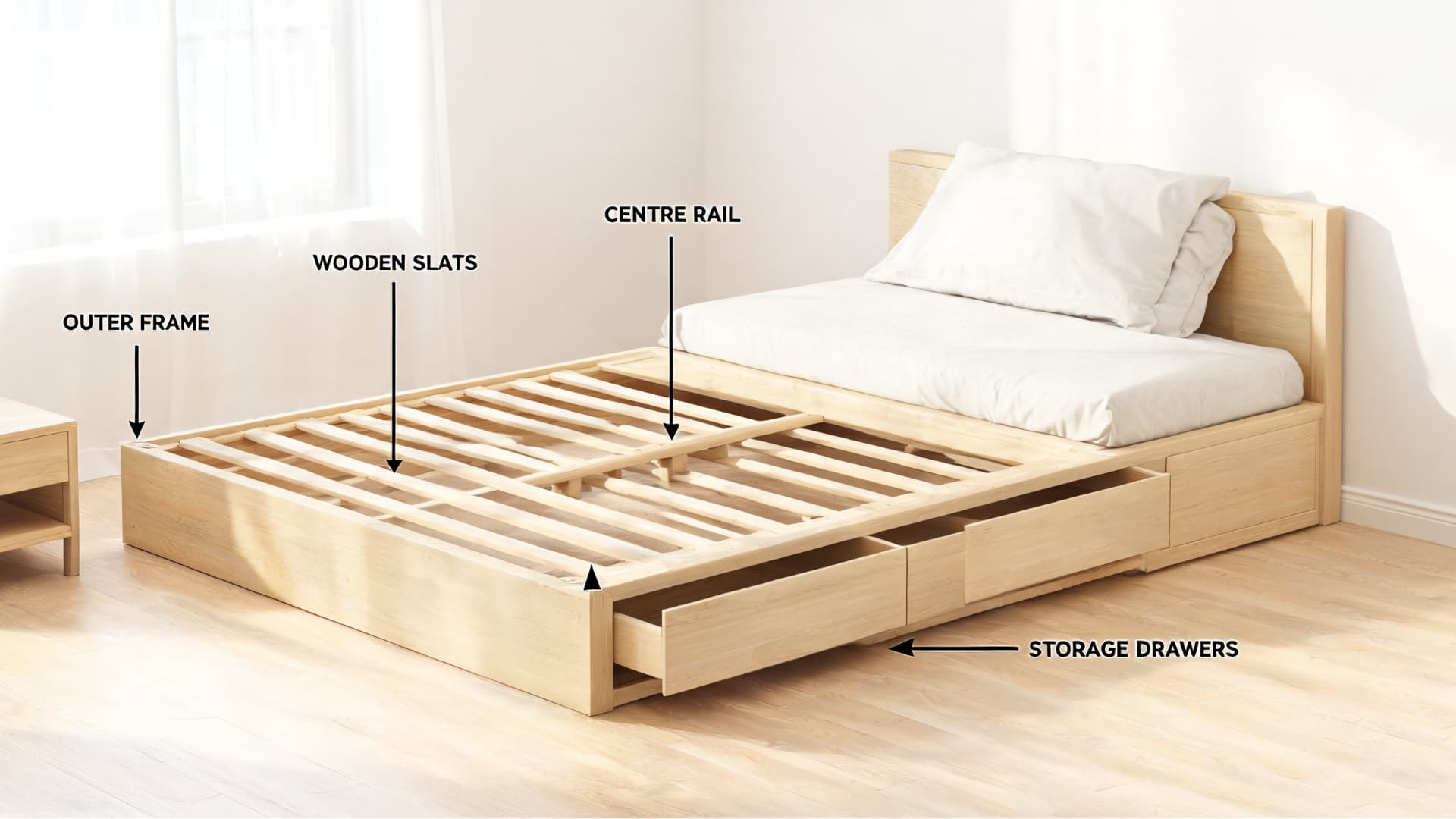
Every platform bed frame has the same job: hold the mattress without a secondary foundation. But the parts doing that job vary considerably, and the quality of each one determines how well the bed holds up over years of daily use.
1. The Outer Frame
This is the perimeter, the four sides that give the bed its shape and hold the rest of the structure in place. In solid hardwood frames, the outer frame is usually mortise-and-tenon or dowel-joined at the corners.
In cheaper particleboard or MDF designs, the corners are bolted together with cam locks, which are fine for a few years but tend to loosen and wobble over time.
2. The Support Surface
This is the part that replaces the box spring. It can be wooden slats, a solid plywood or MDF deck, metal bars, or steel mesh.
Each behaves differently under load and affects how the mattress feels. A solid deck gives a firm, even surface, good for foam and latex. Slats add slight flex and better airflow.
Metal grids are durable but only work well if the bars are close enough together (under 3 inches apart) to prevent foam from sagging through.
3. Slats and Slat Spacing
Slat spacing is one of the most important specs on a platform bed and one of the most frequently glossed over in product listings.
For memory foam and latex mattresses, slats need to be no more than 3 inches apart, ideally closer to 2 inches. Wider than that, the foam compresses into the gaps over time, creating pressure points and uneven wear.
Innerspring mattresses are more tolerant of wider spacing, up to about 4 inches, because the coils distribute weight laterally.
4. The Center Rail and Center Legs
In queen and king sizes, a frame without a center rail will eventually sag in the middle under mattress and body weight.
The center rail, a longitudinal beam running head to foot, is what prevents this. Center legs underneath that rail carry the load down to the floor.
On an inexpensive frame, the center legs are sometimes plastic or adjustable-height glides rather than actual structural legs. Those work, but solid wood or steel legs are more stable over time and don’t compress or shift when the mattress is loaded unevenly.
5. Storage Components
Storage platform beds add drawers, cubbies, or a lift-up gas-piston mechanism under the mattress. The drawers are almost always side-opening and sized for folded bedding or clothing.
Lift-up storage gives more volume but requires clearing the bed fully to access it, not ideal if you’re storing things you need regularly.
The gas pistons on lift-up frames have a lifespan; on cheaper versions, they lose tension after a few years and no longer hold the mattress at height.
6. Frame Material
Solid hardwood, oak, maple, walnut, or bamboo is the best long-term choice, especially if you compare the best furniture woods by strength, grain, and everyday durability. It doesn’t compress over time, holds fasteners without stripping, and can often be repaired rather than replaced.
Solid pine is a step below hardwood in durability (Janka rating of around 870 lbf, compared with white oak at 1,360 lbf) but is widely used in mid-range frames and holds up well under normal loads.
MDF and particleboard are the weakest options; they look fine when new but swell with humidity, strip easily at screw holes, and typically don’t survive a move intact.
Metal frames made from welded steel are strong and light, but the quality varies significantly by gauge and weld quality.
| Pro Tip: Before buying any platform bed, ask the retailer for the slat spacing measurement and the center support configuration. These two specs, not the headboard style or the finish color, determine whether the frame will still perform well in five years. |
Platform Bed Base Types Compared
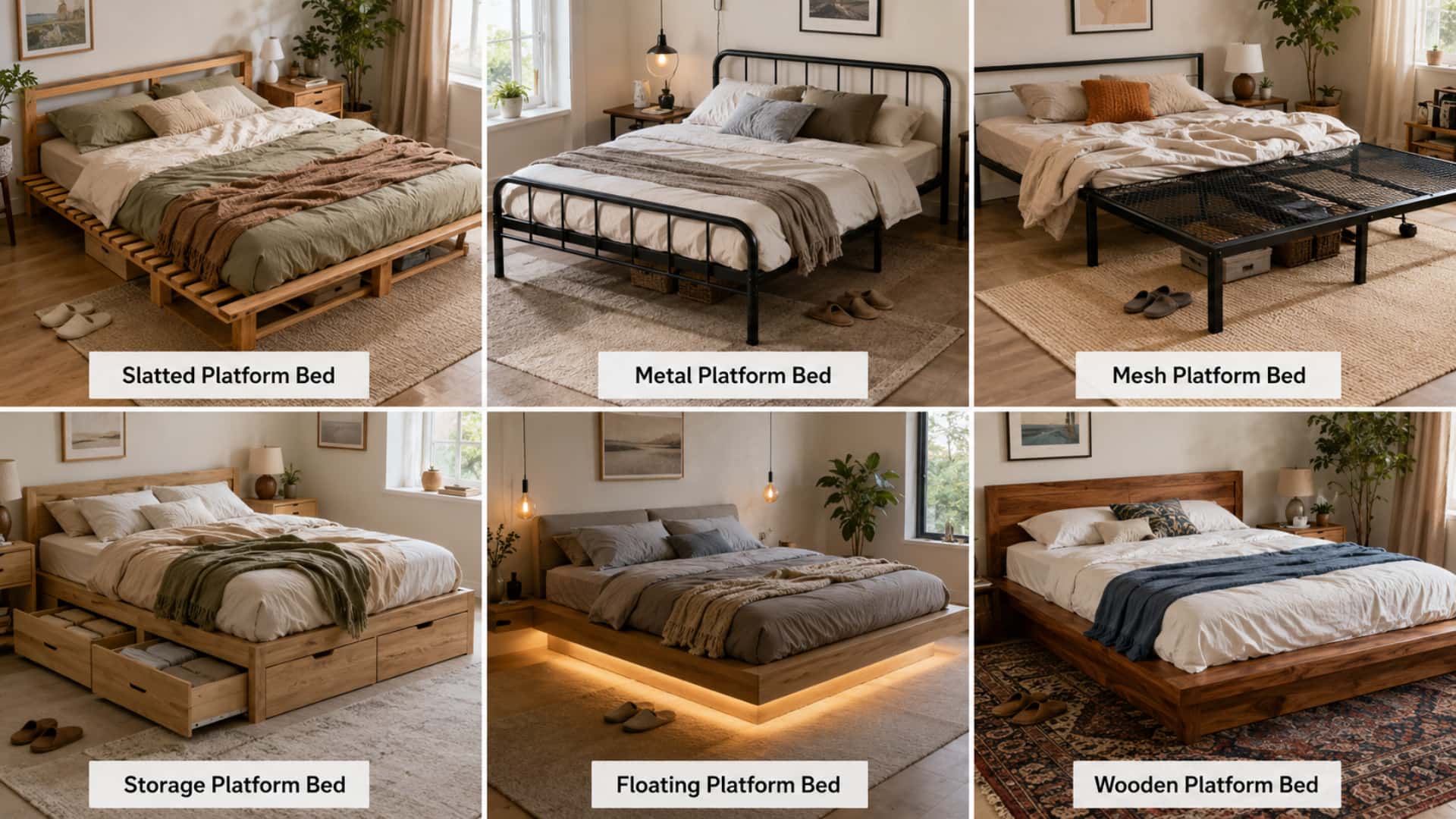
The base type is the most consequential decision in a platform bed. Here’s how each option actually performs, beyond what the product descriptions say.
| Base Type | Best For | The Real Limitation |
| Slatted (wood) | Most modern mattresses; best airflow | Slats must be ≤3 inches apart for foam; check before buying |
| Solid deck (plywood/MDF) | Firmest feel: foam and latex | Traps heat and humidity under the mattress in summer |
| Metal bar grid | Durability; light weight | Bar spacing varies wildly; confirm it’s under 3 inches |
| Steel mesh | Strength with some airflow | Weld quality is the variable; hard to assess before delivery |
| Storage (drawer or lift-up) | Small rooms; extra organization | Heavier, harder to move; lift pistons degrade over time |
| Floating (wall-anchored) | Visual impact; low-profile rooms | Requires structural wall anchoring; no storage underneath |
The slatted base is the right default for most people, especially if the mattress is foam or hybrid. If you run warm or live somewhere humid, avoid solid decks entirely. If storage is the priority, the drawer option is the more practical choice over lift-up for everyday access.
Platform Bed vs Traditional, Panel and Box Spring Bed
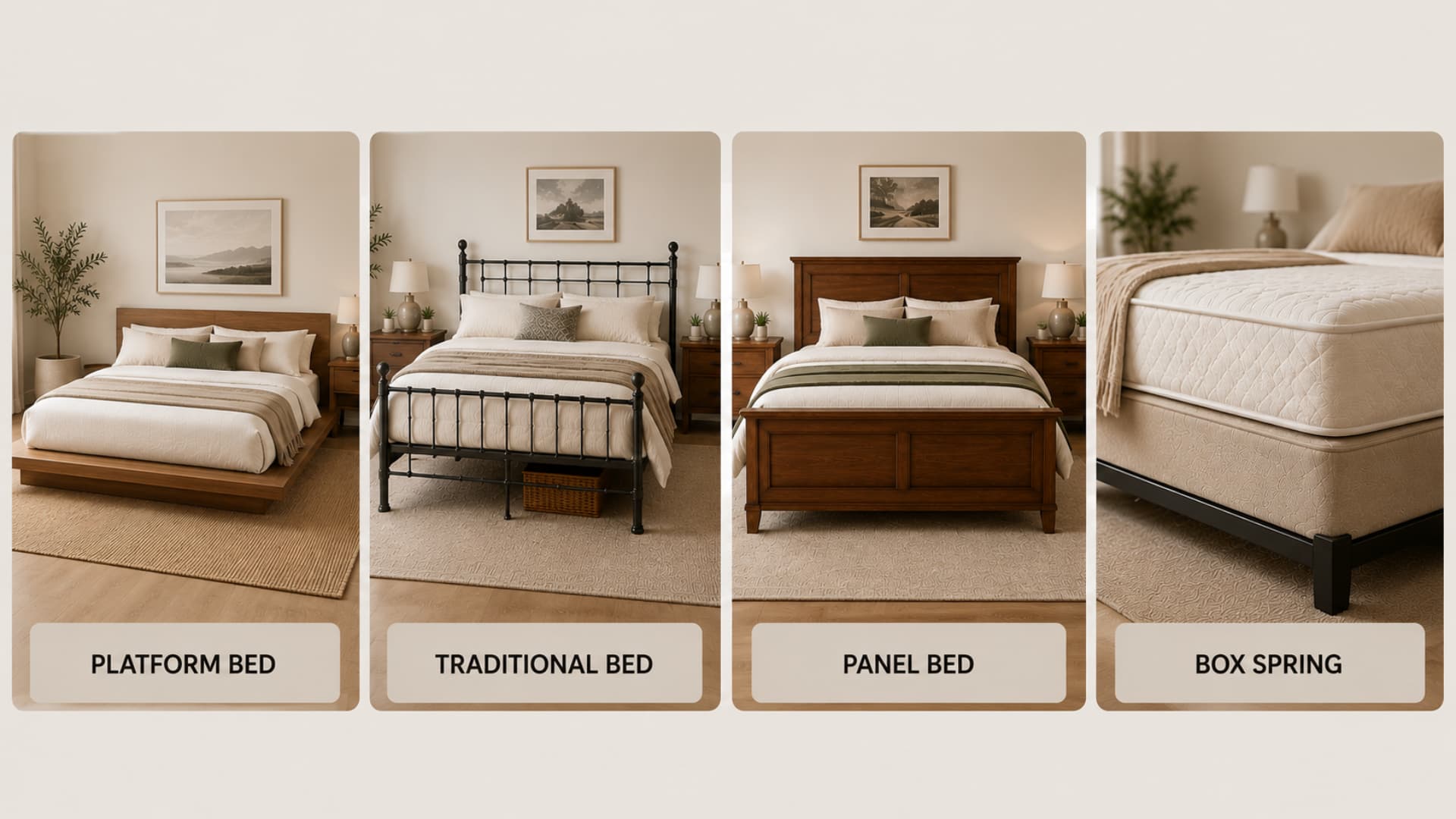
The comparison that matters most is platform bed frame versus a traditional frame-and-box-spring setup, because that’s the real purchase decision most people are making. The differences affect more than just how the bed looks.
| Feature | Platform Bed | Traditional Frame + Box Spring | Panel Bed |
| Mattress support | Built-in slats or deck | Provided by the box spring | Usually needs a box spring |
| Box spring required? | No | Usually yes | Usually yes |
| Total setup cost | Lower, one purchase | Higher, frame + box spring | Higher, frame + foundation |
| Mattress feel | Firm and direct | More bounce from box spring flex | Depends on foundation |
| Best mattress type | Foam, latex, hybrid | Innerspring (designed for this pairing) | Innerspring or hybrid |
| Typical height | Lower overall profile | Taller, box spring adds 6–9 inches | Taller, decorative frame design |
The practical takeaway: if you’re buying a foam or hybrid mattress, a platform bed is the simpler and cheaper path. If you already own a box spring and an innerspring mattress and they’re in good shape, replacing the whole setup with a platform bed may not deliver a meaningful improvement. The platform bed wins on cost and simplicity; the box spring wins on bounce and mattress compatibility for older innerspring designs.
Where Platform Beds Make Sense and Don’t
The benefits are real, but so are the limits. Here’s what to actually weigh before committing.
Where a platform bed is the right call
You’re buying a new foam, latex, or hybrid mattress and want to avoid paying separately for a foundation. You have a small bedroom and want to maximize visual space; lowering the bed makes the room feel less crowded, especially when paired with soft bedding and warm bedroom color ideas.
You want under-bed storage without a bed skirt hiding an awkward gap. You’re assembling a bed solo and want fewer parts to deal with.
Where a platform bed is the wrong call
You or a partner has knee, hip, or back issues that make it difficult to get out of a low bed. Your current mattress warranty specifies a box spring or specific foundation type; using a platform bed without checking this can void coverage.
You’re in a high-humidity climate, and considering a solid-deck base, trapped moisture under a foam mattress shortens its life and creates odor over time.
You frequently rearrange rooms: solid-wood storage platform beds can weigh 150–200 pounds, making them genuinely difficult to move.
| Note: Before buying, check your mattress manufacturer’s warranty language. Many foam mattress brands require slat spacing under a specific measurement, usually 3 inches, and will deny warranty claims if the frame doesn’t meet that spec. The frame’s style is irrelevant; the slat spacing is what’s in the warranty document. |
Which Mattresses Work on a Platform Bed Frame
Platform beds work well with most modern mattresses, but the base type and slat spacing determine whether they actually perform as advertised.
| Mattress Type | Works on Platform Bed? | What to Verify |
| Memory foam | Yes, preferred | Slat spacing ≤3 inches; solid deck also fine |
| Latex | Yes, needs strong support | Latex is heavy; verify center leg load rating |
| Hybrid | Yes | Center support critical for queen and king sizes |
| Innerspring | Usually, check warranty | Some brands require a box spring; check before buying |
| Pillow-top | Usually | Adds height; confirm total bed height for room clearance |
Foam and latex are the clear winners here. They don’t need the spring flex of a box spring to feel comfortable; direct, firm support is actually what they’re designed for. Innerspring mattresses are the one category to double-check, because some older designs were engineered with the assumption that a box spring would absorb part of the impact load.
Frequently Asked Questions
Can a platform bed damage a mattress?
A platform bed should not damage a mattress if the support surface matches the mattress requirements. The biggest risk comes from wide slat gaps, weak center support, or a base that does not meet the mattress warranty rules.
Why do platform beds sit so low?
Many platform beds sit low because they do not need a box spring underneath the mattress. That lower profile can make a bedroom feel more open, but it may not suit everyone, especially if getting in and out of bed is difficult.
Do platform beds need ventilation?
Yes, ventilation matters, especially for foam and latex mattresses. Slatted bases allow more airflow than solid decks. If the room is humid, a solid platform can trap moisture beneath the mattress, leading to odor or mildew issues.
Are storage platform beds worth it?
Storage platform beds are worth it when floor space is limited and you need hidden storage for bedding, clothes, or seasonal items. The tradeoff is weight, since storage frames are harder to move and assemble than simpler platform beds.
Can you put any mattress on a platform bed?
Not always. Many foam, latex, and hybrid mattresses work well on platform beds, but some innerspring mattresses may still need a box spring. Always check the mattress brand’s support guidelines before pairing it with a platform frame.
Practical Takeaway
A good bed frame supports your sleep, fits your room, and is easy to use daily. Choose a platform bed for built-in support, ideal for memory foam and small spaces.
Pick a panel bed for a taller style, a decorative headboard, or if you have a compatible box spring. Use a box spring if your mattress recommends it, if you need extra height, or if you prefer a bouncier feel.
For modern mattresses, a platform bed is simple and supportive; check slat spacing, airflow, height, support, and warranty before buying. Compare options and read related blogs for more tips.