

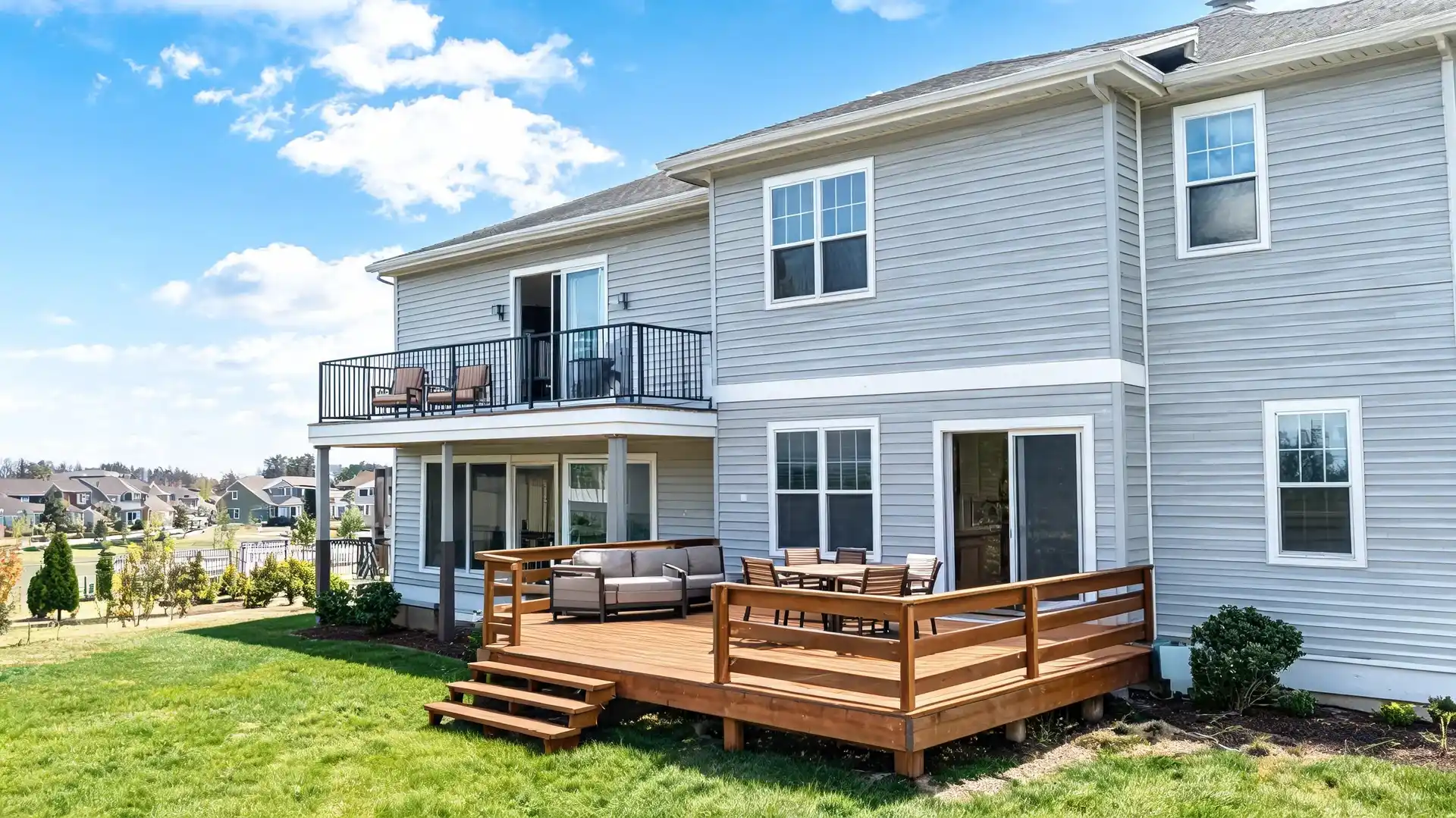


| Structure | Deck | Balcony |
| Location | Ground level or slightly raised, attached to back or side of home | Second floor or higher, projecting from exterior wall |
| Access | Ground-floor door, yard stairs, or direct from backyard | Interior room only, bedroom, living room, or upper hallway |
| Typical Size | 200–400 sq ft | 40–80 sq ft |
| Support | Posts, beams, and concrete footings anchored to the ground | Cantilevered from building frame or supported by columns |
| Avg Cost | $4,340–$12,589 installed | $8,000–$25,000 installed |
| Maintenance | Surface sealing, board checks, drainage | Waterproofing, railing checks, wall-connection seal |
| Best For | Groups, grilling, outdoor dining, yard access | Private sitting, views, upper-floor rooms |
If you care about how your home feels outside, the words you use matter more than you may think. I have seen people point to an upper-floor platform and call it a deck, while others call the same thing a balcony. That small mix-up can change the quote, the permit, and the safety checks.
So let’s make this simple. If you are planning a new outdoor space, updating an old one, or just trying to understand what your home already has, this balcony vs deck comparison will help.
I will walk you through how each one is built, where it sits, how you use it, what can affect cost, and how it compares with patios, porches, verandas, and other outdoor spaces. By the end, you will know what to call your space and how to plan it with more confidence.
| Cost Note: Figures in this article are estimates. Actual costs vary significantly by region, contractor, materials, and project scope. Always get at least three quotes before committing to any project above $1,000. |
What Is a Deck?
A deck is a flat outdoor platform usually attached to the back or side of a home. It sits at or slightly above ground level, though homes on sloped lots may have decks raised 8 to 12 feet. It is still a deck when it uses posts, beams, and footings and connects through a ground-floor door or stairs.
Decks are common in single-family homes because they provide open access to the yard and enough space for a grill, dining table, chairs, and guests. They are often built from pressure-treated wood, composite decking, cedar, or hardwood.
The average deck costs about $8,250, with most projects ranging from $4,340 to $12,589. Pressure-treated wood runs $25 to $40 per square foot installed, while composite decking runs $20 to $45 per square foot for material alone.
- Best for: Grilling, large seating groups, outdoor dining, yard access, and family use.
- Common deck types: Attached decks, freestanding decks, ground-level decks, raised decks, multi-level decks, wraparound decks, and rooftop decks.
What Is a Balcony?
A balcony is a small, elevated platform projecting from the exterior wall of a building, typically on the second floor or higher. It is reached from inside, usually through a bedroom, living room, or hallway door. That upper-floor, inside-only access is the main clue.
Most balconies are smaller than decks, often around 40 to 80 square feet. That is enough for two chairs, a small table, and a planter. Some balconies are purely decorative, while others serve as private outdoor seating areas.
A balcony can be cantilevered from the building frame or supported by posts and beams. Both types need careful planning because load, drainage, waterproofing, and wall connections are more complex than a ground-level build.
Building a balcony costs $8,000 to $25,000, with an average of about $14,000. Per square foot, expect $30 to $90, depending on materials, support type, waterproofing, and railing specs.
- Best for: Views, fresh air, private sitting, and upper-floor access in apartments, condos, and multi-story homes.
- Common balcony types: Cantilevered balconies, supported balconies, Juliet balconies, recessed balconies, stacked balconies, and wraparound balconies.
Balcony vs Deck: Differences Across Every Factor
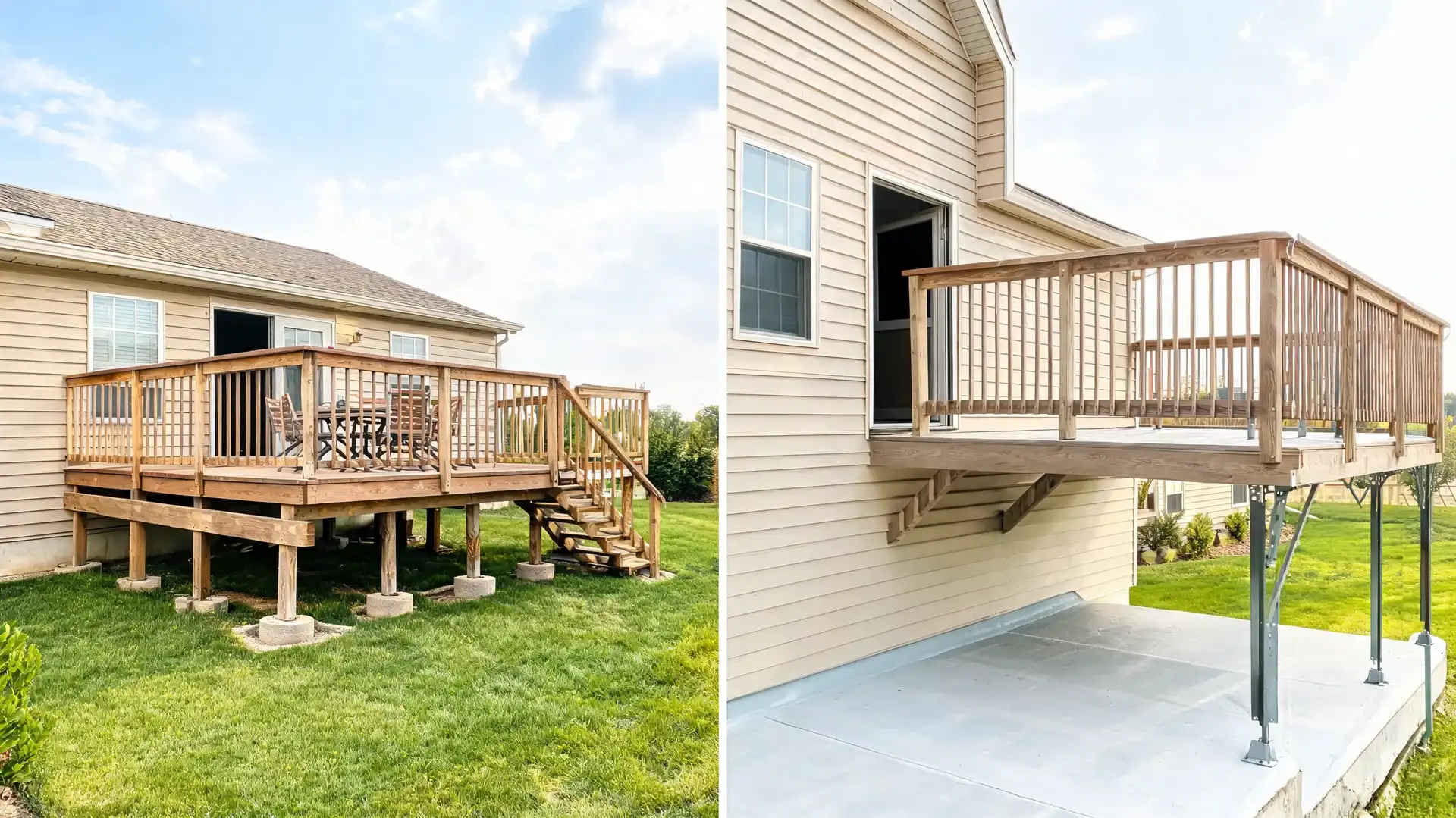
This is where the balcony vs deck comparison gets practical. Each of the factors below can be shown visually, and each one affects how you build, what you spend, and how you use the space.
1. Location and Floor Level
A deck sits at or near ground level, typically behind or beside a single-family home. It connects directly to the yard and the ground floor of the structure. A balcony always sits on the second floor or higher, projecting from the exterior wall above an open space.
That floor-level difference is not just about height. It changes what you see, how you enter, who can access it, and what the structure below it must handle.
2. Access and Entry Point
A deck can be reached in multiple ways: through a ground-floor door, down a staircase, or directly from the yard. This open-access design makes decks practical for gatherings, outdoor cooking, or frequent trips between the house and yard.
A balcony has a single access point: through the door of the room it connects to. Usually, that is a bedroom, master suite, or upstairs living area. Nobody enters a true balcony from the street, yard, or a staircase off the ground.
| Takeaway: Decks support group movement and outdoor hosting. Balconies are personal, accessed by the one or two people in the connected room. |
3. Size and Furniture Space
A standard family deck covers 200 to 400 square feet. That fits a six-seat dining table, a grill station, lounge chairs, and enough clearance between them that people aren’t constantly shuffling around each other. Larger lots push decks to 600 square feet or more.
A balcony averages 40 to 80 square feet. Two chairs and a side table fill it. A 100-square-foot balcony gives a bit more room, but large furniture sets don’t work, and anything over 80 pounds per square foot needs a structural review before you bring it up.
4. Structure and Support
A deck’s structural system starts in the ground. Posts are embedded in concrete footings; beams span between the posts; joists run across the beams; and decking boards lie on top. The IRC Chapter 5 (R507) covers deck structural requirements, including ledger attachment, post sizing, and footing depth.
A balcony attaches to the building’s structure rather than the ground. A cantilevered balcony uses joists that extend through the exterior wall and are locked into the building’s frame.
A supported balcony uses columns or posts running to the ground. Both methods require careful load analysis because the support point is an upper wall or floor system rather than the earth.
|
Takeaway: A deck builds up from the earth. A balcony builds out from the building. Different engineering paths, different inspection requirements, different costs. |
5. Safety, Railings, and Load
Under IRC Section R312.1.2, guardrails are required on any elevated walking surface that is 30 inches or more above grade. This applies to both decks and balconies, but the safety stakes are higher for balconies because of the open space below.
Balcony railings must meet load-bearing tests and attachment requirements that account for outward and downward force. Balcony floors also need waterproofing and a drainage slope to prevent water from tracking back into the wall connection or pooling under the flooring system.
Decks need railing when elevated, plus stair guards and proper footing depth. But a structural failure on a deck at ground level carries less risk than a failure on a balcony 20 feet up.
| Takeaway: Both need proper railings, but balcony safety requirements include upper-floor load attachment and waterproofing, which decks do not always require. |
6. Cost and Build Complexity
A standard ground-level deck of 200 square feet, built with pressure-treated wood, runs roughly $5,000 to $16,000 installed. Composite material pushes that to $10,000 to $18,000 or more. Deck cost scales mostly with size, material, and the complexity of stairs and railings.
A 60-square-foot balcony can cost $8,000 to $25,000, depending on the support method, waterproofing needs, railing specifications, and whether it is new construction or an addition to an existing structure. Cantilevered designs and post-construction balcony additions on existing homes run toward the higher end.
| Line Item | Deck (200 sq ft) | Balcony (60 sq ft) | What Drives Variation |
| Materials | $2,500–$9,000 | $2,000–$8,000 | Wood vs composite; railing spec |
| Labor | $1,500–$5,000 | $3,000–$10,000 | Upper-floor tie-in adds hours on balconies |
| Waterproofing | Not always required | $500–$2,000 | Mandatory on balconies; membrane + slope |
| Permits & Engineering | $300–$800 | $500–$2,500 | Structural calcs required for balconies |
| Total Range | $5,000–$16,000 | $8,000–$25,000 | Balcony costs more per sq ft, less in total sq ft |
7. Maintenance and Water Control
Wood decks need cleaning, sealing, and staining every 1 to 3 years. Composite decks are low-maintenance but still require periodic cleaning and occasional board checks. Drainage on a deck mostly means water running off the sides or through the deck board gaps.
Balconies require a more controlled approach to water. The floor must slope toward a drain or outward edge, and the wall connection must be sealed with a waterproof membrane.
Water that pools on a balcony or sits against the wall connection can work into the building’s framing over time. Railing posts and balusters also need periodic tightening and corrosion checks, especially in coastal climates.
The framing beneath the deck surface should also be properly finished; the deck skirting options chosen affect both airflow under the structure and how effectively debris and pests are kept out.
| Takeaway: Decks need surface upkeep. Balconies need a surface, waterproofing, a drainage slope, and wall-connection maintenance. |
8. Construction and Materials
Decks are usually built with pressure-treated wood, cedar, hardwood, composite boards, or PVC decking. The frame often uses treated lumber for posts, beams, and joists, along with concrete footings. Material choice affects cost, maintenance, heat, slip resistance, and the surface’s longevity.
Balconies use a wider range of structural and finish materials because they are attached to the building. The frame may include steel, reinforced concrete, treated wood, or engineered supports.
The walking surface may be tile, concrete, waterproof decking, or a coated system. Waterproofing matters more on a balcony because water can move into the wall or floor structure if the surface fails.
Pros and Cons: Balcony vs Deck
Before choosing between a balcony and a deck, it helps to see the trade-offs side by side. One gives you more space and yard access. The other offers privacy, views, and upper-floor access. This table makes the choice easier to compare.
| Factor | Deck | Balcony |
| Space | Large, flexible layouts | Small, compact footprint |
| Access | Open, yard, and ground-floor | Private, inside room only |
| Use | Groups, grilling, dining | Personal sitting, views, fresh air |
| Cost to Build | Lower per sq ft, higher total | Higher per sq ft, lower total |
| Privacy | Moderate, visible from the yard | Higher, reached from inside |
| Views | Ground level or slightly raised | Elevated, better long-range views |
| Maintenance | Surface, boards, drainage | Waterproofing, railing, and wall seal |
| Safety Rules | Railing when 30 in+ above grade | Railing plus load and seal requirements |
| Resale Impact | Strong for single-family homes | Adds value in multi-story, city homes |
| Best For | Families, entertaining, yard life | Individuals, couples, upper-floor rooms |
A deck usually wins for space, hosting, and family use. A balcony works better when you want a smaller, private outdoor spot connected to an upper room. Once you know your main use, the better option becomes much clearer.
Balcony vs Patio vs Deck vs Porch vs Veranda: What Is the Difference?
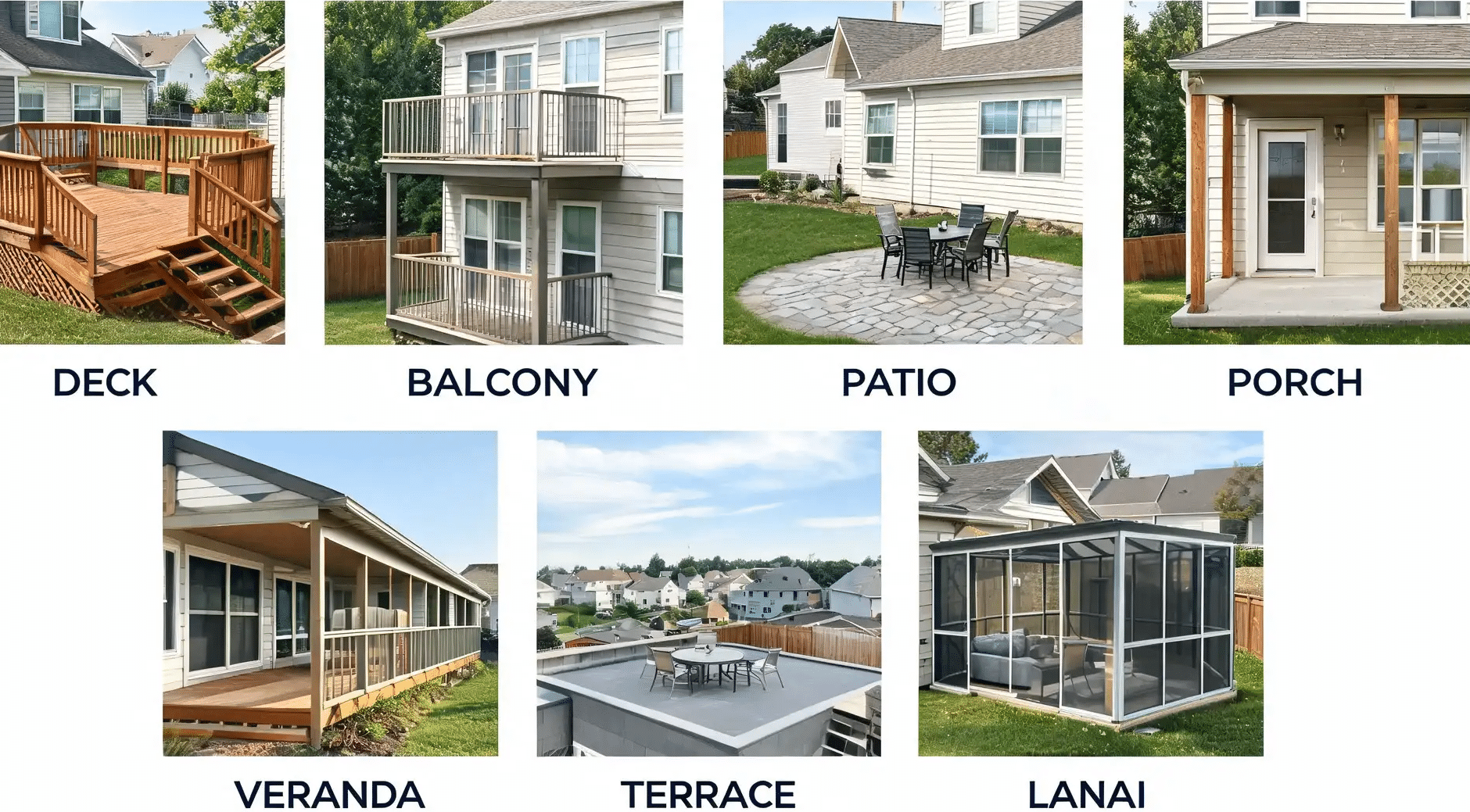
The difference between a patio and a balcony is one of the most-searched questions in this category, and it is easy to answer once you understand the floor level. A patio is always at ground level and paved.
A balcony is always elevated, attached to an upper floor, and reached from inside. They serve entirely different homes, rooms, and use cases.
Here is a plain breakdown of all seven outdoor structures that regularly get mixed up:
| Structure | Floor Level | Roof | Access | Best For |
| Deck | Ground to slightly raised | Open | Ground floor or yard | Groups, grilling, yard access |
| Balcony | Second floor or higher | Open or partial | Interior room only | Views, private sitting |
| Patio | Ground level, paved | Open | Ground floor or yard | Casual seating, low-cost outdoor space |
| Porch | Ground level or slightly raised | Always covered | Entry or front of home | Shade, curb appeal, entry |
| Veranda | Ground level | Covered, wraps around home | Multiple sides | Shaded outdoor living |
| Terrace | Rooftop or raised grade | Open | Rooftop or hillside access | Urban homes, hillside builds |
| Lanai | Ground level | Covered, often screened | Ground floor | Florida and tropical climates |
The difference between patio and balcony goes beyond materials. A patio sits on the earth and can be added to almost any home without structural work. A balcony requires upper-floor attachment, structural load analysis, waterproofing, permits, and is closer to a room addition than a ground-level pour.
If you’re also weighing a covered entry structure, the deck vs porch comparison covers the resale and structural differences in detail.
If a contractor or real estate listing uses any of these terms and you’re unsure what structure is actually described, ask them to confirm the floor level, the access point, and whether a roof is included. Those three facts identify the structure without ambiguity.
| Pro Tip: Before signing any contract, confirm the floor level, access point, and structural support method with your contractor in writing. These three details determine the permit category, the engineering requirements, and ultimately what the project costs. A verbal description and a written scope are not the same thing. |
Which Is Better for Your Home: Balcony or Deck?
Neither option is better for every home. The right choice in the balcony vs deck decision depends on your home type, floor level, yard space, budget, and how you plan to use it.
Choose a deck if:
- You have a single-family home with a yard.
- You want space for grilling, dining, or hosting.
- You need easy access from the house to the backyard.
- You want room for larger furniture.
- Your budget favors a lower cost per square foot.
Choose a balcony if:
- You want outdoor access from an upper floor.
- You live in an apartment, condo, or townhouse.
- You want a private sitting spot.
- You care more about views than a large space.
- You only need room for chairs, plants, or a small table.
On hillside lots, either can work. A raised deck connects better to the main floor when the grade drops away from the back door, and on flatter ground, a concrete patio and wood deck pairing often handles the yard transition better than either structure alone.
A balcony can make more sense off an upper bedroom when the slope is severe enough that a raised deck would require significant post height and structural complexity.
Confirm all permits and HOA requirements with your local building office before finalizing any design. You can find your local permit authority through USA.gov’s permit guidance.
Common Mistakes When Comparing a Balcony and Deck
Small wording mistakes can lead to wrong quotes, wrong permits, and extra work later. Before you price anything, make sure you are naming the structure correctly and thinking through the parts that affect safety, water, and approvals.
- Calling every raised platform a deck: A raised platform attached to an upper floor and reached from inside is a balcony, not a deck. Using the wrong term can lead to the wrong quote, permit category, and material plan.
- Ignoring water drainage on balconies: A flat balcony can hold water and send it toward the wall connection. Every balcony needs a clear drainage plan, so water moves away from the building, not into it.
- Assuming smaller means simpler: A small balcony can cost more than a larger deck because upper-floor support, waterproofing, and load checks add complexity.
- Skipping Permit or HOA Checks: Both structures require permits in most US jurisdictions. Balconies may also trigger HOA rules in condos, townhomes, and planned communities.
These mistakes are easy to avoid when you start with the right name, check local rules early, and ask your contractor how the structure will handle support, drainage, railing, and long-term wear.
| According to the U.S. Department of Housing and Urban Development (HUD), major structural additions, including outdoor platforms, must comply with local safety and building codes. Starting without a permit can create problems when you sell the home or file an insurance claim. |
Frequently Asked Questions
Can you add a balcony to an existing house?
Yes, but it is often more complex than adding a deck. A contractor must check the wall framing, floor structure, waterproofing, railing support, and door opening. It may also need engineering approval, permits, and HOA permission before any exterior work can begin safely on site.
Can you put a grill on a balcony?
Sometimes, but many apartments, condos, HOAs, and fire codes restrict grills on balconies. Open-flame grills are often not allowed, especially on covered or small balconies. Check local fire rules and building policies first. A deck usually offers safer grill placement and clearance around nearby walls.
Which lasts longer, a balcony or a deck?
A well-built deck can last 10 to 30 years, depending on material, climate, and upkeep. Wood usually needs more care than composite. A balcony can also last decades, but its waterproofing, railing connections, and wall attachment must be inspected regularly to prevent damage over time.
Can you enclose a balcony or deck?
You may be able to enclose either one, but approval matters. Enclosing a deck can turn it into a screened room or porch. Enclosing a balcony can affect airflow, drainage, load, and exterior appearance, so condos and HOAs often have stricter rules for this work.
Does a deck or balcony add more resale value?
It depends on the home type. A well-built deck adds $10,000 to $20,000 in resale value for single-family homes with usable yards, where outdoor entertaining space is expected. A balcony adds value in multi-story and urban homes where upper-floor outdoor access is otherwise unavailable. Neither adds value if it was built without permits.
Should you tell insurance before adding a balcony or deck?
Tell your home insurance provider before adding a balcony or deck. A new outdoor structure can affect replacement value, liability risk, and coverage needs. If it is built without permits or proper inspections, future claims may be harder to settle after damage or injury later.
Final Thoughts
The balcony vs. deck choice becomes much easier when you stop looking at photos and start considering how you will use the space. I always tell homeowners to begin with four things: floor level, access, structure, and daily use.
The right answer follows the structure of your home, not a preference for one look over another. If you have a single-family home with a yard and you want space for people, a grill, and a dining setup, a deck built from pressure-treated lumber or composite will do that for $5,000 to $16,000 with far less engineering complexity.
If you have an upper-floor room and no yard access, a balcony is the only way to get outdoor space from that room. At $8,000 to $25,000, that access comes at a real cost, so make sure the waterproofing and structural tie-in are done right the first time.
Before you call anyone, get the floor level, access point, and drainage plan confirmed in writing. That’s the single most important step before any money changes hands.