




Rewiring a house runs $10,000 to $30,000 for most US homes, or about $5 to $17 per square foot depending on size, access, and how much old wiring needs to come out.
That gap is wide because two houses with identical square footage can price out $15,000 apart once an electrician sees what’s actually behind the walls.
I’ve watched homeowners go into this process anchored to a number they read online, then get blindsided when plaster walls, a tight attic, or a panel running at 100-amp service adds four figures to the estimate. The goal of this article is to make sure that doesn’t happen to you.
| Cost Note: Figures in this article are estimates based on national averages. Actual costs vary significantly by region, contractor, materials, and project scope. Always get at least three quotes before committing to any project above $1,000. |
| Safety Note: House rewiring involves live electrical systems. All rewiring work requires a licensed electrician in virtually every US jurisdiction. Never attempt whole-home rewiring as a DIY project, as improper wiring is a leading cause of residential fires. Check your local permit requirements before any work begins. |
House Rewiring Cost by Home Size
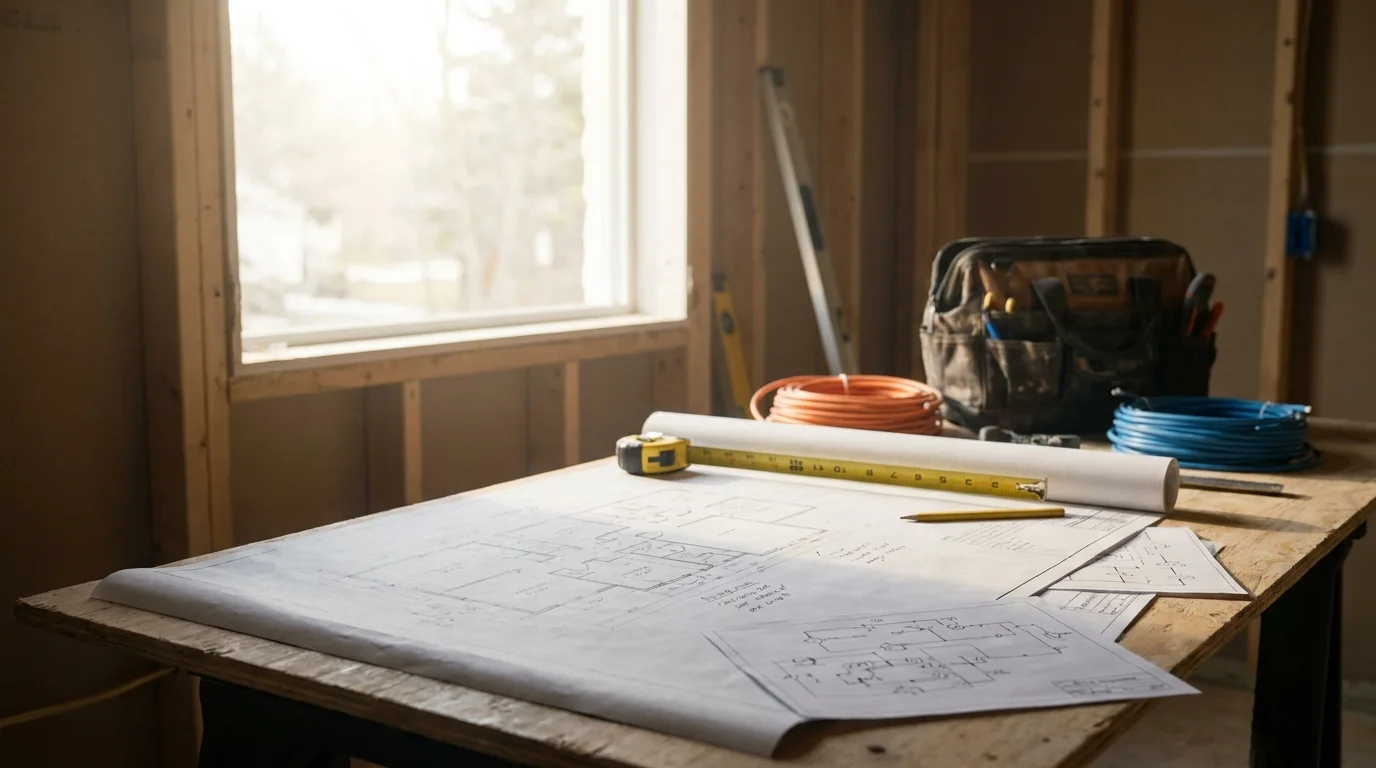
Square footage is the fastest way to build a rough budget before you call anyone. A larger home needs more wire runs, more outlet placements, and more crew hours, so cost generally scales with size. Use these ranges as your planning frame, not your final number.
| Home Size | Low Estimate | High Estimate | What Drives Variation |
| 1,000 sq ft | $5,000 | $17,000 | Open access, simple layout vs. finished ceilings, older wiring |
| 1,500 sq ft | $7,500 | $25,500 | Number of circuits, panel work, plaster vs. drywall |
| 2,000 sq ft | $10,000 | $34,000 | Two-story access challenges, knob-and-tube removal |
| 2,500 sq ft | $12,500 | $42,500+ | High-demand rooms, service upgrade, asbestos or hazmat discoveries |
The low end of each range assumes the electrician has reasonable access, clean drywall construction, and a panel that can be upgraded without a full service replacement.
The high end assumes plaster walls, tight attic or crawlspace access, aging knob-and-tube wiring, and a panel running out of headroom.
Both scenarios involve the same square footage, which is exactly why size alone doesn’t tell the full story.
Cost Per Square Foot: How the Math Works

Electrical rewiring costs roughly $5 to $17 per square foot for an existing home.
The shortcut: multiply your home’s square footage by both ends of that range to get a quick budget window.
A 1,800 sq ft house runs $9,000 on the low end and $30,600 on the high end before any extras.
I use per-square-foot pricing only to walk into quote conversations with a calibrated expectation.
If an estimate lands well below $5 per square foot, ask what it excludes. If it lands above $17, ask why. The answer may be completely legitimate, or it may be a red flag.
| Pro Tip: Per-square-foot pricing reflects wire runs and outlet placements, not access difficulty. A 1,200 sq ft home with plaster walls and a finished basement ceiling can price like a 2,500 sq ft home with open framing. Never use the per-square-foot figure without asking the electrician what it assumes about access. |
New Construction Electrical Cost vs. Rewiring: What the Difference Actually Means
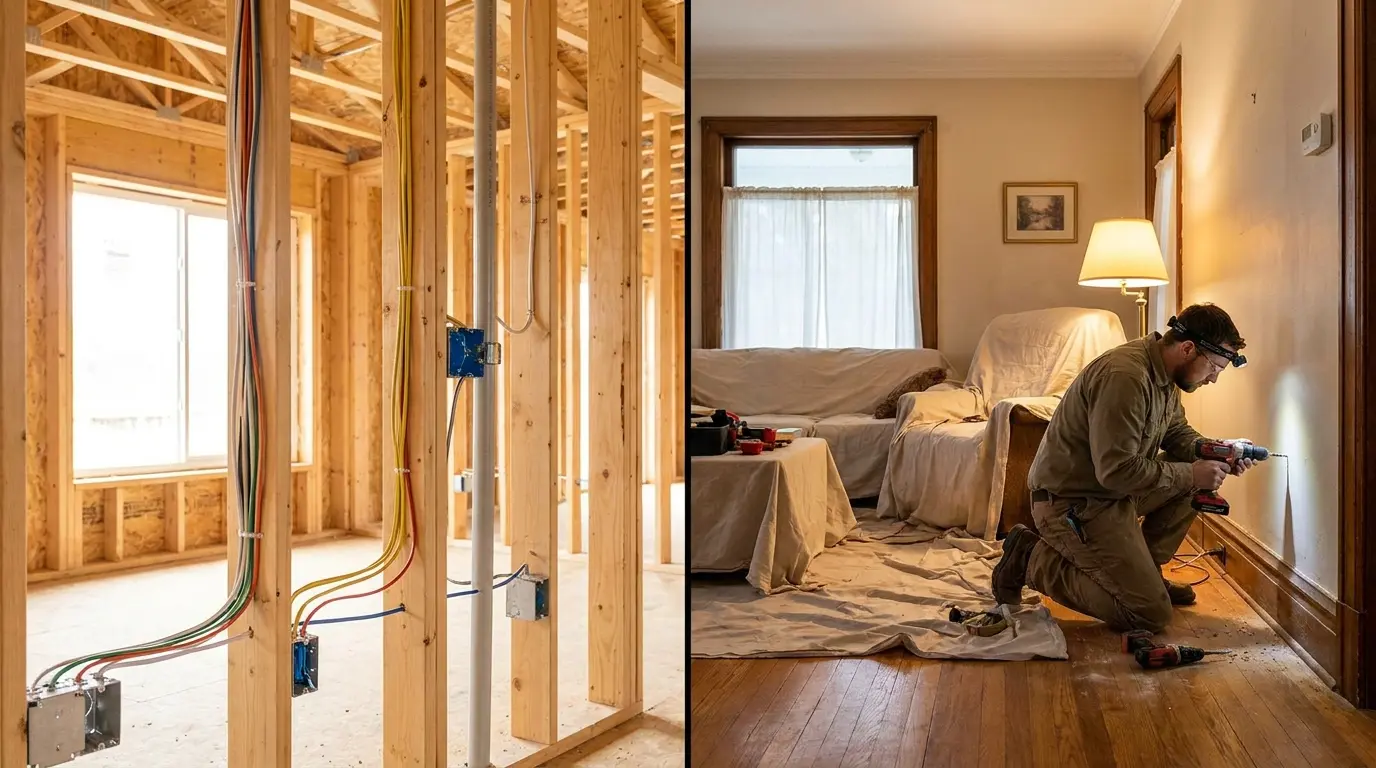
New construction electrical cost per square foot typically runs $3 to $5, meaningfully lower than the $5 to $17 range for rewiring an existing home. That gap confuses homeowners who see new-build numbers cited online and wonder why their estimate is higher.
The reason is straightforward: new construction wiring happens before walls are closed. The electrician runs wire through open framing, places boxes in unfinished space, and works without any finished surface in the way. There’s nothing to protect, nothing to patch, and no guesswork about where the wire can travel.
Rewiring an existing home is a completely different job. The electrician has to navigate around finished rooms, push wire through closed cavities, minimize damage to ceilings and walls, and work with whatever the original builder left behind. Every foot of wire costs more to install when access is limited. That’s not markup; that’s labor.
If you see new-construction pricing and wonder why your rewire quote is higher, the access gap is the reason.
What Drives the Cost: Five Factors That Move the Number Most
Square footage sets the baseline. These five factors are what move an estimate above or below it.
1. Wiring Type and Age
Knob-and-tube wiring, common in homes built before 1950, takes more time to remove safely than modern wiring because it’s ungrounded, often runs through insulation, and requires careful tracing before disconnection.
Aluminum wiring from the 1960s and 70s needs specific connection hardware at every junction point to prevent fire risk. Cloth-wrapped wiring from the same era is brittle and unpredictable once disturbed.
None of these automatically means the whole house needs replacement, but all of them add labor.
A home where the electrician can pull old wire in straightforward runs will price lower than one where every room requires tracing, testing, and careful extraction before new wire can go in.
| Pro Tip: Before requesting quotes, locate any home inspection report, seller disclosure, or past electrical invoice. Electricians who know the wiring type upfront can price more accurately, and you’ll have a better basis for comparing estimates. |
2. Wall and Ceiling Access
Access is the most unpredictable cost driver. An attic with clear runs to exterior walls is an electrician’s best-case scenario.
A finished basement ceiling directly below a living room, where outlets need to be relocated, is the opposite.
Tight wall cavities, plaster walls (which crack rather than cut cleanly), built-in shelving, and blocked ceiling paths all add time to every single circuit.
I always ask homeowners to walk me through their home before I price it.
If I know there’s a cathedral ceiling in the master bedroom or a brick interior wall in the kitchen before I write numbers, the estimate is more accurate from the start. Surprises mid-project cost more than surprises during the walkthrough.
3. Electrical Panel Capacity
Rewiring the home’s circuits doesn’t automatically solve a panel that’s out of capacity.
A 100-amp service panel, standard in homes built before the 1970s, often can’t support the load of a modern household running central air, an electric range, EV charging, and a home office simultaneously.
Upgrading from 100-amp to 200-amp service adds roughly $1,500 to $4,000 to the project, depending on whether the utility company needs to move the meter, the panel location, and local permit requirements.
If you’re planning an EV charger, finished basement, or home addition after the rewire, discuss panel capacity in the same conversation.
Doing it twice costs more than doing it right once. For context on how panel upgrades factor into broader home improvement projects, the cost to finish a basement often includes a panel upgrade line item for the same reason.
4. Room-by-Room Demand
Not every room is priced the same. Bedrooms typically need a few circuits and a handful of outlets, which is straightforward work.
Kitchens require dedicated 20-amp circuits for large appliances, GFCI outlets within 6 feet of the sink, and often a separate circuit for the refrigerator, dishwasher, and microwave.
Bathrooms need GFCI protection on all outlets. Laundry rooms need a dedicated 240-volt circuit for the dryer.
A home office used for multiple monitors, external drives, and video production equipment puts far more demand on the wiring than the “spare bedroom” label suggests.
Tell the electrician how you actually use each room, not what it’s called on the floor plan.
5. Permit and Inspection Costs
Most jurisdictions require a permit for whole-home rewiring, and some require a separate electrical inspection before walls are closed.
Permit fees vary by county; expect $500 to $2,000 depending on project scope and location. The electrician typically pulls the permit, but confirm this in writing before work starts.
Some contracts expect the homeowner to handle permits, which changes your timeline and adds a step before work can legally begin.
Skipping the permit to save money is a mistake that surfaces at resale.
Buyers’ home inspections flag unpermitted electrical work, lenders sometimes won’t finance homes with open permit violations, and insurance companies have grounds to deny claims when unpermitted work is involved in a fire or damage event.
A Full Cost Breakdown: What the Line Items Actually Are
This is what a complete rewiring project typically consists of, priced individually. Not every project includes all of these, but knowing each line item helps you verify that a quote is complete before you sign.
| Line Item | Low End | High End | What Drives Variation |
| Wire and materials | $1,500 | $6,000 | Home size, circuit count, wire grade |
| Electrician labor | $4,000 | $18,000 | Access difficulty, crew size, days on-site |
| Panel upgrade (100A to 200A) | $1,500 | $4,000 | Meter location, utility coordination, panel brand |
| Outlets and switches | $500 | $2,500 | Count, GFCI/AFCI requirements, finish grade |
| Permits and inspections | $500 | $2,000 | Jurisdiction, project scope, reinspection fees |
| Drywall/plaster repair | $500 | $4,000 | Number of access holes, surface type, paint matching |
The labor line is the one that surprises homeowners most. Electricians in high-cost metro areas (Boston, San Francisco, Seattle) bill $90 to $150+ per hour.
Rural or mid-sized markets typically run $60 to $90. A two-person crew on a 1,500 sq ft rewire might spend four to six days on-site. That labor total, before materials or permits, can exceed the cost of the wire itself on a complex project.
What Homeowners Actually Pay: Three Real-World Examples
National averages only go so far. These examples, drawn from homeowner discussions about actual projects, show how the same baseline question produces very different answers depending on the house.
Lower-Cost Example: 1,500 sq ft Townhome, $11,000

A 1,500 sq ft townhome rewired from knob-and-tube wiring came in at $11,000. The details that kept it on the lower end: drywall construction (not plaster), a single-story layout, accessible attic, no panel upgrade required, and a relatively simple circuit layout. That’s what the low end of the range actually looks like. Not a bare-bones quote, but a project where the access conditions went in the homeowner’s favor.
Mid-Range Example: 1,200 sq ft Two-Story, $14,000
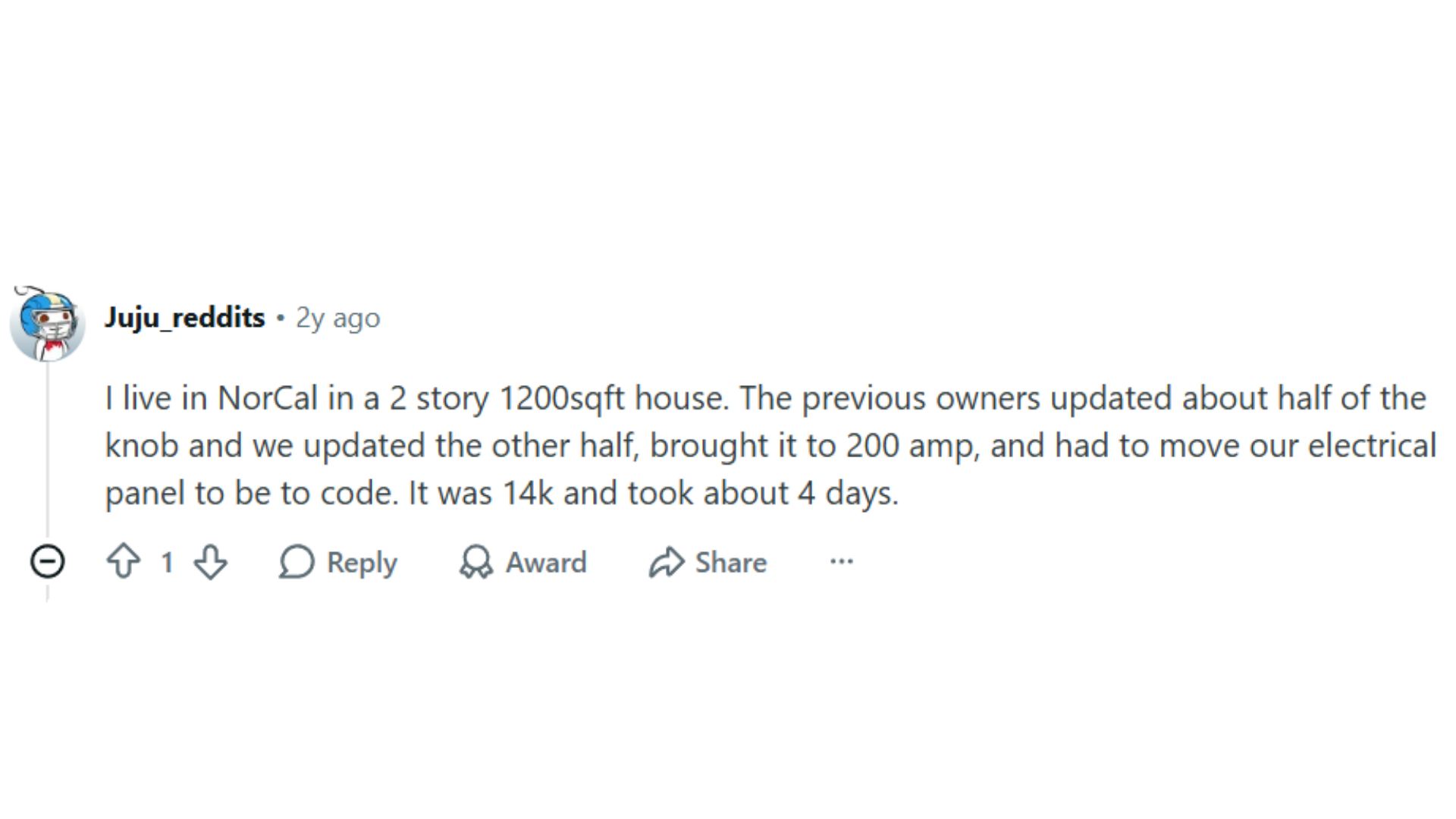
A 1,200 sq ft two-story home had remaining knob-and-tube wiring updated, the panel moved, and service brought to 200 amps. The project took four days. At $14,000, this sits comfortably in the mid-range. The job had real scope (panel relocation, service upgrade) but the electrician didn’t encounter serious access problems in every room.
High-Cost Example: Older Home with Plaster, $40,000
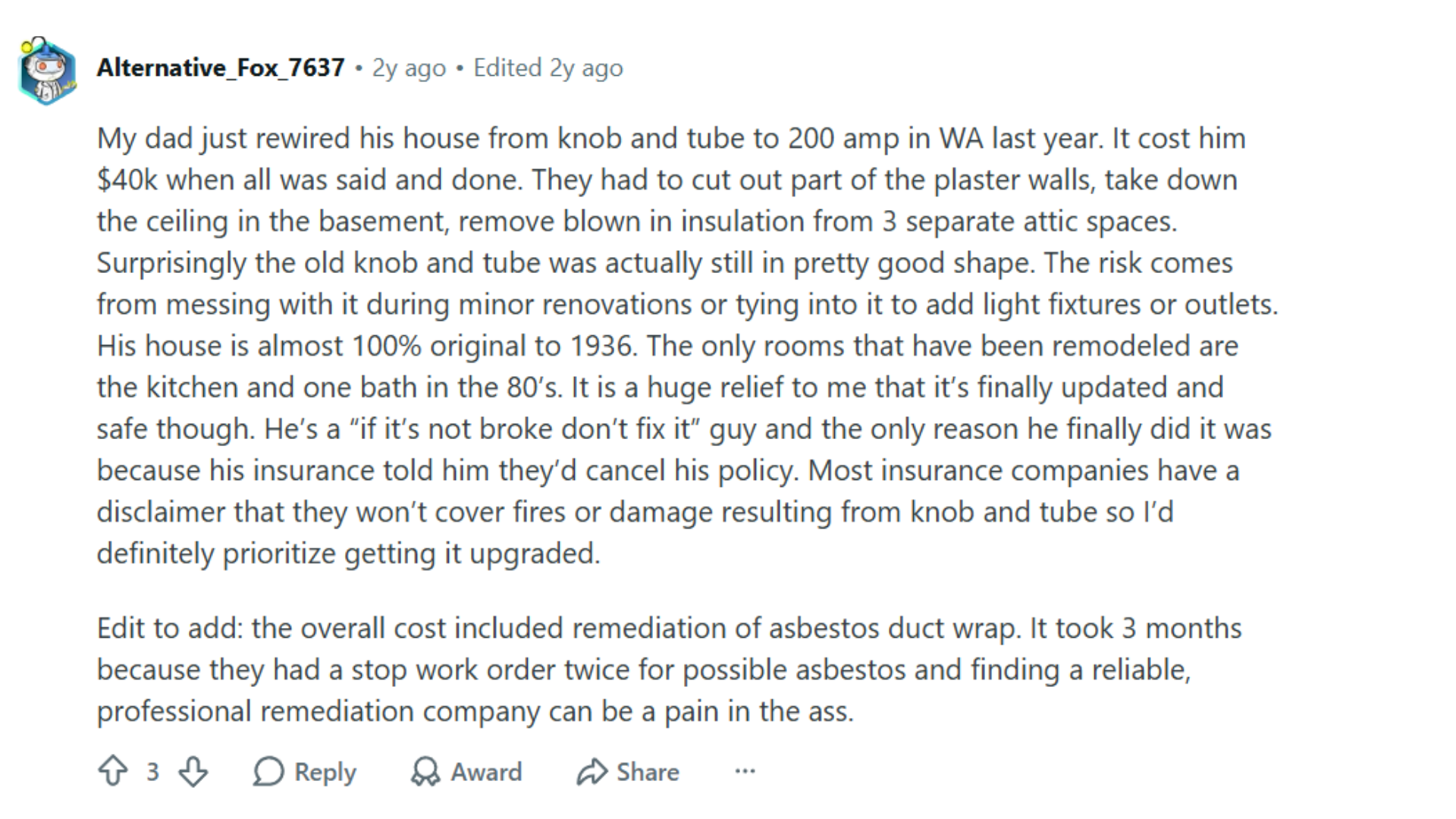
A full knob-and-tube replacement in an older home with plaster walls, basement ceiling removal, attic insulation removal, and asbestos-related delays reached $40,000. This is what the top end looks like. It’s not a contractor overcharging; it’s what happens when difficult materials, hazmat protocols, and blocked access converge on the same project. Older homes with these characteristics routinely exceed published national averages.
The practical takeaway is to use these examples for pattern recognition, not direct comparison. Your house has its own access conditions, its own wiring history, and its own panel story. Local quotes from licensed electricians who have walked your home are the only numbers that actually apply.
How to Tell If a Quote is Fair
A quote can be low because the job is straightforward, or because the contractor left out half the work. Before you choose, verify that each estimate covers the same scope.
| What to Check | Why It Matters | What to Ask |
| Full vs. partial rewire | Defines the project scope | Which rooms and circuits are included? |
| Permit handling | Avoids compliance gaps | Who pulls the permit: you or the electrician? |
| Panel work | Can add $1,500 to $4,000 if excluded | Is panel upgrade or relocation included? |
| Wall repair | Drywall patching is often not included | Who repairs access holes after work? |
| Inspection support | Confirms the job closes properly | Do you attend the inspection or handle callbacks? |
| Warranty | Protects you after completion | What’s covered and for how long? |
If one bid comes in 30% lower than the others, ask what it excludes before celebrating. The most common omissions are wall repair, permit fees, and panel work. A quote without those line items isn’t necessarily dishonest, but it’s not a complete price either.
Extra Costs That Don’t Show Up in the Electrical Quote
The electrician’s invoice ends when the wiring is done. The project isn’t over at that point.
Drywall repair after access cuts typically runs $500 to $4,000 depending on how many walls were opened and whether the surfaces require texture matching or paint blending.
Plaster is more expensive to repair than drywall. The material behaves differently and most drywall contractors don’t patch it to the same standard.
If your home has original plaster, budget separately for a plasterer, not just a drywall finisher.
Furniture moving, temporary hotel nights during heavy work, and hidden damage discovered once walls are opened (old leaks, improper splices from previous owners, pest damage in wall cavities) are all legitimate budget items that a fixed-price quote can’t anticipate.
I tell homeowners to hold 10 to 15% of their electrical budget in reserve for this category. It doesn’t always get spent, but the projects where it doesn’t get spent are the lucky ones.
Signs Your House May Need Rewiring
Electrical problems rarely announce themselves clearly. They start as small, repeated annoyances and grow from there. If you’re consistently seeing more than one item on this list, schedule an inspection with a licensed electrician rather than waiting for the issue to resolve on its own.
- Breakers tripping more than once a month on the same circuit
- Lights flicker when large appliances run
- Outlets that feel warm to the touch
- Burning smell near switches or outlet plates
- Buzzing or crackling from light switches
- Scorch marks or discoloration around outlet covers
- Two-prong ungrounded outlets throughout most of the home
- Fuse box (not a circuit breaker panel)
- Home inspection report flagging aluminum wiring, knob-and-tube, or sub-standard grounding
Each of these on its own might be an isolated fix. Several together, especially in an older home, usually point to a system that’s been running past its useful life. The inspection cost ($100 to $250 for most electricians) is the cheapest information you can buy before committing to a full rewire budget.
Budget Tips That Actually Work
The legitimate savings in a rewire project come from project management decisions, not from cutting corners on the electrical work itself. Here’s what makes a real difference:
- Time it with a renovation. If you’re already opening walls for a kitchen remodel, bathroom update, or home addition, rewiring those spaces simultaneously eliminates most of the access labor cost. The walls are already open.
- Clear the rooms before day one. Furniture, boxes, and wall items that haven’t been moved before the crew arrives slow down every circuit. Electricians bill by the hour for time spent working around obstacles.
- Lock in the scope before work starts. Adding a circuit, moving an outlet, or expanding to another room mid-project costs significantly more than planning it upfront. Scope creep is one of the most consistent drivers of final invoices exceeding initial estimates.
- Get three written estimates. Not three verbal conversations. Three written scopes with line items. The differences between them will tell you more about what you’re actually buying than any single number.
- Don’t skip the permit. A failed inspection after the fact, or a compliance issue discovered during resale, will cost more than the permit ever would have. This is especially relevant if you’re also working through the cost of a sunroom addition or another permitted project simultaneously. Permits are always cheaper than the alternative.
- Hire licensed electricians for major work. An unlicensed contractor doing whole-home rewiring creates liability you’ll carry indefinitely. Insurance claims, resale inspections, and permit compliance all touch this decision.
Frequently Asked Questions
These are the questions homeowners ask most often after they get a first estimate and start trying to make sense of it.
How much does it cost to rewire a house completely?
A complete house rewire typically runs $10,000 to $30,000, or $5 to $17 per square foot. The final number depends on home size, access conditions, panel capacity, and whether old wiring like knob-and-tube needs careful removal.
What is the average cost to rewire a house?
The national average lands around $12,000 to $18,000 for a 1,500 to 2,000 sq ft home with moderate access and a panel upgrade included. Homes with plaster walls, difficult access, or hazmat discoveries regularly exceed this range.
How much does it cost to rewire a 3 bedroom house?
A three-bedroom home typically falls between 1,200 and 2,000 sq ft, putting the rewire cost at roughly $10,000 to $34,000. Kitchen and bathroom circuit requirements, not just bedroom count, drive much of the final number.
How much does it cost to rewire a whole house vs. partial rewire?
A partial rewire targeting specific circuits or rooms costs less upfront but may require a second visit if more problems surface. Whole-home rewiring is generally more cost-efficient per circuit when the electrical system is broadly outdated.
Does homeowners insurance cover house rewiring?
Standard homeowners insurance doesn’t cover rewiring for age or obsolescence. It may respond to electrical damage from a covered event, but that depends entirely on your policy. Call your insurer before work starts to understand what documentation they require for completed licensed work.
Can rewiring a house increase home value?
Rewiring doesn’t produce a visible ROI like a kitchen remodel, but it reduces buyer objections at inspection. Buyers in older home markets often negotiate harder or walk away when inspection reports flag outdated electrical systems. Updated wiring gives you more control over that conversation.
Do you need a permit to rewire a house?
Yes, in virtually every US jurisdiction, whole-home rewiring requires a permit and inspection. The electrician typically pulls it. Keep copies of permits and inspection sign-offs permanently; they’re required documentation when you sell.
How long does it take to rewire a house?
Most whole-home rewires take three to seven days for a 1,500 to 2,500 sq ft home with a two-person crew. Plaster walls, blocked access, or permit delays extend that timeline. Ask for a room-by-room schedule before work begins.
Can you live in a house during rewiring?
Sometimes, but it’s uncomfortable. Power shutoffs, open walls, dust, and noise make full-home rewiring disruptive. Smaller, room-by-room projects are more manageable. Discuss which rooms are affected each day so you can plan meals, work, and sleeping arrangements.
Can you finance a house rewire?
Yes. Personal loans, home equity loans, HELOCs, and some contractor financing programs all cover rewiring costs. Compare total repayment cost, not just monthly payments. Confirm deposit and draw schedule requirements match your financing timeline before signing anything.
Summing Up
After ten years of helping homeowners navigate home-building budgets, I’ll give you the direct answer: yes, when the system needs it.
A $10,000 to $30,000 rewire is a significant number, but the electrical system in a home built before 1970 was never designed for the load of a modern household.
The homeowners who put this off long enough usually end up paying more, whether in emergency repairs, failed inspection negotiations at resale, or insurance complications after a fire traced back to old wiring.
Get three written estimates from licensed electricians, understand what each one includes on panel work and permits, and ask the one concrete question that matters: what will you find once the walls are open?
The answer shapes the real budget more than any national average ever will.
Cost estimates based on HomeGuide and Angi national averages, 2025-2026. Verify current pricing with local licensed electricians before committing to any project.