

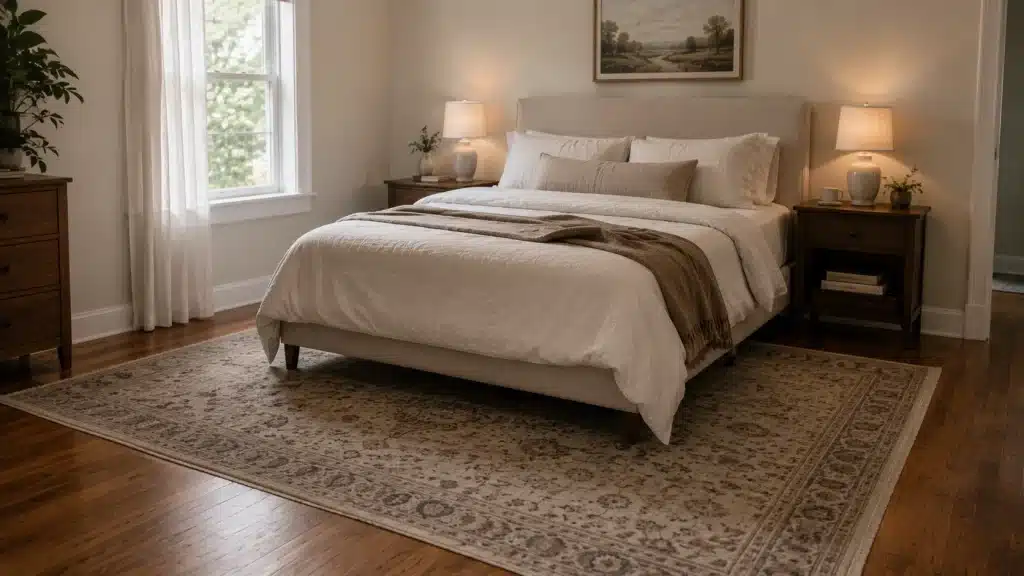


| Bed Size or Type | Mattress Size | Best Rug Size | Works Best When |
| Twin bed | 38 x 75 in | 5 x 7 or runner | Small bedroom, one-sided landing space |
| Full bed | 54 x 75 in | 6 x 9 or 8 x 10 | Guest room or compact main bedroom |
| Queen bed | 60 x 80 in | 8 x 10 | Most standard bedrooms |
| Queen bed in a small room | 60 x 80 in | 5 x 8 or 6 x 9 | The rug sits near the lower half or foot of the bed |
| Queen bed in a large room | 60 x 80 in | 9 x 12 | Nightstands can sit fully on the rug |
| King bed | 76 x 80 in | 9 x 12 | A wider bed needs more side coverage |
| California king bed | 72 x 84 in | 9 x 12 or 10 x 14 | Longer bed and larger room |
| Platform bed | Varies by frame | 8 x 10 or 9 x 12 | A low profile needs enough visible rug around it |
| Storage bed | Varies by frame | 8 x 10 or runners | Drawer clearance matters near bed sides |
A rug under a queen bed sounds simple until the room starts arguing back. One size looks too small. Another covers too much floor. The bed frame, nightstands, room width, and walking paths all change what actually works.
After years of solving real bedroom layout problems, I have seen the same mistake often: people choose a rug size before checking the full room. A standard queen mattress is 60 inches wide and 80 inches long, but the frame, bedding, and furniture make the footprint feel larger.
That is why choosing a queen bed rug size should start with the layout, not just the label. The right rug gives your feet a soft landing, makes the bed feel settled, and leaves enough open floor around it.
What Is the Best Queen Bed Rug Size?
For most bedrooms with a queen bed, the best queen bed rug size is 8 x 10. It gives enough width on both sides of the bed for a comfortable landing, enough length to extend past the foot, and it does not take over the room.
In a small bedroom, 6 x 9 or 5 x 8 can work when the rug sits lower under the bed or only near the foot. In a larger room, 9 x 12 gives a more complete layout because the bed and nightstands can both sit on it.
A queen mattress is 60 inches wide. That sounds like a lot, but a rug needs to extend well beyond the mattress edges to look intentional rather than accidentally small.
If the rug ends too close to the mattress, the bed can look like it is sitting on a narrow strip. If the rug is too large for the room, it starts to feel like wall-to-wall carpet rather than a defined area.
The general rule that works most often is to aim for about 18 to 24 inches of rug showing on each side of the bed. That is why 8 x 10 is the safe middle answer for most queen bedrooms. For a small room where that much exposure would eat up the floor, size down. For a larger room with space to spare, size up.
One thing worth saying clearly before moving forward: the rug does not need to match the mattress size exactly. It needs to fit the room and the full furniture footprint, which is a different calculation.
If one rule is worth keeping: Choose 8 x 10 for a standard queen bedroom, then size up or down based on how much walking space is left after the bed and nightstands are placed.
Important Factors When Choosing an Area Rug
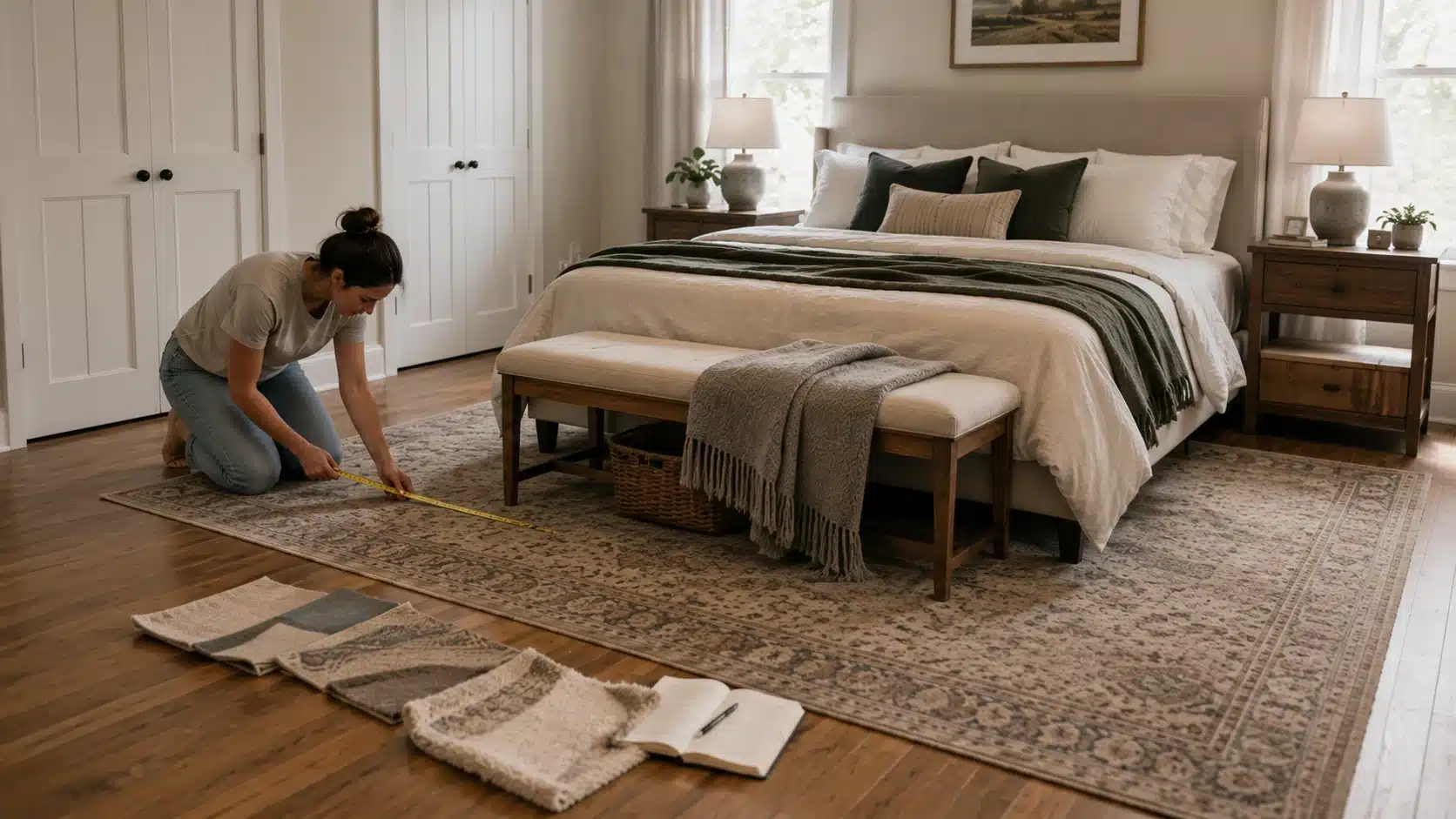
The right rug size depends on more than the mattress. A queen bed can feel very different once the frame, nightstands, bench, closet doors, and room width are all considered. Measuring the full layout before choosing is far more reliable than guessing from a mattress dimension alone.
- Room size: A tight room usually needs a smaller rug or runners. A larger room can handle 8 x 10 or 9 x 12 without crowding the floor. The rug should not press against every wall.
- Bed frame width: Upholstered beds, platform frames, and storage beds often extend beyond the mattress by several inches on each side. Measure the frame, not just the mattress, before sizing.
- Nightstand placement: Decide before buying whether the nightstands should sit on the rug, off the rug, or near its edge. That decision alone often determines whether 8 x 10 or 9 x 12 is the right call.
- Walking space: Leave enough clear floor around the bed so the rug does not block doors, closets, or dresser drawers. A rug that fights the room’s moving parts never looks right.
- Rug exposure: The visible rug matters most on both sides of the bed and at the foot, where it affects both comfort and visual balance. Those are the spots where size becomes obvious.
- Rug thickness: Thick rugs can block storage drawers and make furniture feel slightly uneven. Low-to-medium pile tends to be more practical under heavy bedroom furniture.
- Budget: Larger rugs cost more. It helps to know whether the room genuinely needs 9 x 12 or if an 8 x 10 in the right position looks just as complete.
- Cleaning needs: Bedrooms with pets, kids, or high dust may need washable, low-pile, or easy-vacuum options. Material choices matter as much as dimensions.
| Note: Measure the open floor around the bed before shopping. A rug that looks right online can feel wrong once it is in the room and partially under a heavy bed frame. Check door and drawer clearance before placing any order. |
The best rug is not always the largest one. It is the one that fits the room’s daily use, clears the furniture, and gives the bed enough visual weight without making the floor feel completely covered.
Queen Bed Rug Size Ideas With Visual Layout Examples
Each rug size changes the bedroom in a different way. Some create only a soft landing near the bed. Others make the whole sleeping area feel connected. Use these examples to match the rug size to the room and the layout, not just the mattress dimensions.
1. Small Accent Choice: 4 x 6 Rug
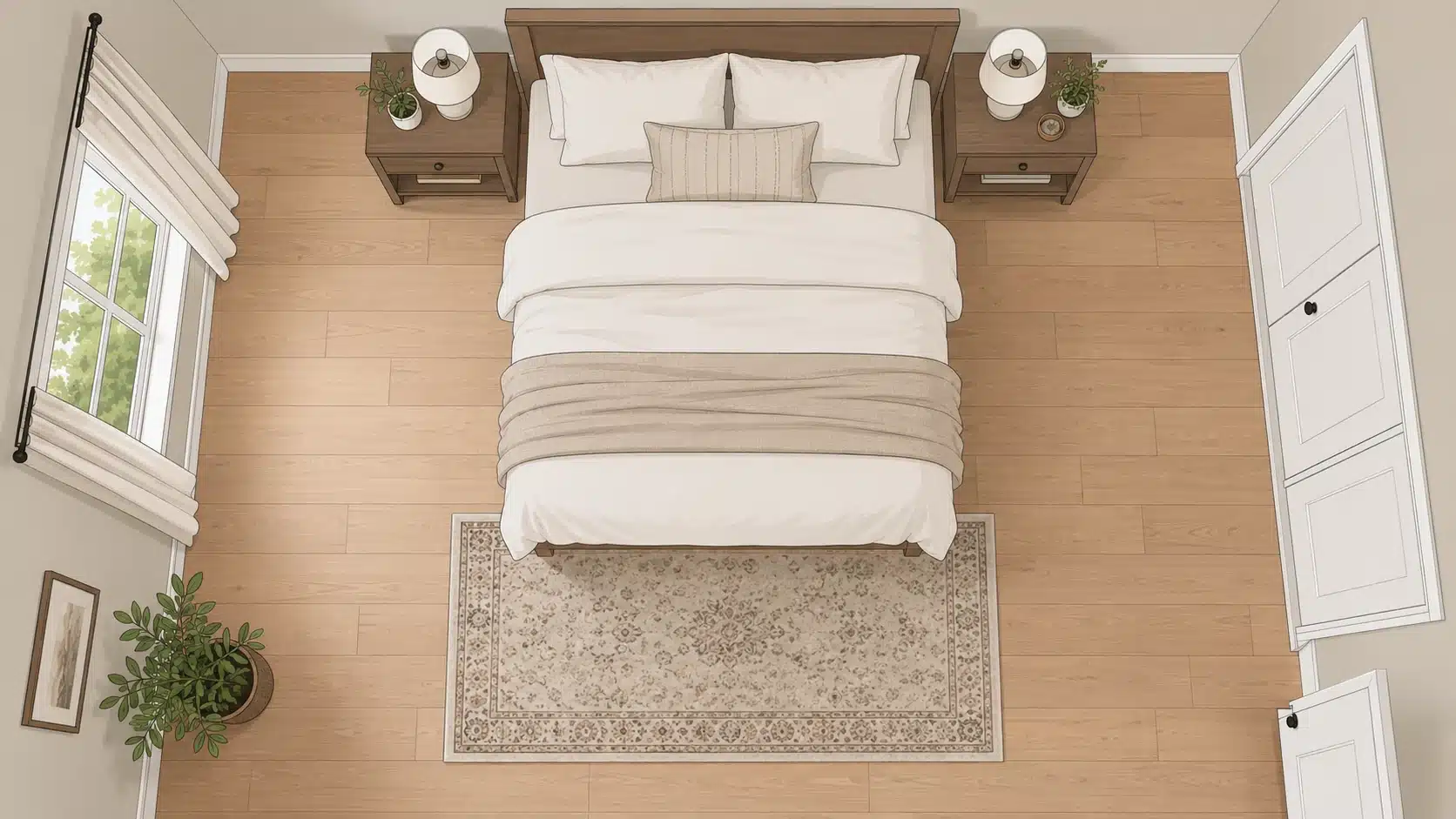
A 4 x 6 rug is usually too small to support a queen bed layout on its own. It works better near the foot of the bed, beside one side, or as part of a layered setup. Use this size only when the bedroom is very tight, the budget is limited, or the goal is a small landing area rather than full coverage for the whole bed or frame choice.
2. Tight-Room Option: 5 x 7 Rug
A 5 x 7 rug can work in a small bedroom, but it gives limited coverage around a queen bed. It is best placed toward the lower half of the bed instead of trying to reach the nightstands. This size is useful when floor space is tight, and the main goal is comfort near the foot and sides rather than a fully connected layout in narrow rooms with less clearance.
3. Small Practical Pick: 5 x 8 Rug
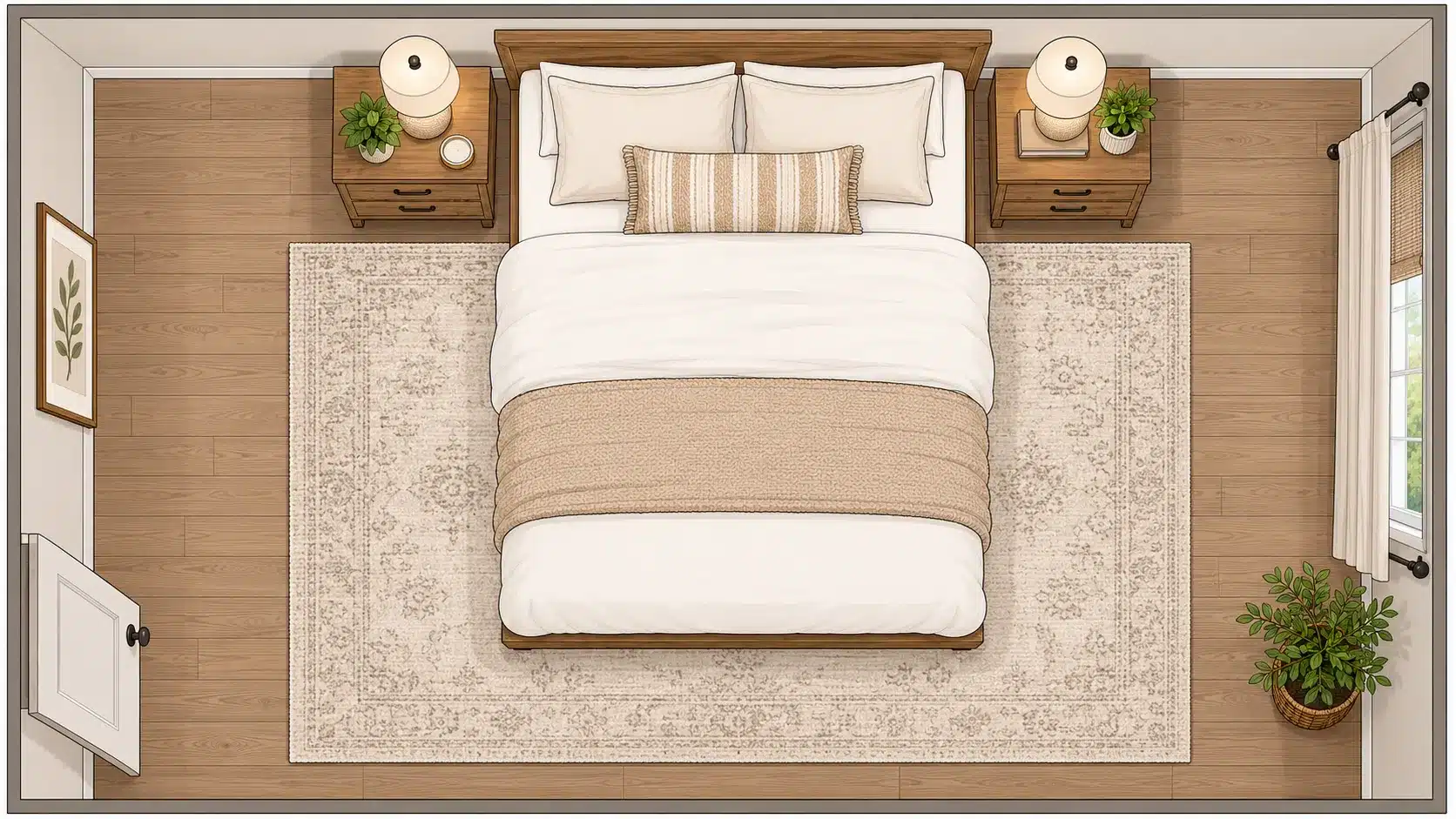
A 5 x 8 rug is one of the smallest useful choices for a queen bed. It can sit under the lower third or lower half of the bed, depending on the room. This size works best in compact bedrooms where a larger rug would block walkways, doors, or drawers. It is not ideal for a fully connected bed area or wider side coverage on both sides of the bed.
4. Compact Standard Choice: 6 x 9 Rug
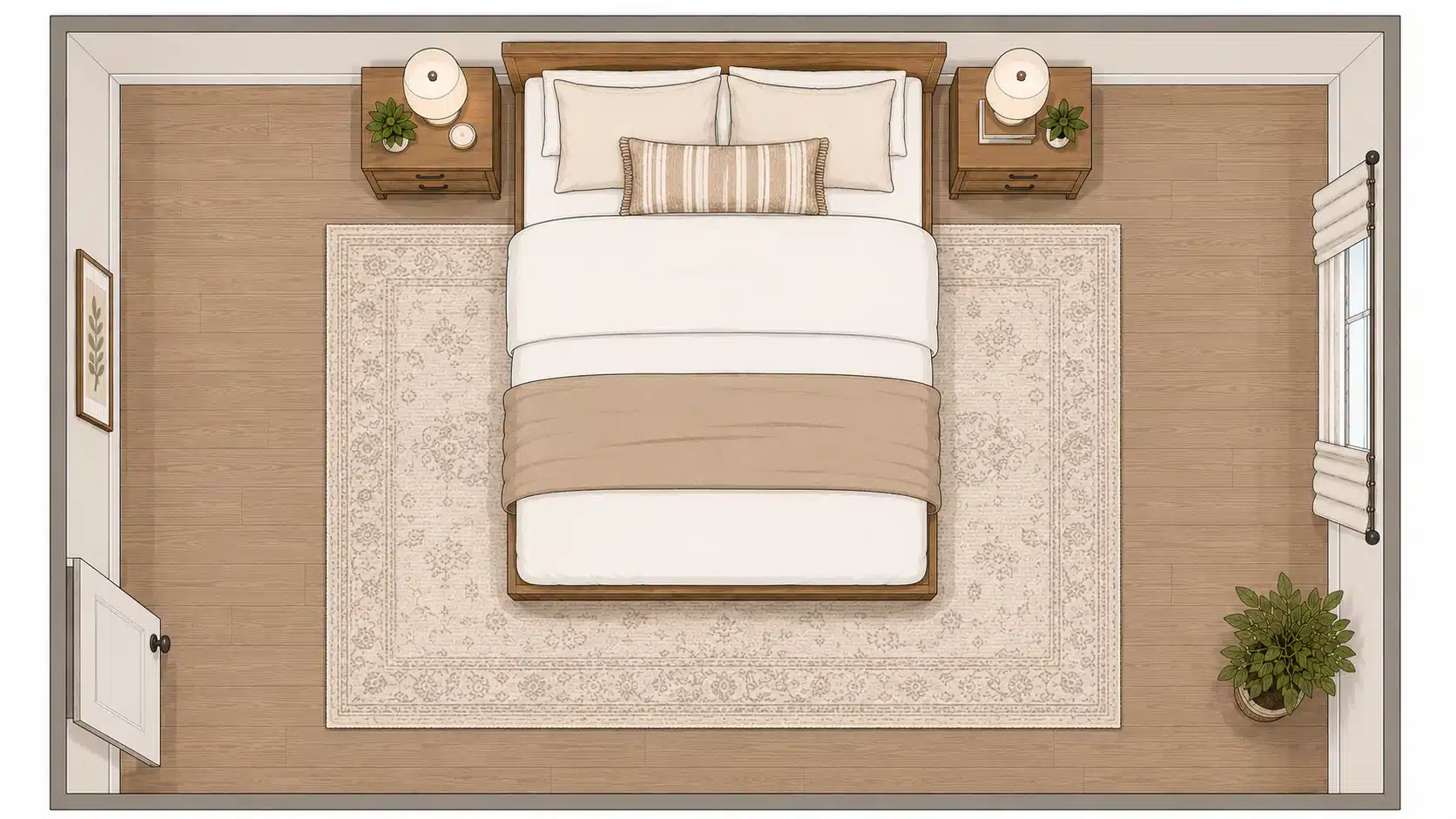
A 6 x 9 rug gives better coverage than a 5 x 8 and can work well in smaller standard bedrooms. It usually starts below the nightstands and extends past the foot of the bed. This size is a good compromise when 8 x 10 feels too large, but the room still needs softness and structure around the bed without crowding the floor or making the bedroom layout feel overfilled.
5. Middle-Ground Layout: 7 x 10 Rug
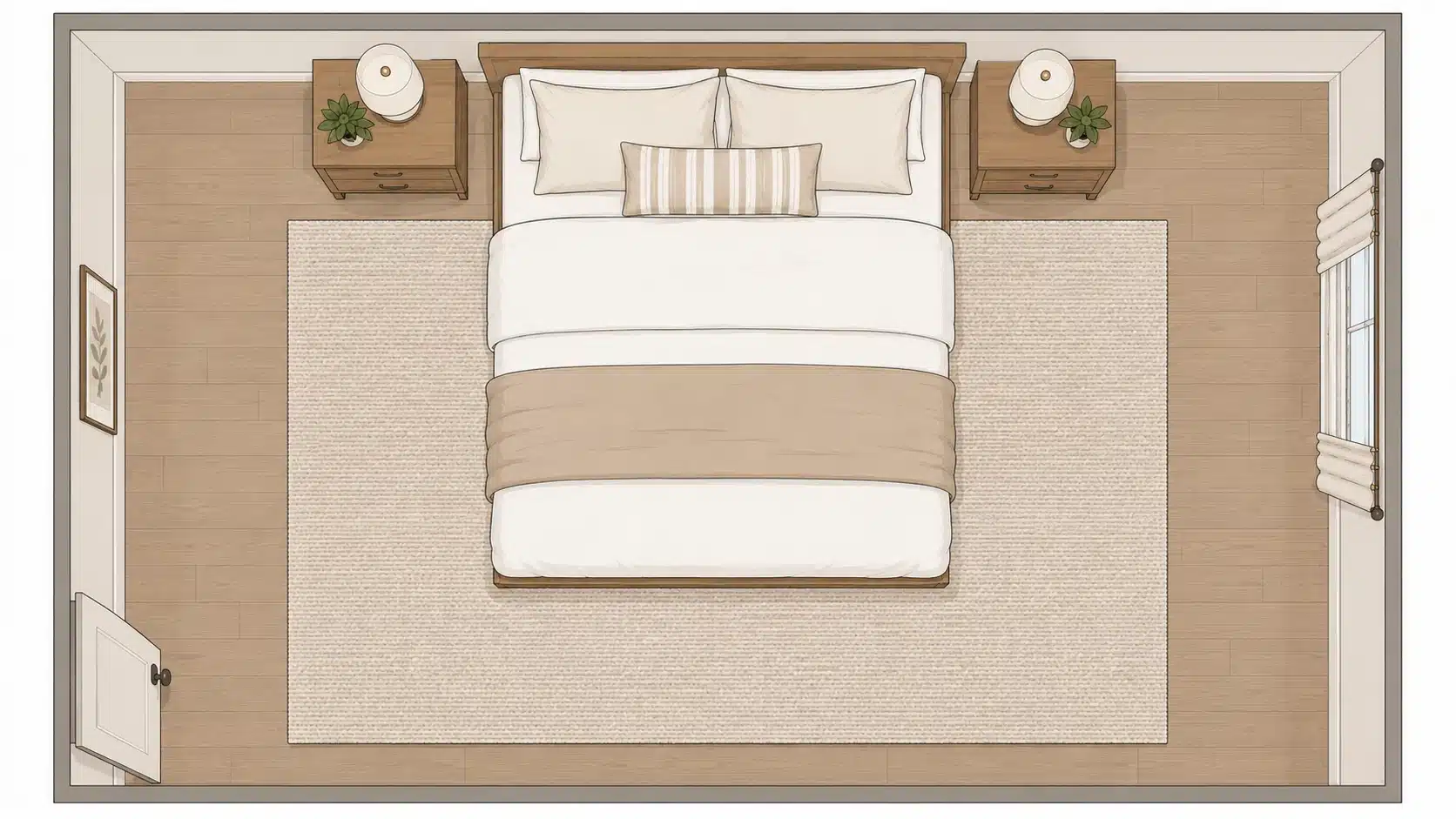
A 7 x 10 rug is useful when a 6 x 9 feels too narrow, but an 8 x 10 takes up too much floor space. It gives more side coverage and better length at the foot while still leaving the floor open. This size works well in average bedrooms, especially when the nightstands stay off the rug, and the bed is centered in the room with clear walking space left.
6. Best Overall Fit: 8 x 10 Rug
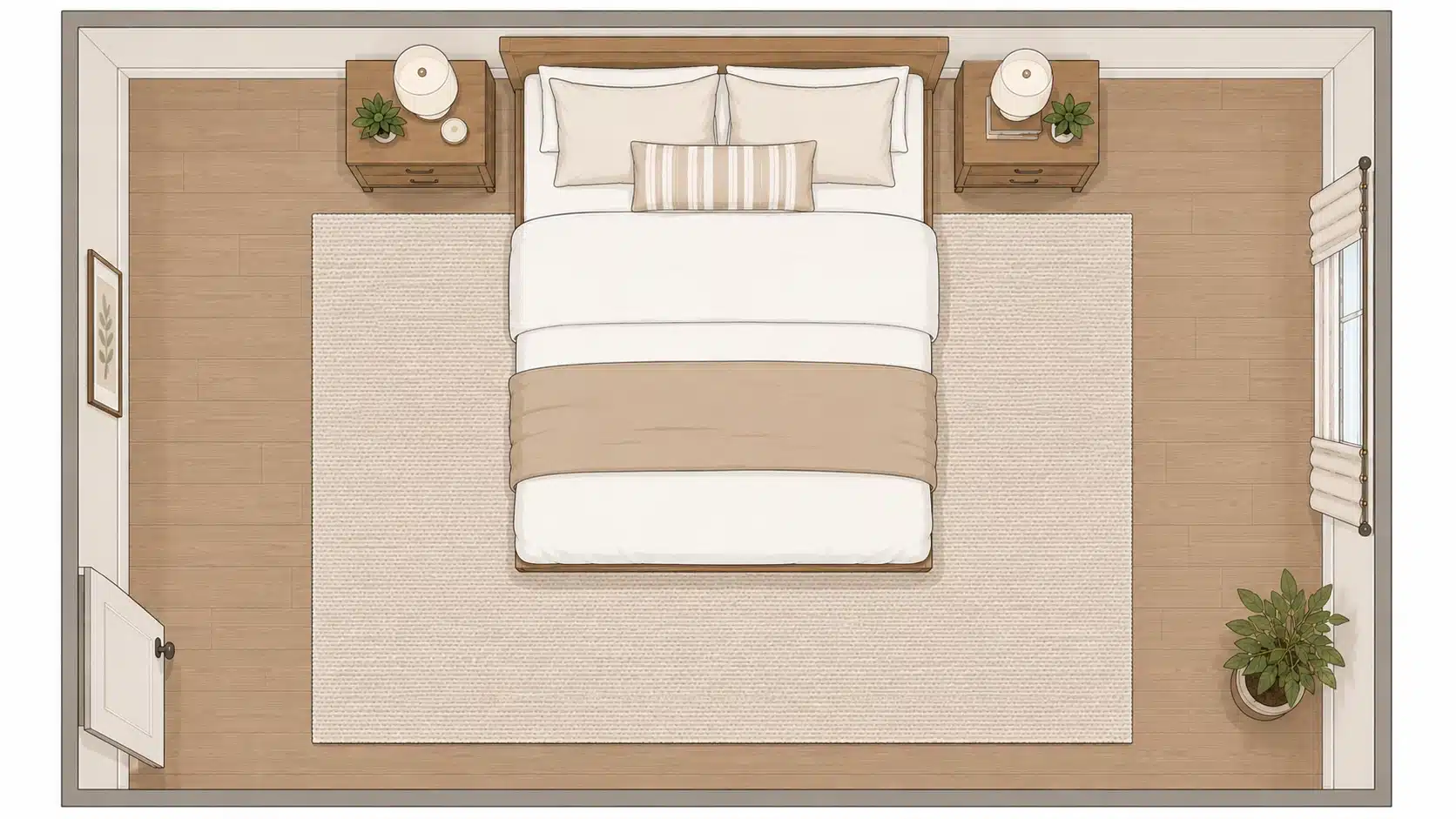
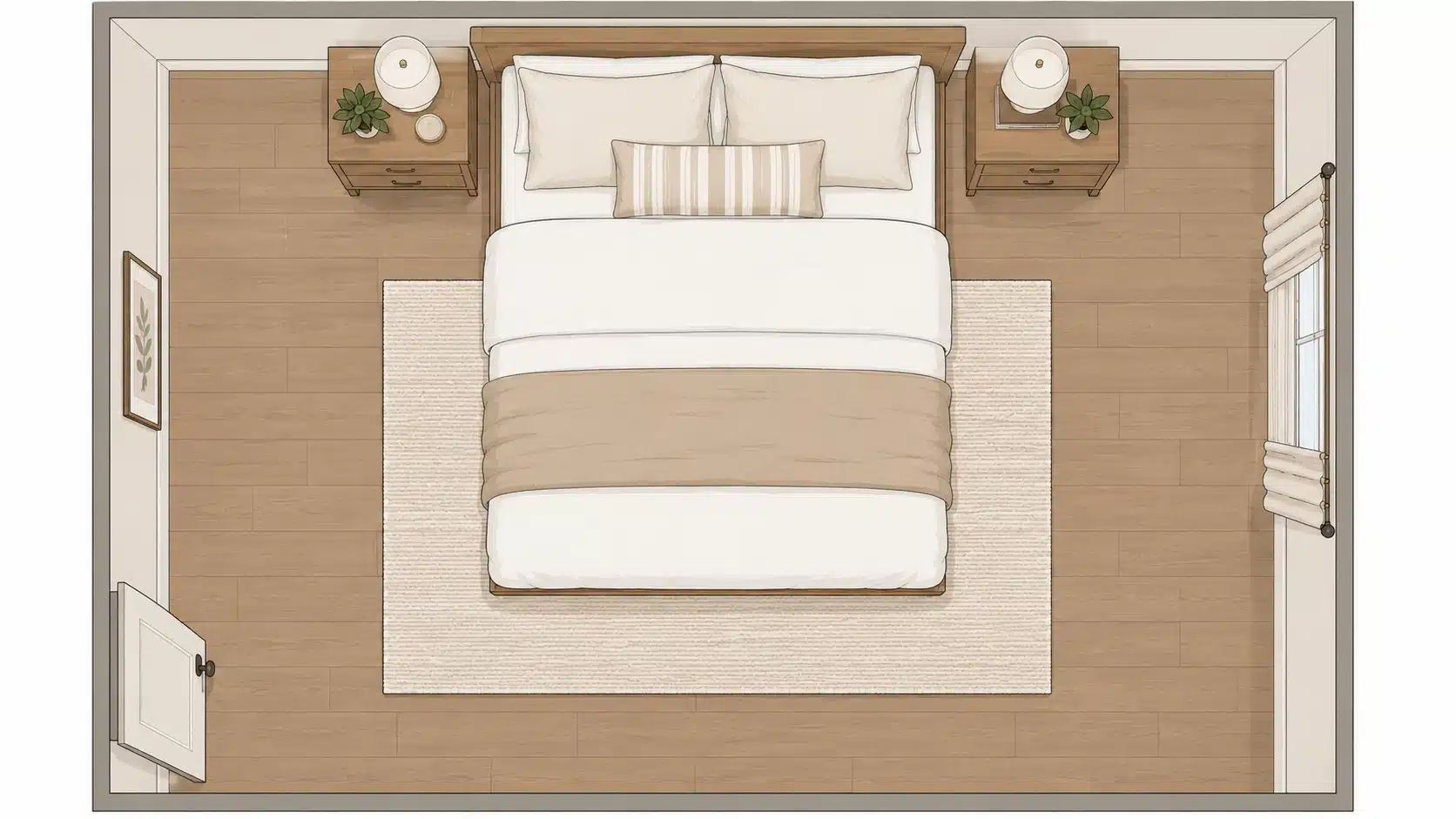
An 8 x 10 is usually the safest queen bed rug size for most bedrooms. It gives enough coverage on both sides for a comfortable landing and enough length at the foot for the bed area to feel complete. This size works well under the lower two-thirds of the bed and is the best starting point before sizing up or down for the room without taking over the entire floor.
7. Large Bedroom Choice: 9 x 12 Rug
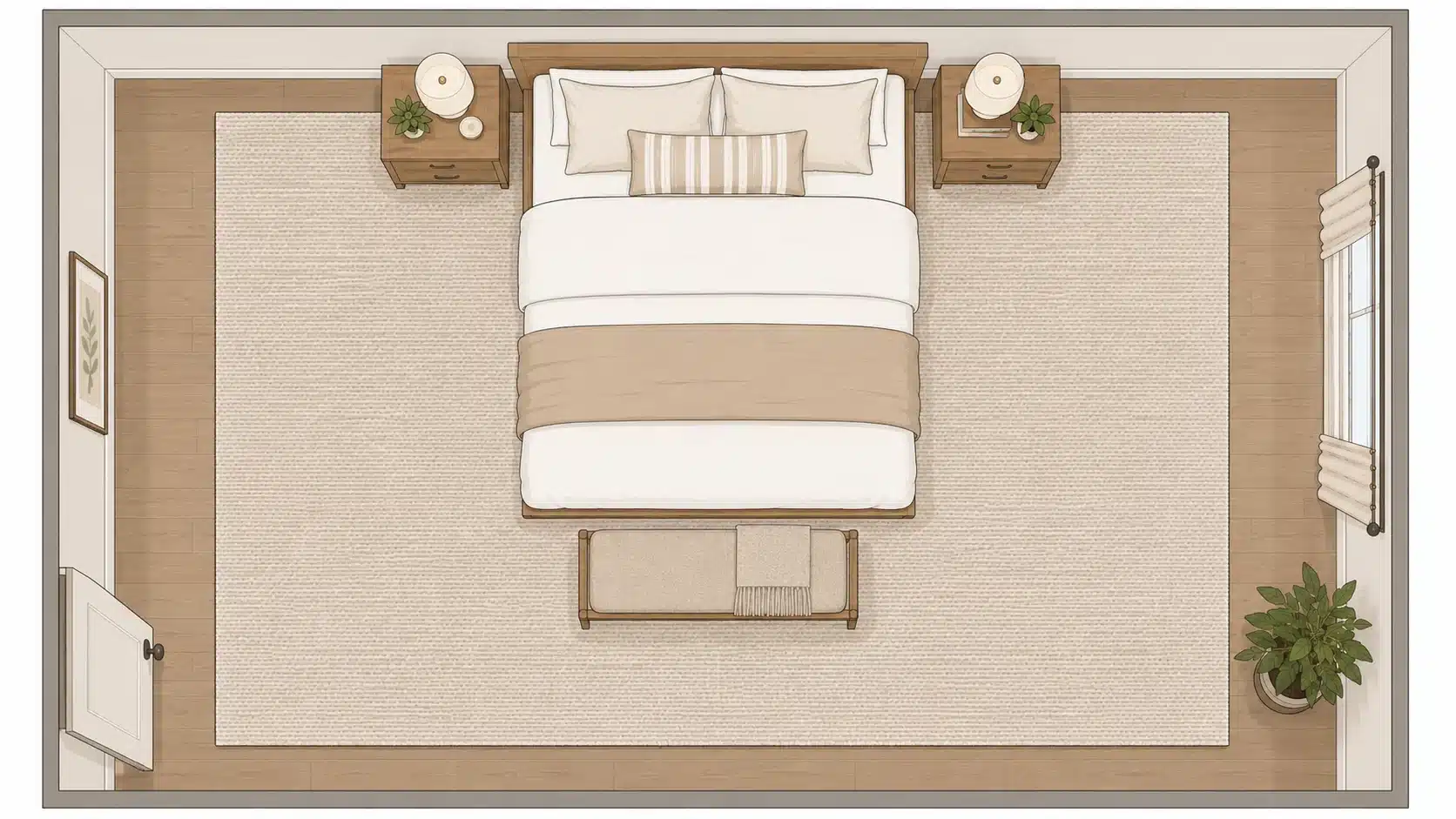
A 9 x 12 rug works best in a larger bedroom with enough open floor around the bed. It can sit under the bed, on nightstands, and even on a bench at the foot of the room if the room allows it. This size gives the most coverage, but it can feel too large in a compact room where the rug sits too close to the walls or doors, or leaves almost no visible floor.
8. Runner Rugs Beside a Queen Bed
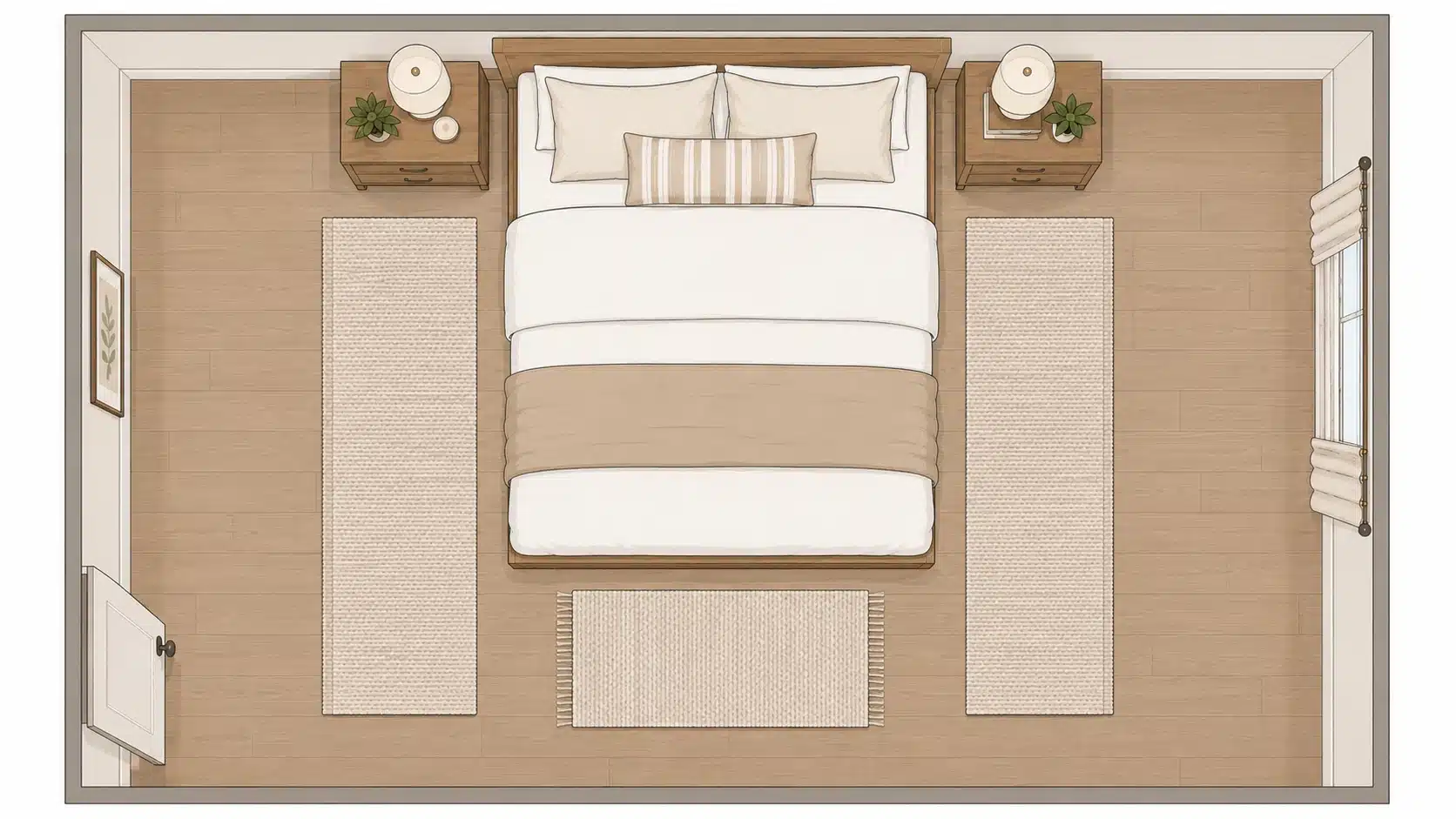
Runners are a practical alternative when a full area rug is too expensive, too hard to move under the bed, or too large for the room. Place one on each side of the bed for symmetry, or use a single runner on the main walking side. This gives softness underfoot without forcing a large rug into a space that was not built for it.
The visual difference between sizes is mostly about how much rug appears at the sides and foot of the bed. Smaller rugs act as accents. Medium rugs create a landing zone. Larger rugs connect the entire sleeping area into a single defined space.
Ways to Place a Rug Under a Queen Bed
Rug placement changes how the same size looks under a queen bed. The rug can sit under the lower two-thirds of the bed, run fully under the bed and nightstands, sit only at the foot, or be replaced by runners in narrow rooms. Knowing the placement option first makes size decisions much easier.
| Placement Style | How It Works | Best Rug Size | Useful When |
| Lower two-thirds | Rug starts below the nightstands, extends past the foot | 6 x 9 or 8 x 10 | Standard room with a centered bed |
| Full bed placement | The rug sits under the bed, and both nightstands | 9 x 12 for queen bed | Larger bedroom with space to spare |
| Foot-only | Rug near the foot of the bed, extends into the open floor | 5 x 7 or 5 x 8 | Minimal rooms or tight floor plans |
| Side runners | Two runners sit beside the bed instead of one rug | Runners 2.5 x 8 | Narrow rooms or very heavy beds |
| Asymmetrical shift | The rug moves toward the open side when one side is near the wall | Any size, adjusted | Beds against a wall or corner layout |
| Bench-at-foot layout | Rug extends past the bench at the foot of the bed | 8 x 10 minimum | Rooms with a bench or storage at the foot |
Placement decides whether the rug feels connected to the bed or looks like a separate piece sitting nearby. Center the rug on the bed first, then adjust for nightstands, benches, doors, and walking space.
Tip: Center the rug under the bed, keep equal rug exposure on both sides, and leave enough visible at the foot. Avoid placing nightstands half on and half off the rug. Use a rug pad for stability, test dimensions with painter’s tape before buying, check door and drawer clearance, and leave some floor visible around the edges for a balanced look.
Should the Rug Go Under the Nightstands?
This is one of the most common layout questions that comes up after the rug is purchased, which is usually the wrong time to be asking it. The answer depends on the rug size and the room.
With a 9 x 12 rug, nightstands in a queen bedroom can usually sit fully on the rug with room to spare. With an 8 x 10 rug, nightstands may sit off the rug or partly near the edge, depending on how deep the bed and room are. With a 5 x 8 or 6 x 9, the cleaner look is usually to keep the nightstands off the rug entirely and let the rug sit lower under the bed.
A rug placed under nightstands can look very intentional when done with the right size. When it is done with a rug that is slightly too small, the nightstand legs end up partially hanging off the edge, which tends to look more like a measurement error than a design choice.
The cleaner rule is this: put both nightstands fully on the rug or keep both fully off it. Consistency matters more than forcing a large rug into a room that was not quite sized for it.
This also applies when one nightstand is taller or deeper than the other, if the legs will not land cleanly on both sides, leave both off.
What Rug Material Works Best Under a Queen Bed?
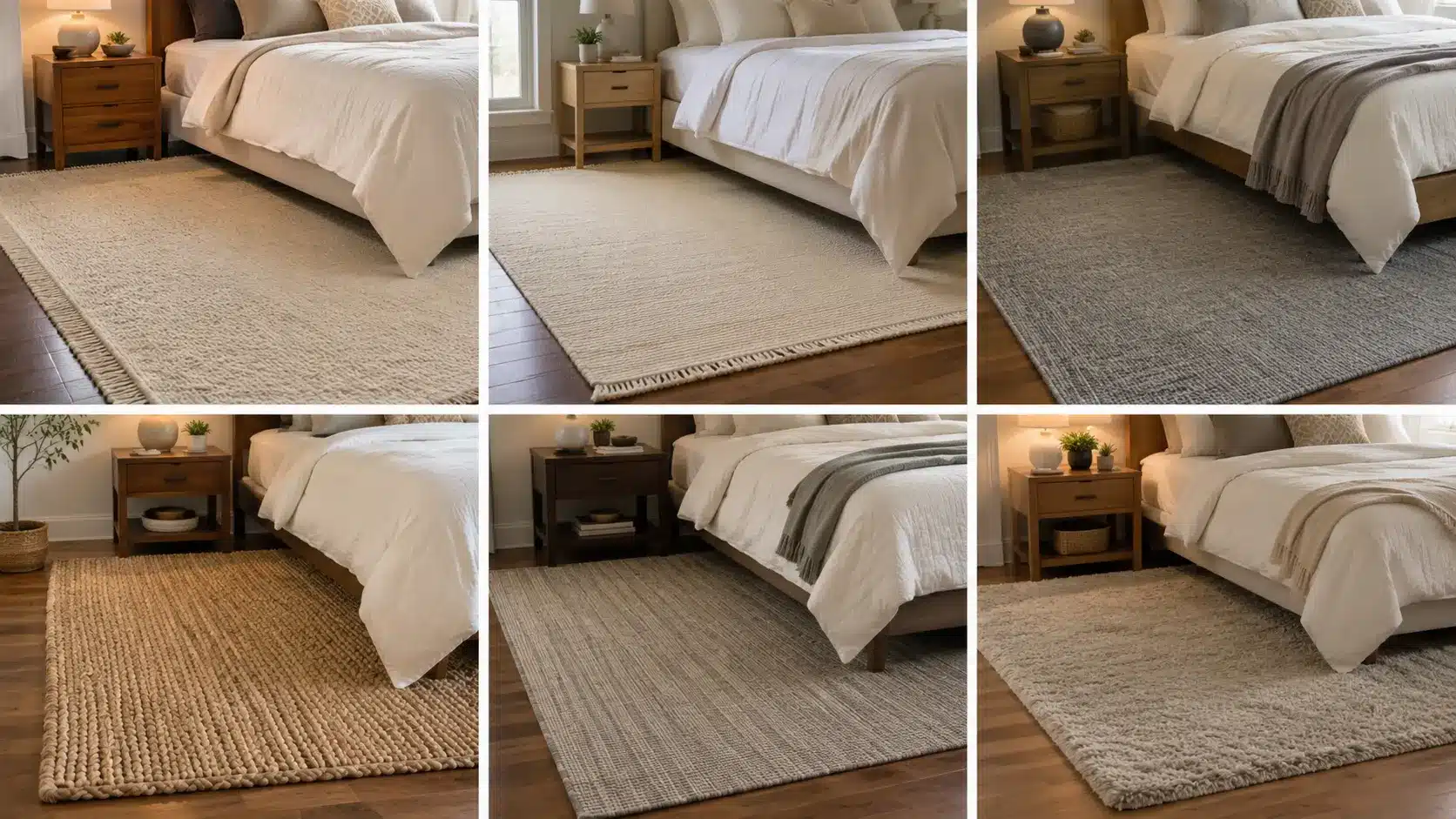
A bedroom rug should feel good under bare feet, sit flat under furniture, and be easy enough to clean. The right material depends on budget, pets, allergies, and how frequently the bedroom is used.
| Rug Material | Best For | What to Know |
| Wool | Long-term use and comfort | Soft, durable, and long-lasting. It is usually the most expensive option, but it holds up well under furniture over time. |
| Cotton | Guest rooms and low-use bedrooms | Light, casual, and easy to move. It may wear faster in high-traffic rooms but works well in rooms with lighter daily use. |
| Synthetic fibers | Pets, kids, and easier cleaning | Usually more budget-friendly and easier to clean. A practical choice for families, pet owners, or anyone who wants a washable option. |
| Jute or sisal | Natural texture and layered layouts | Adds texture and a grounded look, but it is not always soft enough for bare feet beside a bed. |
| Low-pile rugs | Storage beds, robot vacuums, and heavy furniture | Easier under-bed legs and less likely to make furniture sit unevenly. Also, simpler to vacuum. |
| Medium-pile rugs | Comfort-first bedrooms | Softer underfoot than low-pile rugs. Check that doors, drawers, and storage bed openings still clear the pile height. |
For most queen bedrooms, comfort and daily maintenance matter more than a perfect showroom look. A soft, natural-fiber rug with a rug pad underneath will perform better over time than a more fragile option that shows wear near the nightstands.
If there is any doubt between two pile heights, go lower, heavier furniture legs compress a thick pile unevenly and the uneven legs become the more noticeable problem.
Common Queen Bed Rug Size Mistakes
Most rug mistakes happen before the rug arrives. The size looks fine online, but the bedroom tells a different story once the bed, nightstands, doors, and walking paths are taken into account.
- Measuring only the mattress: A queen mattress is not the full footprint. Measure the bed frame, bedding overhang, and nearby furniture before choosing the rug.
- Choosing a rug that is too narrow: If the rug barely extends past the bed sides, it will not give enough landing space or visual weight.
- Letting the rug stop too short: The rug should extend past the foot of the bed so the lower part of the layout does not feel cut off.
- Pushing the rug against the wall: Center the rug on the bed, not the wall. Leave some visible floor around the room edges.
- Placing furniture legs unevenly: Avoid nightstands with one leg on the rug and one leg off. Decide furniture placement before buying.
- Skipping a rug pad: A rug pad improves grip, comfort, and shifting, especially under a bed and along daily walking paths.
- Skipping the tape test: Tape the rug size on the floor before ordering. This catches layout problems better than numbers alone.
- Choosing by price only: A smaller rug may cost less, but it can make the whole bed area feel unfinished if the size does not work.
The safest way to avoid these is to measure the full bed wall, not just the mattress. If the rug provides enough side-landing space and clears the room’s moving parts, the choice is usually sound.
Getting this right is one of those basic space planning decisions that changes how the whole room reads once it is done.
Frequently Asked Questions
Does the rug need to match the headboard wall exactly?
No. Center the rug on the bed, not the wall. Rooms are rarely perfectly even, and centering on the wall can make the rug look slightly off. The bed is the main anchor point for placement.
Should the rug extend under a bench at the foot of the bed?
Yes. If the bench sits off the rug, the two pieces can look disconnected. For a bench at the foot, a minimum of 8 x 10 is usually needed. A 9 x 12 is better if the bench is deep.
Can two smaller rugs work instead of one large rug?
Yes. Two runners placed on each side of the bed can work well in narrow rooms. Keep both runners the same size for visual balance. This works best when the space between the bed and wall is tight on both sides.
How much floor should show around the rug?
Aim for about 18 to 24 inches of bare floor between the rug edge and the wall. In very tight rooms, even 12 inches of visible floor on the sides can be enough to keep the rug from looking wall-to-wall.
Does a patterned rug change which size works best?
Yes. Patterned rugs with large repeats need enough space for the pattern to read fully. A large bold pattern on a small rug can look cut off. For strong patterns, sizing up by one step, such as from 8 x 10 to 9 x 12, often gives the pattern room to work.
What is the minimum rug size for a queen bed?
A 5 x 8 is generally the smallest size that works as a standalone area rug under a queen bed. Anything smaller functions as an accent piece at the foot rather than a rug that supports the full layout.
Does rug size change for a platform bed versus a standard frame?
Not significantly, but a low platform bed needs more visible rug around it to keep the profile from disappearing into the floor. An 8 x 10 or 9 x 12 tends to work better with platform frames than a 6 x 9, which can make a low-profile bed feel even more compressed.
Is an 8 x 10 rug big enough for a queen bed with two nightstands?
In most standard-sized bedrooms, yes. The nightstands will likely sit off the rug or at its edge with an 8 x 10. If you want both nightstands fully on the rug, size up to 9 x 12 and confirm the room has enough open floor left around the edges.
Final Takeaway
Choosing the right queen bed rug size depends on the room, not just the mattress. For most standard bedrooms, 8 x 10 is the safest choice because it gives good side coverage, enough length at the foot, and still leaves open floor.
For smaller rooms, 6 x 9 or 5 x 8 can work when placed lower under the bed. For larger rooms, 9 x 12 works well when the nightstands can sit on the rug too.
Before buying, tape the rug size on the floor and check the bed, nightstands, doors, and walking paths. The right rug should give your feet a soft landing, keep the furniture balanced, and leave enough floor visible around the edges.